
Have you ever received a short “yw” after saying “thank you” and wondered what it means? You are not alone. Texting is full of short forms, and some can be confusing when you see them for the first time.
If you are a teen, student, parent, gamer, social media user, or someone who chats online, you will likely see YW in messages. It is most often a simple and friendly way to say “you’re welcome.”
You may see it in text messages, Snapchat chats, Instagram DMs, TikTok comments, Discord servers, gaming chats, and other online conversations. In most cases, it is used after someone says thanks.
Understanding YW meaning in text can help you avoid confusion and understand the tone of a conversation. It can also help you know when this short form is fine to use and when a more formal phrase is better.
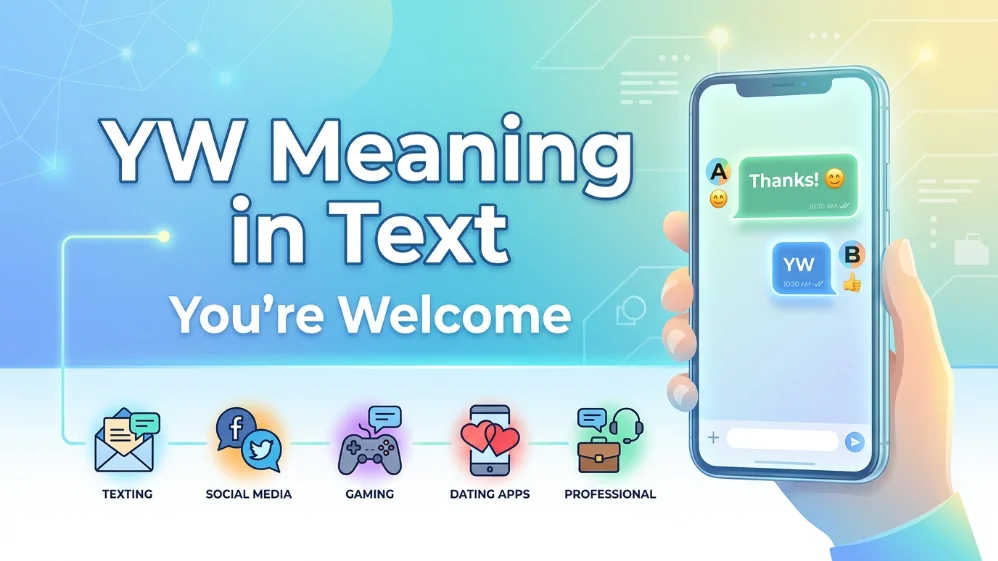
Quick Answer: YW means “you’re welcome” in text messages and online chats. It is usually a casual way to respond when someone thanks you.
What Does YW Mean in Text?
The most common YW meaning in text is “you’re welcome.”
People use YW as a short reply after someone says thank you, thanks, or another expression of gratitude. It has the same basic meaning as saying:
“You’re welcome.”
The main difference is that YW is shorter and more casual.
For example:
Alex: Thanks for helping me with my homework!
Sam: Yw!
Here, Sam is simply saying, “You’re welcome!”
You may also see YW written in different ways, such as yw, YW, or sometimes Yw. The capitalization usually does not change the meaning.
Simple examples of YW
Friend: Thanks for sending me the notes.
You: Yw!
Friend: Thank you for saving me a seat.
You: yw 🙂
Sibling: Thanks for picking me up.
You: YW!
In all three examples, YW means you’re welcome.
The abbreviation is especially useful when people want to keep a conversation quick. Texting often removes unnecessary words because people already understand the context.
For example, instead of typing:
“You’re very welcome. I’m happy that I could help you.”
Someone might simply type:
“yw!”
That does not mean the person is being rude. It often just means they prefer a short response.
However, tone depends on context. A plain “yw” can sometimes feel less warm than “you’re welcome!” or “no problem 😊.” If you are talking to someone you do not know well, the relationship and conversation style can help you decide which version sounds best.
Background and History of YW
The abbreviation YW comes from the phrase “you’re welcome.” Like many texting abbreviations, it became popular because online communication rewards short and fast messages.
Before smartphones became a major part of everyday communication, people already used shortened language in online chats, forums, instant messaging, and SMS. Typing fewer characters could make conversations faster and easier.
The phrase “you’re welcome” was naturally shortened to YW because the first letters are easy to remember:
Y = You’re
W = Welcome
This follows the same pattern as many other internet abbreviations.
For example:
TY = Thank you
THX = Thanks
NP = No problem
YW = You’re welcome
OMG = Oh my God
LOL = Laughing out loud
As texting culture grew, abbreviations became common among friends, classmates, coworkers, gamers, and social media users.
The rise of smartphones made these shortcuts even more convenient. People could respond to a message with only two letters instead of typing an entire phrase.
Today, YW is widely understood in casual digital communication. You can find it in text messages, group chats, social media conversations, gaming communities, and direct messages.
However, its use depends on the setting.
A friend may send:
“yw lol”
A gamer might simply type:
“yw”
But in a formal email, a person would usually write:
“You’re welcome.”
This shows how internet language has developed alongside digital communication. Abbreviations like YW are not necessarily replacements for standard English. They are usually short forms designed for informal communication.
The abbreviation has also become part of a larger texting culture where people expect quick responses. Instead of writing complete sentences every time, users rely on familiar abbreviations, emojis, and slang.
So, while YW is short, its meaning is quite simple and stable: you’re welcome.
How Is YW Used in Different Contexts?
The meaning of YW usually stays the same, but the tone can change depending on where it appears.
YW in Text Messages
Text messaging is one of the most common places to see YW.
Friend: Thanks for reminding me about the meeting.
You: Yw!
It can make the conversation feel quick and relaxed.
YW on Social Media
You may also see YW in Instagram DMs, Snapchat messages, TikTok conversations, Facebook chats, or other social platforms.
Person 1: Thanks for sharing my post!
Person 2: Yw!
It works well when the conversation is casual.
YW in Gaming
Gamers often use short messages because conversations can move quickly during a match.
Player 1: Thanks for the heal!
Player 2: yw
The player does not need to stop and type a full sentence.
YW in Group Chats
YW can also appear in school, college, family, or friend group chats.
Friend: Thanks everyone for helping with the project.
You: yw!
YW in Casual Conversations
You can use YW when talking to someone you know well.
Friend: Thanks for grabbing my coffee.
You: yw 🙂
In this setting, YW feels natural.
Does YW Always Sound Friendly?
Usually, yes. But the tone can change based on the rest of the message.
Compare:
“yw 😊”
with:
“yw.”
The first may feel warmer because of the emoji. The second may feel more direct or neutral.
Still, you should not assume that “yw” is rude just because it is short. Some people naturally prefer brief replies.
Common Misconceptions About YW
Several misunderstandings can happen when people first encounter YW.
Misconception 1: YW Is Always Rude
This is not true.
YW is normally a casual abbreviation for you’re welcome. Its short length does not automatically make it rude.
For example:
You: Thanks!
Friend: yw
That is a normal response.
The conversation may simply be informal.
Misconception 2: YW Means “Your Welcome”
People sometimes write “your welcome” instead of “you’re welcome.”
The correct phrase is:
You’re welcome.
“You’re” is short for “you are.”
“Your” shows possession.
So, YW usually represents “you’re welcome,” not “your welcome.”
Misconception 3: YW Has Only One Possible Meaning
“YW” most commonly means you’re welcome, but abbreviations can sometimes have different meanings in different communities.
Context matters.
If someone says:
“Thanks for the gift!”
and receives:
“yw”
the meaning is very clear.
But if YW appears in a conversation with no connection to thanks, you should look at the surrounding messages before deciding what it means.
Misconception 4: YW Is Only Used by Teenagers
Not necessarily.
People of many ages use texting abbreviations. Their popularity can vary by person, age group, platform, and community.
Misconception 5: You Should Use YW Everywhere
This is also incorrect.
YW is best suited to casual digital conversations. It is not always the best choice for professional or formal communication.
Similar Terms and Alternatives to YW
There are many ways to respond when someone thanks you.
Here are some common alternatives:
| Term | Meaning | Tone |
|---|---|---|
| YW | You’re welcome | Casual |
| You’re welcome | Direct response to thanks | Neutral |
| NP | No problem | Casual |
| No problem | It was not a burden | Friendly |
| No worries | There is nothing to worry about | Friendly |
| Anytime | I am happy to help again | Warm |
| Of course | Helping was natural | Friendly |
| My pleasure | I was glad to help | Polite |
| Sure | A simple acknowledgment | Casual |
| Glad to help | Happy that I could help | Friendly |
For example:
Friend: Thanks for helping me move.
You: Anytime!
Or:
Friend: Thanks for the advice.
You: No worries!
Or:
Coworker: Thanks for sending that report.
You: You’re welcome.
The best response depends on the relationship and setting.
How Should You Respond to YW?
If someone sends you YW, you usually do not need to respond at all.
The conversation may naturally end there.
For example:
You: Thanks for helping!
Friend: yw
You can leave it there.
But if you want to continue the conversation, you can respond in several ways.
Casual Response
Keep it simple.
You: Thanks!
Friend: yw
You: 😊
Funny Response
If you have a playful relationship, you can joke around.
You: Thanks!
Friend: yw
You: I owe you one 😂
Warm Response
If you want to sound appreciative:
You: Thanks again!
Friend: yw
You: I really appreciate it!
Flirty Response
In a romantic or dating conversation, YW can simply be a polite reply.
You: Thanks for making my day 😊
Them: yw
You: You’re pretty good at that.
The context matters more than the abbreviation itself.
Privacy Conscious Response
If you are chatting with someone you do not know well, you do not need to reveal personal information just because they say YW.
You can simply reply:
“Thanks!”
or end the conversation.
Regional and Cultural Differences
YW is mainly an English language abbreviation. Its meaning is easiest to understand in English speaking online communities.
People who speak English as a first or second language may recognize it through social media, texting, gaming, or international online communities.
However, not every culture uses the same abbreviations.
For example, someone may prefer writing the full phrase:
You’re welcome.
Another person may use:
No problem.
Someone else might use:
No worries.
These differences are often based on language, culture, age, and personal communication style.
In multilingual communities, abbreviations can become mixed with local slang.
For example, a person who frequently chats in English may use YW even when most of the conversation is in another language.
The important point is that YW is not a universal abbreviation across every language.
If someone does not understand it, writing “you’re welcome” is clearer.
Cultural ideas about politeness can also influence how people use short replies. In some situations, a very short answer may feel perfectly normal. In others, people may prefer a warmer response.
For example:
YW 😊
may sound friendlier than:
YW.
Still, punctuation and emojis do not have one fixed meaning. Always consider the person’s normal texting style.
YW vs Similar Expressions
YW is often confused with other ways of responding to thanks.
| Expression | Main Meaning | Best Use | Tone |
|---|---|---|---|
| YW | You’re welcome | Texts and DMs | Casual |
| You’re welcome | You are welcome | Most situations | Neutral |
| NP | No problem | Casual chats | Relaxed |
| No worries | It is okay | Friendly conversations | Warm |
| Anytime | Happy to help again | Friends and familiar people | Warm |
| Of course | Helping was natural | Casual conversations | Friendly |
| My pleasure | Glad to help | Polite situations | Formal |
| Glad to help | Happy to assist | Work or Casual chats | Polite |
| Sure | Simple acknowledgment | Informal chats | Neutral |
The key difference is tone.
YW is short and casual.
“My pleasure” sounds more polished.
“No worries” sounds relaxed.
“Anytime” can sound especially warm.
For example:
Friend: Thanks for helping me study.
You: Yw!
This is casual.
But:
Client: Thank you for your assistance.
You: My pleasure.
This is more professional.
YW in Online Communities and Dating Apps
Online communities use short language because conversations can move quickly. This makes YW common in places such as gaming servers, social media, forums, and messaging apps.
In gaming communities, a player might write:
Player: Thanks for the revive!
Teammate: yw
The meaning is straightforward.
In social media DMs:
Person A: Thanks for following me back!
Person B: yw
Again, it means you’re welcome.
YW on Dating Apps
You may also see YW on dating apps such as Tinder when one person thanks the other.
For example:
You: Thanks for the compliment 😊
Match: yw
The response itself is not necessarily romantic. YW simply means you’re welcome.
Do not assume that YW means someone is flirting.
Instead, look at the entire conversation.
If the messages contain compliments, jokes, questions, or romantic language, those details provide more information about the person’s intentions.
Tips for Responding Online
If someone sends YW:
- You can leave the conversation there.
- Send an emoji if the conversation is casual.
- Continue with a new question if you want to keep chatting.
- Do not assume YW is romantic.
- Look at the entire conversation before judging tone.
Does YW Have a Hidden or Offensive Meaning?
In ordinary texting, YW is not normally offensive.
Its standard meaning is “you’re welcome.”
However, online abbreviations can sometimes have alternative meanings in specific communities. That is why context matters.
For example, if someone uses YW immediately after you say:
“Thanks!”
the intended meaning is almost certainly you’re welcome.
There is usually no hidden message.
Tone can still affect how the abbreviation feels.
Compare:
yw 🙂
with:
yw.
The first may feel more relaxed. The second may seem more direct.
But that does not mean the second one is offensive.
Another important point is that abbreviations can be used sarcastically. Someone might say:
You: Thanks for ruining my game 😂
Friend: yw
Here, YW still resembles “you’re welcome,” but it is clearly being used as a joke.
So, context, punctuation, emojis, and the relationship between the speakers all matter.
If you are unsure, look at the messages before and after YW instead of interpreting the abbreviation by itself.
Is YW Appropriate for Professional Communication?
YW can be acceptable in casual workplace chats, especially when colleagues already use informal texting language.
For example:
Coworker: Thanks for sending that file.
You: yw
This may be perfectly fine in a relaxed team chat.
However, it is usually better to avoid YW in formal emails, official documents, customer communication, or important business messages.
Instead, use:
You’re welcome.
or:
My pleasure.
or:
Glad I could help.
For example, a customer writes:
“Thank you for your assistance.”
A professional response could be:
“You’re very welcome. Please let me know if you need anything else.”
That sounds more polished than:
“yw”
The rule is simple:
Use YW when the conversation is clearly casual. Use the full phrase in formal settings.
Examples of YW in Real Conversations
Here are several natural examples.
Example 1: Friends
Mia: Thanks for sending me that picture.
Jake: yw!
Example 2: School
Student: Thanks for sharing your notes.
Friend: yw
Example 3: Gaming
Player 1: Thanks for covering me.
Player 2: yw
Example 4: Social Media
Follower: Thanks for the follow back!
User: yw 😊
Example 5: Group Chat
Sam: Thanks everyone for helping!
Alex: yw!
Example 6: Funny Conversation
You: Thanks for letting me copy your playlist 😂
Friend: yw 😂
Example 7: Dating App
Match: Thanks for the compliment.
You: yw 😊
Here, YW does not automatically mean flirting. The surrounding conversation determines the tone.
When Should You Use YW?
YW is a good choice when:
- You are chatting with friends.
- You are texting casually.
- You are using social media DMs.
- You are talking in a gaming community.
- The other person already uses abbreviations.
- You want a short response to “thanks.”
For example:
“Thanks!”
“yw!”
This is perfectly natural in an informal conversation.
When Should You Avoid YW?
You may want to avoid YW when:
- Writing a formal business email.
- Talking to a customer.
- Writing an academic message.
- Sending an official request.
- Communicating with someone who prefers formal language.
- You are unsure whether the other person understands texting abbreviations.
In these situations, write:
“You’re welcome.”
It is clear, polite, and easy for everyone to understand.
Why Do People Use YW Instead of “You’re Welcome”?
The main reason is speed.
Typing YW takes only two letters. It can also match the casual style of modern messaging.
People often use abbreviations because:
- They save time.
- They are easy to type.
- They make messages shorter.
- They fit casual online communication.
- They are widely understood among frequent texters.
This does not mean people are becoming less polite.
A person can write:
“yw 😊”
and still genuinely appreciate the other person’s thanks.
Digital communication simply gives people more ways to express the same idea.
FAQs
What does YW mean in text?
YW usually means “you’re welcome” in text messages. It is a casual response to someone who says thank you.
Is YW rude?
No. YW is not normally rude. It is simply a short and casual way to say “you’re welcome.” Tone can depend on the conversation.
What does yw mean from a girl?
If a girl sends “yw,” it usually means “you’re welcome.” The abbreviation itself does not automatically indicate flirting or romantic interest.
What does yw mean from a guy?
If a guy sends “yw,” it generally means “you’re welcome.” Look at the surrounding conversation to understand the tone.
What is the difference between YW and NP?
YW means “you’re welcome,” while NP means “no problem.” Both can be used after someone thanks you, but they have slightly different wording.
Can I use YW at work?
You can use YW in an informal workplace chat if your team commonly uses texting abbreviations. For formal emails and professional communication, “you’re welcome” is safer.
Does YW mean “your welcome”?
Usually, no. YW stands for “you’re welcome.” The correct grammar is “you’re welcome,” because “you’re” means “you are.”
Final Thoughts on YW Meaning in Text
Understanding short forms like YW makes online conversations much easier. When you see YW after saying thanks, the person is almost always saying “you’re welcome.”
It is a simple, casual abbreviation used in text messages, social media, gaming chats, group conversations, and online communities.
The main thing to remember is context. YW is normally friendly, but the tone can change depending on punctuation, emojis, humor, and the relationship between the people talking.
You can use YW with friends and in relaxed online conversations. For formal emails, professional messages, and customer communication, writing “you’re welcome” is a better choice.
So, the next time someone replies “YW” after you say thanks, you do not need to overthink it.
YW simply means “you’re welcome.”