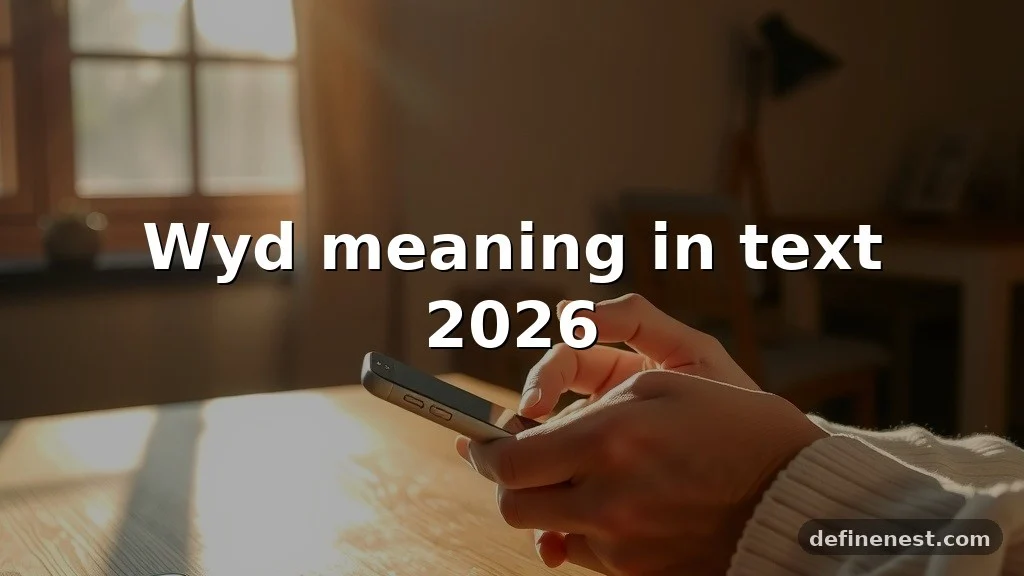

Have you ever looked at your phone, seen a notification from a friend or a crush, and felt a tiny spike of confusion when you saw the letters WYD? You are not alone. Whether you are deep into a gaming session, scrolling through your favorite social media feed, or just trying to navigate the complex world of modern messaging, you have likely encountered this short acronym.
It is one of the most common ways people check in on each other today. If you have ever wondered why someone sent it to you or how you should reply without sounding boring, this article is for you.
We will break down the true meaning behind these three letters, how to use them, and when to avoid them entirely. Understanding these nuances will help you stay sharp in every digital conversation you have.
Defining the Acronym and Its Core Meaning
At its simplest level, WYD is an acronym that stands for What You Doing. It is a shorthand version of the phrase What are you doing. In the fast-paced world of digital communication, people often look for ways to save time and effort while typing.
By stripping away the auxiliary verbs and extra letters, users create a quick way to initiate contact. It is a functional tool for checking the status of someone else.
When someone sends you this, they are usually looking for a few specific things. They might be bored and looking for entertainment, they might want to hang out, or they might just be checking to see if you are free for a quick chat.
It is a low-pressure way to start a conversation. Unlike a formal email or a long-form message, it requires very little from the sender, which is why it is so popular.
Think of it as the digital equivalent of walking into a room and asking, Hey, what is up? It does not necessarily imply that you need to be doing something productive. You could be sitting on your couch watching television, and the answer would still be valid.
The meaning is flexible, which is part of its charm. It is a bridge between silence and a full conversation.
Because it is so brief, it can sometimes feel a bit abrupt, but that is rarely the intent. Most people use it as a casual, friendly gesture to bridge the gap between their world and yours.
The Evolution and History of Digital Shorthand
The rise of acronyms like WYD is closely tied to the history of mobile technology and early messaging platforms. In the days of T9 texting on numeric keypads, every character took effort to type. If you wanted to send a message, you had to press buttons multiple times for a single letter.
Consequently, brevity became a necessity rather than a stylistic choice. This era birthed a generation of shorthand that has persisted even though our modern smartphones have full QWERTY keyboards and autocorrect features.
As we moved into the age of instant messaging services like AIM or MSN Messenger, these acronyms became part of a digital subculture. They helped people communicate in real time, where speed was a priority.
If you were playing a game and needed to ask a teammate for help, you did not have time to type out a full grammatical sentence. You typed a quick code, and they understood immediately.
Over the last decade, this language has migrated from niche tech circles to mainstream social media platforms. Today, you see it on Twitter, Instagram, Snapchat, and TikTok. It has become a staple of how younger generations interact.
While some language purists might argue that it degrades our ability to write, it is actually a form of linguistic evolution. It allows for a specific type of social signaling where the tone is relaxed and informal.
You can read more about how slang evolves in language to understand why these terms stick around. It is not just about laziness; it is about efficiency and creating a shared sense of belonging among those who know the code.
Usage Across Different Platforms and Contexts
The way you use this acronym changes depending on where you are and who you are talking to. In a casual text message between close friends, it is perfectly normal. It acts as a casual icebreaker.
For example, if you are planning a weekend, you might see a friend text: Hey, wyd tonight? You would then reply with your plans or ask if they have anything in mind.
In the world of online gaming, the context is often more urgent. You might see a player type it into the chat box while waiting for a match to start. It is a way to gauge if your friends are ready to jump into a new round.
In this setting, nobody expects a long explanation. A simple I am just waiting for the lobby or I am grabbing a snack is usually enough.
Social media usage is slightly different. On platforms like Snapchat, it is often sent as a way to keep a streak alive or to get a conversation started with someone you are interested in.
It is less about the literal question and more about the engagement. Here is how a typical dialogue might look:
Person A: Wyd?
Person B: Nothing much, just finished some homework. You?
Person A: Same, just chilling. Want to play a game?
This shows how the acronym functions as a social lubricant. It removes the barrier to entry for starting a chat. You do not need a specific topic to reach out; you just need to show that you are thinking of the other person.
Common Misconceptions and Tone Issues
One of the biggest issues with this short phrase is that it can easily be misinterpreted as dry or uninterested. Because it is so short, some people feel that the sender is not putting any effort into the conversation. If you send it to someone you have just met, they might think you are being lazy or that you are not actually interested in hearing about their life.
Another misconception is that it is always a romantic gesture. While it is often used in dating, it is definitely not exclusive to it. A parent might text it to a child to see if they are home from school.
A coworker might send it to see if you have a moment to hop on a call. The intent relies entirely on your existing relationship.
Tone is invisible in text. Without facial expressions or vocal inflection, a simple WYD can come across as demanding or even suspicious. If a partner sends it at a late hour, it might be perceived as a check-up or a sign of jealousy.
This is why context is your best friend. If you feel like your message might come across the wrong way, you can always add a bit of detail. Instead of just sending the acronym, you could say: Wyd?
Thinking of grabbing food, want to join? This small addition changes the entire vibe of the message from a demand to an invitation.
Similar Terms and Alternatives
If you feel that the acronym is too informal or might come across as dry, there are plenty of other ways to ask the same question. Depending on the situation, you might want to vary your vocabulary to keep your conversations feeling fresh and engaging.
Here is a quick breakdown of alternatives you can use:
| Term | Context | Tone |
|---|---|---|
| What are you up to? | Casual / Friendly | Warm |
| Any plans? | Planning / Social | Direct |
| How is your day going? | Polite / Conversational | Interested |
| What is the move? | Social / Fun | Enthusiastic |
| Doing anything fun? | Curious / Casual | Lighthearted |
Using these alternatives can help you stand out. While everyone else is sending the same three-letter acronym, you are showing that you can hold a more nuanced conversation. If you are trying to impress someone, avoiding overly common slang can actually be a benefit.
It shows that you are capable of articulating your thoughts clearly and that you value the conversation enough to use full sentences. However, there is nothing wrong with sticking to the classics if you and your friends have a shorthand that works perfectly for your dynamic.
How to Respond to the Message
Knowing how to reply is just as important as knowing how to send the message. If someone sends you this, your response should reflect the level of intimacy you have with them and what you are actually doing.
If you are busy, a professional or direct response works best. You could say: Currently finishing a project, can we talk later? This is clear, polite, and sets a boundary without being rude.
If you are just hanging out, a casual response is perfect. You could say: Just watching a movie, what about you? This keeps the ball in their court and invites them to share their status as well.
If you want to be funny, you can lean into the absurdity of the question. If you are doing something mundane, like doing laundry, you could say: I am currently fighting a mountain of laundry.
It is losing. This adds personality to your text and gives the other person something specific to comment on.
Always remember that you do not owe anyone an immediate answer. If you are in the middle of something important, it is perfectly acceptable to wait until you are free to reply. You do not need to feel pressured to drop everything just because someone sent a short question.
Cultural Variations and Regional Differences
Language is not static, and it changes depending on where you are in the world. While the acronym is widely understood in English-speaking countries, its usage can vary.
In some cultures, being too direct or too brief in text can be seen as rude. In these regions, people might prefer a greeting followed by a more polite inquiry, such as: Hope you are having a good day, are you busy right now?
In gaming communities, the term is universal. Because gaming is a global activity, players from different countries all use the same shorthand to communicate quickly. In this environment, it is not considered rude at all; it is simply the language of the game.
It is also worth noting that slang changes rapidly. What is popular today might be outdated in a few years. While this acronym has shown impressive staying power, it is always a good idea to pay attention to how the people around you are communicating.
If you notice your peer group moving toward different terms, it is easy enough to adapt. The goal of any communication is to be understood, so using the language that your specific community understands is always the best path forward.
Professional Communication and Boundaries
One question that often comes up is whether this acronym is appropriate for professional settings. The answer is almost always no. In a workplace environment, clarity and professionalism are key.
Sending a three-letter acronym to a boss or a client can come across as flippant or unprofessional. Even in a Slack or Teams environment, it is better to be slightly more formal.
Instead of sending just the acronym, use a complete sentence that explains why you are reaching out. For example: Hi, do you have a moment to discuss the project? or Are you free for a quick sync?
These messages are much more effective because they provide context. The recipient knows exactly what you want and can decide if they have the time to help you.
If you have a very close relationship with a colleague, you might be able to get away with more casual language, but it is always safer to lean toward being polite. Remember that digital communication leaves a paper trail.
You want your messages to reflect your professionalism and your respect for other people’s time. By avoiding overly casual slang in formal channels, you protect your reputation and ensure that your requests are taken seriously.
Frequently Asked Questions
1. Is saying the phrase flirty?
It can be, but it depends on the context. If it is sent late at night, it is often interpreted as a low-effort flirtatious attempt.
2. Is it considered dry texting? Yes, many people find it to be a dry way to start a conversation because it places the burden of carrying the interaction on the other person.
3. Does it have different meanings?
Generally, it is just a question about your current activity. It does not usually have a hidden or secondary meaning.
4. Should I reply if I am busy?
You do not have to reply immediately. It is perfectly fine to wait until you have the time to engage in a proper conversation.
5. Is it okay to use with my parents?
Sure, if you have a casual relationship with them. It is a quick way to check in.
6. Why do guys send it more often? There is no scientific evidence that one gender uses it more, but it is often perceived as a guy-to-girl interaction in dating contexts.
7. How can I make my reply more interesting?
Give a specific detail about what you are doing. Instead of just saying nothing, describe your activity to give the other person a hook for a follow-up question.
Final Thoughts on Digital Etiquette
At the end of the day, this acronym is just a tool. It is a simple, efficient way to bridge the gap between two people in a digital space. Like any tool, its effectiveness depends on how you use it.
If you use it to check in on a friend or start a fun conversation, it works perfectly. If you use it as a low-effort way to demand attention, it might fall flat. The key is to be mindful of your audience and the context of your relationship.
By adding a little bit of personality and detail to your messages, you can ensure that you are always communicating clearly and effectively. Digital conversations are a huge part of our lives, so taking the time to understand the nuances of how we speak to each other is a great way to improve your social interactions. Keep things light, stay respectful of boundaries, and enjoy connecting with the people who matter to you.


Pingback: KYS Meaning in Text: What It Really Means, Why People Say It, and the Dark Side of Internet Slang in 2026
Pingback: ^^ Meaning in Text Slang: What This Tiny Symbol Really Says in Chats, DMs & Online Conversations in 2026
Pingback: IDEK Meaning in Text: What This Casual Slang Really Says About Confusion, Indifference, and Everyday Online Chats in 2026
Pingback: What Does DW Mean in Texting and Social Media?
Pingback: What Does MBN Mean in Texting and Social Media?
Pingback: What Does Mama Say Mama Sa Mamakusa Mean?
Pingback: What Does FML Mean?
Pingback: What Does OML Mean in Texting and Social Media?
Pingback: What Does MHM Mean in Texting and Social Media?
Pingback: What does ong mean?
Pingback: What Does BTA Mean?
Pingback: What Does DND Mean in Texting and Social Media?
Pingback: What Does SYM Mean in Slang?
Pingback: What Does YT Mean in Slang?
Pingback: What Does MB Mean in Texting and Social Media?
Pingback: What Does XD Mean: A Deep Dive into Internet Culture?
Pingback: What Does GNG Mean in Texting and Social Media?
Pingback: What Does IMO Mean?
Pingback: ISTG Meaning in Text: Is It a Promise, Warning or Reaction? Discover the Real Meaning in 2026
Pingback: Til Meaning in Text: What This Tiny Slang Really Means in Chats, Texts & Social Media in 2026
Pingback: IRL Meaning in Text: What This Everyday Slang Really Means in Online Chats & Real-Life Conversations in 2026
Pingback: What Does STG Mean in Text? The Real Meaning, Hidden Tone & How People Actually Use It in 2026
Pingback: WS Meaning in Text: Decode This Tiny Two-Letter Slang Before You Misread the Conversation in 2026
Pingback: CYA Meaning in Text: What Does CYA Really Mean in Chat, Texting & Online Slang? 2026
Pingback: STG Meaning in Text: What Does STG Really Mean in Chat, Snapchat & Social Media? 2026
Pingback: WYS Meaning in Text: What Does WYS Mean in Chat, Snapchat & Social Media? A Complete Guide to Its Real-World Uses in 2026
Pingback: LMY Meaning in Text: What Does LMY Mean and How to Reply in 2026