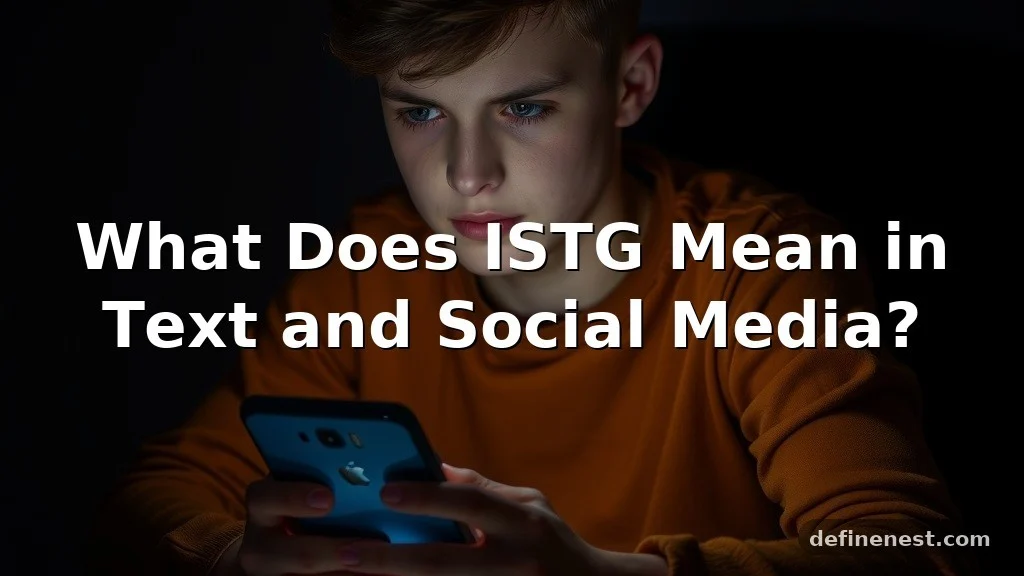

Have you ever been scrolling through your favorite social media feed or checking your text messages only to see a string of letters that leaves you scratching your head? You are certainly not alone. Whether you are a parent trying to keep up with how your kids communicate or someone just trying to stay relevant in digital spaces, deciphering modern internet shorthand can feel like learning a new language.
One acronym that pops up constantly is ISTG. You might see it in a heated debate on Twitter, a casual text from a friend, or even in the comments section of a viral video. Understanding this term is essential for navigating modern digital interactions.
It is a quick way for people to convey intensity, honesty, or frustration without typing out a full sentence. Let us break down exactly what this means and how you can use it properly.
Defining the Acronym and Its Meaning
At its most basic level, ISTG stands for the phrase I swear to God. It is a common piece of digital shorthand that people use to emphasize the truthfulness of a statement or to express a high level of frustration or disbelief. When someone types this, they are essentially signaling that they are being completely serious about what they just said.
It functions as an intensifier. Instead of simply saying that something happened, adding this acronym at the beginning or end of a sentence acts as a verbal stamp of authenticity.
Think of it as a digital version of a cross-your-heart promise. In daily life, we often use body language, tone of voice, and facial expressions to show that we are not lying. In a text message or a comment, those physical cues are missing.
ISTG fills that gap. It tells the reader that the speaker is not joking and that the situation is real. You will often see it written in lowercase as istg or sometimes in uppercase for added emphasis.
People use it to validate their own experiences, especially when they feel like the person on the other end of the conversation might doubt them. It is a very common tool in casual conversations, particularly among younger generations who value efficiency in their typing. By shortening the phrase, users can maintain the speed and flow of a quick chat while still making their point with significant emotional weight.
The History and Evolution of Digital Slang
The evolution of internet shorthand is a fascinating study of how humans adapt to technology. As texting became the primary mode of communication in the early 2000s, characters were limited and typing on a physical keypad was slow. This necessity birthed a new dialect.
Phrases that were commonly spoken in person were quickly compressed into acronyms to save time. ISTG belongs to this family of shorthand that includes staples like LOL, BRB, and BTW. While the phrase I swear to God has been a part of the English language for centuries, its transformation into an acronym is a relatively modern development.
As social media platforms like Twitter, Instagram, and TikTok rose to dominance, the need for quick, punchy communication became even more pronounced. On platforms with character limits, every letter counts. Using an acronym allows a user to pack a large amount of emotion into a very small space.
Over the past decade, this term has moved from niche gaming forums and early chat rooms into mainstream usage. It is no longer just for kids or tech-savvy teens. You will now find it in professional group chats, dating app profiles, and casual family threads.
The usage has evolved from a simple declaration of truth into a multifaceted tool that can express everything from extreme excitement to profound annoyance. It is a perfect example of how language changes to fit the medium in which it is used. Today, it is so deeply embedded in digital culture that many people do not even realize they are using an abbreviation.
Usage Across Various Contexts
The way this term is used depends heavily on the context of the conversation. In a casual text between friends, it might be used to share a shocking story. For example, if a friend texts, “I just saw our teacher at the grocery store buying a giant bag of cat food, istg,” they are using it to emphasize that the event actually happened.
In a gaming environment, you might see it used during a competitive match. If a player feels like they were cheated or experienced a glitch, they might type, “That shot hit me, istg!” to express their frustration.
Social media platforms like TikTok are another major hub for this term. You will often see it in captions where the creator is trying to be relatable. A user might post a video about a common struggle and add the caption, “My life is a mess, istg.”
This creates a sense of camaraderie with their audience. It tells the viewers that the creator is being vulnerable and honest. In the context of dating apps, someone might use it to show they are serious about a specific interest or trait.
A bio might say, “I love pineapple on pizza, istg,” which is a lighthearted way to show they are firm in their opinion. The beauty of this acronym is its versatility.
It can be used to emphasize joy, anger, disbelief, or simple facts. Because it is so flexible, it has become a permanent fixture in the way we talk to one another online.
Common Misconceptions and Clarifications
One common misconception is that this term is always religious. While the literal phrase involves a reference to a deity, the acronym itself has become almost entirely secular in digital usage. Most people who type it are not making a religious vow; they are simply using a common idiom to express intensity.
However, this does not mean it is appropriate for every situation. Because the phrase can still carry a religious connotation for some people, it is worth being mindful of who you are talking to. If you are in a formal or religious setting, it might be better to avoid it.
Another point of confusion is whether the term is considered rude. On its own, it is not inherently offensive. However, because it is often used to express strong emotions like anger or impatience, the tone of the surrounding words matters.
If someone says, “Stop bothering me, istg,” the acronym adds a layer of aggression to the request. It signals that the speaker has reached the end of their patience. Conversely, if someone says, “I love this song, istg,” it is purely positive.
The acronym acts as a mirror for the user’s intent. If you are ever unsure whether it is appropriate to use, the best rule of thumb is to look at the tone of the rest of the conversation.
If the mood is light and casual, it is usually perfectly fine. If the situation is delicate or professional, it is safer to use a more neutral way to express your sincerity, such as “I am being serious” or “I really mean it.
Similar Terms and Alternatives
There are many ways to express sincerity or frustration in the digital age. Depending on the vibe you want to project, you might choose an alternative. Some people prefer to use emojis to convey the same level of emotion.
For example, using a face with a rolling eye or a frustrated expression can often communicate the same message as the acronym without needing to type it out. Others prefer to use full phrases if they want to avoid any potential confusion or misunderstanding.
| Term | Meaning | Tone |
|---|---|---|
| ISTG | I swear to God | Intense/Casual |
| FR | For real | Casual/Agreement |
| Deadass | Seriously/No joke | Street/Casual |
| No cap | No lie/Truthful | Slang/Trendy |
| Legit | Honestly/Actually | Casual/Common |
As shown in the table, there are several ways to indicate that you are telling the truth. If you find that the acronym does not fit your style, you can easily swap it for something else. FR (for real) is perhaps the most common alternative and is widely understood across all age groups.
Deadass is another popular option, though it carries a specific regional flavor that might not fit every conversation. Choosing the right term comes down to your personal style and the specific relationship you have with the person you are messaging.
Responding to the Term
How you respond to someone using this acronym depends on the context of the conversation. If a friend uses it to tell you something shocking, your response should reflect that. A simple “No way!” or “Are you serious?” is usually the perfect reply.
If they are using it to express frustration, you might want to offer some support or empathy. For instance, if they say they are having a bad day, you could reply with, “I am sorry to hear that, I believe you.”
If you are in a more professional or polite setting and someone uses the term, you do not necessarily need to address the acronym itself. You can simply acknowledge the sentiment behind it. If a coworker says, “I am really struggling with this deadline, istg,” you can respond by offering help or acknowledging the stress of the situation.
You do not need to repeat the acronym back to them. If you want to keep your communication style more formal, simply ignore the slang and respond to the core of the message. This keeps the conversation moving forward without you having to adopt the same shorthand.
Remember, you never have to use slang just because the other person is using it. Your own authentic voice is always the best way to communicate.
Regional and Cultural Differences
While this acronym is common in the English-speaking world, its usage can vary significantly based on region and culture. In some areas, the phrase I swear to God is used much more frequently in daily speech, which naturally leads to more frequent use of the acronym in texts. In other cultures, where such expressions might be considered too intense or even taboo, you might find that people avoid the acronym entirely.
It is also interesting to note how different generations use it. Younger people tend to use it as a default intensifier for almost anything, whereas older generations might reserve it for moments of genuine high stress or disbelief.
In some international contexts, English slang is adopted by non-native speakers, but it is often used in ways that might slightly differ from the original intent. The internet has created a global culture, but local nuances remain. You might find that in certain countries, the term is viewed as a direct translation of a local expression, while in others, it is seen as a purely American import.
Understanding these differences can help you navigate international digital spaces with more grace. It is always a good idea to observe how people in a specific community are using a term before you start using it yourself. This is known as “lurking” in some online circles, and it is a perfectly valid way to learn the norms of a new group.
Usage in Online Communities and Dating Apps
On platforms like Tinder, Bumble, or Hinge, how you communicate can make a big difference in how you are perceived. Using too much slang can sometimes make someone look immature, but using it correctly can make you seem relatable and fun.
If you are using this acronym on a dating app, use it sparingly. It is a great way to show passion for a hobby or a strong opinion, but if you use it in every sentence, it can start to sound like you are constantly trying to convince the other person of your sincerity.
In gaming communities, the usage is almost always tied to high-intensity moments. When you are in the middle of a raid or a match, you do not have time for long, formal sentences. The acronym acts as a quick-fire reaction.
If you are new to a gaming group, take note of how the veteran players communicate. You will likely see a lot of shorthand. Learning these terms is part of the process of becoming a part of the community.
It shows that you are listening and that you are on the same page as the rest of the team. If you want to learn more about the complexities of how we communicate online, you can check out resources from the Pew Research Center, which frequently publishes studies on digital behavior and trends.
Hidden Meanings and Tone
It is vital to remember that tone is difficult to convey in text. When you read a message, you are projecting your own mood onto the words. If you are having a good day, you might read “istg” as a funny, lighthearted exaggeration.
If you are having a bad day, you might read the same message as a sign of agitation or rudeness. This is why it is so important to consider the relationship you have with the person. If you know they are generally a positive person, give them the benefit of the doubt.
Sometimes, the term can be used sarcastically. If someone says, “Oh, I love doing taxes, istg,” they are clearly being ironic. The acronym, in this case, actually highlights the absurdity of the statement.
This is a common pattern in internet humor where people use serious-sounding words to describe ridiculous situations. If you are unsure if someone is being sarcastic, look for other clues like exclamation points, emojis, or the general topic of the conversation. If the statement sounds too extreme to be true, it is probably sarcasm.
Professional Communication Standards
Is this term appropriate for work? Generally, the answer is no. While the modern workplace is becoming more casual, there is still a line between friendly chat and professional communication.
Using acronyms like this in an email to a client or a formal report can make you seem unprofessional. It can also be confusing for colleagues who may not be familiar with internet slang. If you are messaging a close coworker on a platform like Slack or Teams, it might be fine, but even then, it is better to err on the side of caution.
If you find yourself wanting to use this term at work, try to find a professional alternative. Instead of “I did the report, istg,” try “I have completed the report and am confident in the results.” It conveys the same message of sincerity and accuracy without the risk of appearing unprofessional.
Your goal in a workplace setting should always be clarity. Slang, by its very nature, relies on shared cultural knowledge that not everyone in an office might possess. Keeping your language clear and accessible ensures that everyone is on the same page and that your message is received exactly as you intended.
Frequently Asked Questions
1. Is ISTG always used to mean I swear to God?
Yes, that is the primary meaning. There are no other common interpretations for this specific acronym in modern slang.
2. Is it rude to use ISTG in a text?
It depends on the context.
If you are using it to emphasize a point in a friendly way, it is not rude. If you are using it to be aggressive, it can be perceived as rude.
3. Can I use ISTG in a professional email?
It is generally best to avoid it. Professional settings usually require more formal language to ensure clarity and respect.
4. How do I reply if someone says ISTG?
You can reply with “I believe you,” “Really?” or a simple emoji that matches the mood of the conversation.
5. Is ISTG popular with older generations?
It is mostly used by younger generations like Gen Z and Millennials, but it is becoming more common among older people who spend a lot of time on social media.
6. Why do people use ISTG instead of just saying the words?
It is faster and more efficient for digital communication, especially on platforms with character limits.
7. Does ISTG have any offensive meanings?
No, it is not inherently offensive. However, because it references a religious phrase, some people may find it disrespectful if used in a flippant or excessive manner.
Final Thoughts on Digital Communication
Navigating the world of internet slang can be a bit overwhelming, but acronyms like ISTG are a natural part of how our language is evolving. They allow us to express complex human emotions in the fast-paced, character-limited environment of the digital world. The key to using these terms effectively is to understand their origin, their tone, and their appropriate context.
By being mindful of who you are talking to and what you are trying to convey, you can use these shortcuts to enhance your communication rather than cause confusion. Whether you are texting a friend, posting on social media, or navigating a professional chat, remember that your tone and your intent are just as important as the words you choose.
Stay curious, keep learning, and do not be afraid to ask if you are ever unsure about a new term you encounter. Digital literacy is a journey, and you are already on the right path.

Pingback: What Does In Transit Mean?
Pingback: What Does HY Mean in Text?
Pingback: What Does Ash Mean in Text Slang?
Pingback: IRL Meaning in Text: What This Everyday Slang Really Means in Online Chats & Real-Life Conversations in 2026
Pingback: What Does Gyatt Mean?
Pingback: GTFO Meaning in Text: What It Really Means, When to Use It, and the Internet Moments That Make It Hit Different in 2026
Pingback: BSF Meaning in Text: What This Slang Really Means and Why It’s Everywhere in 2026
Pingback: NTH Meaning in Text: What This Slang Really Means, How to Use It & Why You Keep Seeing It Online in 2026
Pingback: Emoji Meaning in Text: Decode the Hidden Feelings, Reactions, and Messages Behind Your Favorite Emojis 2026
Pingback: Hru Meaning in Text | What Does “HRU” Really Mean in Chats, Texts & Social Media? 2026
Pingback: ATM Meaning in Text | What Does ATM Really Mean in Chat, Texting & Social Media? 2026
Pingback: CM Meaning in Text: What Does CM Mean in Chat, Slang & Social Media? A Complete Guide for 2026
Pingback: FR Meaning in Text: What Does FR Mean in Chat, Texting & Social Media? Real-World Uses Explained in 2026
Pingback: What Does S/U Mean in Texting and Academic Contexts?
Pingback: What Does Baka Mean?
Pingback: What Does HMU Mean?
Pingback: What does dtf mean?
Pingback: What Does MK Mean in Text?
Pingback: What Does ATP Mean in Texting and Social Media?
Pingback: What Does Demure Mean?
Pingback: What Does ASL Mean in Text?
Pingback: What Does APT Mean in the Context of the Viral Rosé and Bruno Mars Song?
Pingback: What Does PMO Mean in Text and Social Media?
Pingback: What Does SMH Mean | Internet Slang That Says “I Can’t Believe You” Without Saying a Word | 2026
Pingback: OC Meaning in Text: What Does OC Really Mean in Chats, Comments & Online Conversations? 2026
Pingback: Myb Meaning in Text: What It Really Means, How Gen Z Uses It & More in Everyday Chats 2026
Pingback: XD Meaning in Text: From Old-School Internet Laugh to Modern Chat Slang, Explained Simply in 2026
Pingback: TM Meaning in Text | What Does TM Mean in Chat, Slang & Social Media? A Complete Guide to Its Hidden Meanings in 2026
Pingback: NTM Meaning in Text | What Does NTM Really Mean in Chats, Texts & Social Media? 2026
Pingback: MHM Meaning in Text | What Does MHM Really Mean in Chat, Texting & Social Media? 2026