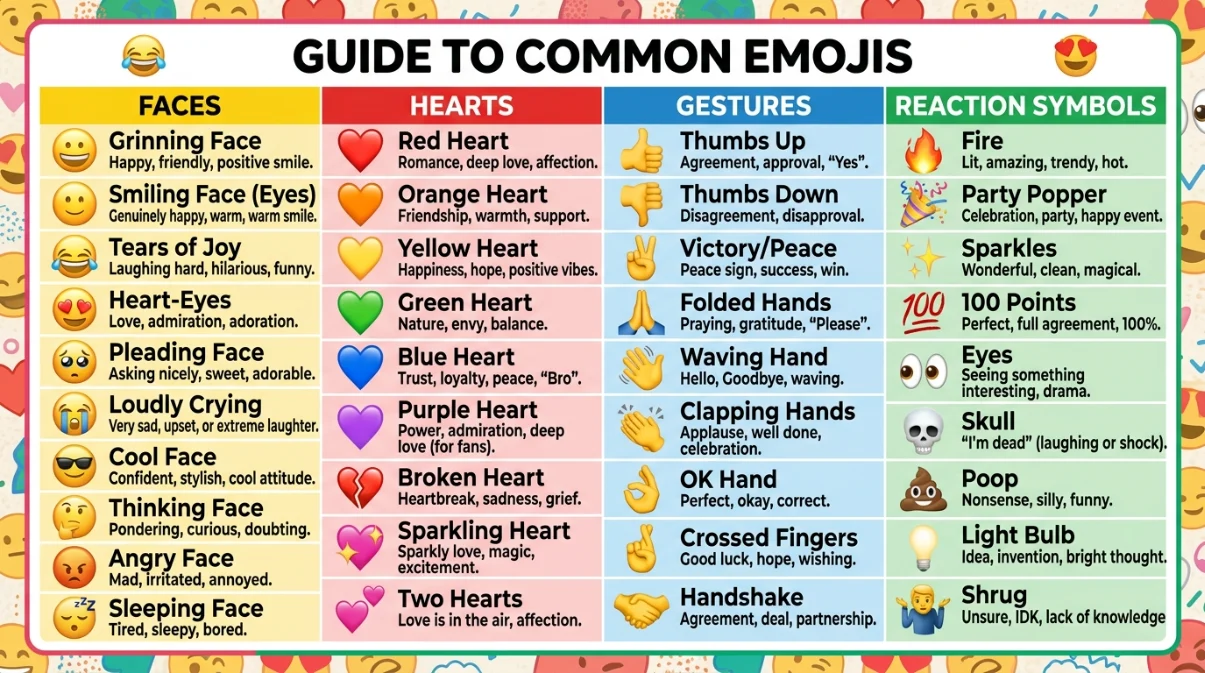

An emoji meaning chart gives you a useful starting point for understanding what an emoji usually communicates, but it cannot decode every message perfectly. The same emoji may express humor in one conversation, sadness in another, and sarcasm in a third.
Unicode standardizes emoji characters and their CLDR names, while everyday users give many of those symbols additional conversational meanings. The current published Unicode emoji chart is Emoji v17.0.
Quick Emoji Meaning Chart
| Emoji | Official Name | Common Meaning | Tone | Where or When It Is Used |
|---|---|---|---|---|
| 😂 | Face with Tears of Joy | Intense laughter | Amused, joyful | Jokes and funny reactions |
| 😭 | Loudly Crying Face | Strong sadness or overwhelming emotion | Dramatic, emotional | Grief, laughter, emotional reactions |
| 🥺 | Pleading Face | Pleading, yearning, feeling touched | Soft, vulnerable | Requests, affection, emotional texts |
| 🫠 | Melting Face | Heat, embarrassment, overwhelm | Awkward, sarcastic | Stress, hot weather, cringe moments |
| 🙃 | Upside-Down Face | Irony, silliness, sarcasm | Playful, resigned | Awkward or ironic situations |
| 👍 | Thumbs Up | Approval, yes, acknowledgment | Positive or neutral | Confirmations and quick replies |
| ❤️ | Red Heart | Love, affection, support | Warm, loving | Romance, friendship, family |
| 🔥 | Fire | Fire; figuratively excellent or exciting | Enthusiastic | Compliments, reactions, achievements |
| 👀 | Eyes | Looking, watching, interest | Curious | News, gossip, teasers |
| 💀 | Skull | Death; figuratively extreme laughter or shock | Dark, dramatic | Humor, exaggerated reactions |
These meanings describe common use, not rules. Official naming is standardized through Unicode and CLDR.
Why Can One Emoji Have Several Meanings?
Emoji work together with ordinary language.
Consider 😭.
“I miss him so much 😭”
This communicates sadness.
“That video is hilarious 😭”
Now it expresses overwhelming laughter.
The visual image has not changed. The sentence has.
That pattern appears across many emojis, especially faces and gestures.
Common Laughing and Happy Emojis
😂 Face with Tears of Joy
Usually indicates strong laughter.
“That was the funniest thing I’ve seen all week 😂”
The tears represent laughing so hard that you cry.
🤣 Rolling on the Floor Laughing
Often suggests even more exaggerated laughter.
“I cannot believe you actually did that 🤣”
😊 Smiling Face with Smiling Eyes
Usually conveys warm happiness, gratitude, friendliness, or gentle affection.
“Thank you so much 😊”
It tends to feel softer than a big laughing emoji.
Common Sad and Emotional Emojis
😢 Crying Face
Usually represents sadness, hurt, or disappointment.
“I’m going to miss everyone 😢”
😭 Loudly Crying Face
Can express intense crying but is also commonly used for overwhelming reactions such as laughter or joy.
🥺 Pleading Face
Shows “puppy dog” eyes and often expresses begging, yearning, vulnerability, adoration, or being emotionally touched. Emojipedia documents these uses.
“Can we stay five more minutes? 🥺”
Awkward, Ironic, and Sarcastic Emojis
🫠 Melting Face
May literally represent extreme heat or figuratively communicate embarrassment, dread, stress, shame, or feeling overwhelmed. Its distorted smile also makes it useful for sarcasm.
“I replied to the wrong group chat 🫠”
🙃 Upside-Down Face
Often adds silliness, irony, or a “this is fine” feeling.
“Another meeting at 7 a.m. 🙃”
The sentence tells you that the smile probably is not straightforward happiness.
Common Hand Gesture Emojis
👍 Thumbs Up
Usually means:
- yes
- good
- approved
- okay
- got it
It can become sarcastic or passive-aggressive in tense contexts.
👎 Thumbs Down
Generally communicates disagreement, dislike, rejection, or “no.”
🙏 Folded Hands
Depending on context, Folded Hands can communicate prayer, thanks, a request, or respectful appreciation. Cultural interpretation can vary, so the message around it matters.
Common Heart Emojis
❤️ Red Heart
Love, affection, support, friendship, family love, or strong positive feelings. Romance is common but not required.
💔 Broken Heart
Commonly expresses heartbreak, emotional pain, grief, or strong disappointment.
🤍 White Heart
Used for affection and can also appear in sympathy, memorial, or condolence messages.
Popular Reaction Symbols
🔥 Fire
Literally represents fire.
Figuratively, it can mean something is:
- excellent
- exciting
- impressive
- attractive
“That new song is 🔥”
means the song is very good or exciting, not that it is literally burning.
👀 Eyes
Often means:
- I’m watching
- I noticed that
- I’m interested
- tell me more
“There’s big news tomorrow 👀”
creates curiosity.
💀 Skull
Its literal association is death, but informal online use can exaggerate laughter, shock, or disbelief.
“That comment took me out 💀”
may figuratively mean “That was extremely funny.”
How to Interpret an Emoji More Accurately
Before deciding what an emoji means, consider these clues:
- Read the sentence first. Words usually narrow the interpretation.
- Look at nearby emojis. Emoji combinations can create a clearer tone.
- Consider your relationship. A heart from a partner may feel different from a reaction in a work group.
- Notice the sender’s habits. Some people use ❤️ with everyone; others rarely use it.
- Check whether the message is literal. 🍉 can simply mean watermelon and 🍆 can simply mean eggplant.
- Consider sarcasm. Positive-looking emojis can become ironic when paired with negative wording.
Why Emojis Can Look Different on Different Phones
Unicode standardizes the character, but Apple, Google, Samsung, Microsoft, and other vendors create their own artwork. Unicode’s full emoji chart shows vendor renderings side by side.
Small visual differences can sometimes affect how an expression feels, although the underlying character remains the same.
Should You Trust “Secret Emoji Codes”?
Be cautious.
Some communities, relationships, fandoms, or social platforms may develop specialized meanings, but those should not be treated as universal definitions.
This is especially important for heart colors. Emojipedia’s heart analysis shows substantial overlap in how colored hearts are used rather than a single fixed code for every color.
Frequently Asked Questions
Do emojis have official meanings?
Unicode and CLDR provide standardized characters, short names, and keywords. Everyday conversational meanings can expand beyond those technical labels.
Can one emoji mean opposite things?
Yes. Sarcasm, irony, jokes, and surrounding text can change how a symbol is interpreted.
Why does an emoji look different on iPhone and Android?
Different vendors create their own emoji artwork while implementing the same standardized Unicode character.
How do I understand a confusing emoji?
Read the entire message and conversation. If the meaning matters and remains unclear, asking the sender is more reliable than guessing.
Are emoji meanings different on social media?
The basic character stays the same, but communities and platform features can create special contextual meanings.
Conclusion
An emoji meaning chart is most useful as a guide, not a decoding system. Emojis such as ❤️, 👍, 🥺, 🫠, and 😭 have recognizable common meanings, but words, relationships, humor, and conversation history can change the final interpretation. Start with the usual meaning, then use the surrounding context to understand what the sender most likely intended.


Pingback: MB Meaning in Text 💬 | What Does MB Mean in Chat?
Pingback: What Does MYF Mean in Text?
Pingback: Brown Heart Emoji Meaning 🤎 | Love, Support, Identity, and Context
Pingback: NTN Meaning in Text: Decode This Popular Chat Acronym Before You Reply in 2026