
Seeing “MB” in a text can make you pause for a second. Does it mean “my bad,” “megabyte,” or something else?
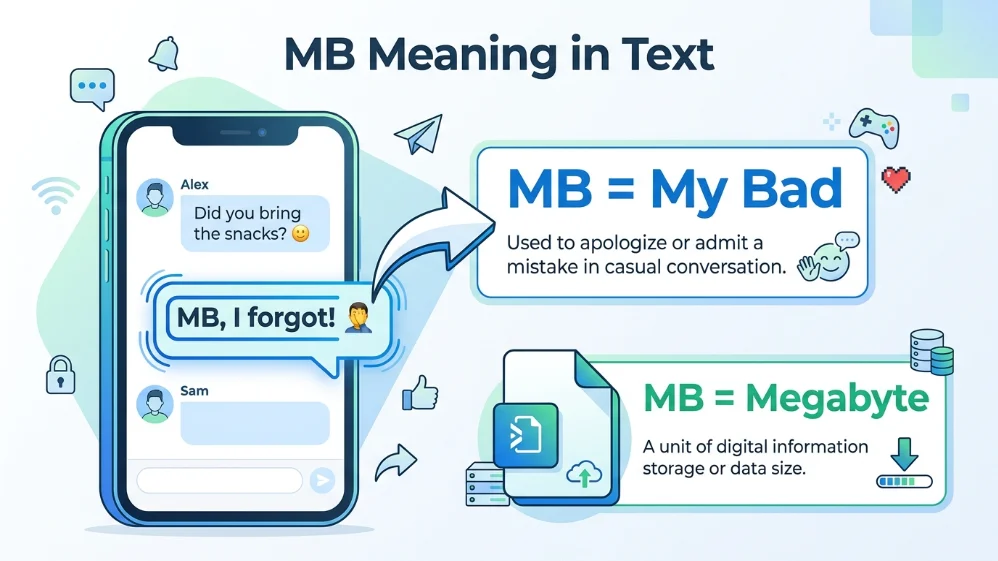
The answer depends on the context. In everyday texting, MB usually means “my bad.” People use it as a quick way to admit a small mistake, apologize, or correct something they said. For example, someone might text, “MB, I thought you were coming at 8.”
You may also see MB on Snapchat, Instagram, TikTok, Discord, WhatsApp, gaming chats, and other online spaces. In technology discussions, however, MB often means megabyte, a unit used to measure digital data.
This guide is for students, parents, gamers, social media users, texters, and anyone who wants to understand modern internet slang. If you have received “MB” and wondered what the sender meant, you’re in the right place.
What Does MB Mean in Text?
In text messages and casual online conversations, MB most commonly means “my bad.”
“My bad” is an informal way to admit that you made a mistake. It can also work as a quick apology when the mistake is small.
For example:
Friend 1: Did you send the address?
Friend 2: MB, I forgot.
Here, MB means “my bad.” The person is admitting that they forgot to send the address.
The expression is usually casual and friendly. It does not normally sound like a serious apology. Instead, it is often used for minor mistakes, misunderstandings, missed messages, or incorrect information.
MB can also mean “megabyte”
The meaning changes when you’re talking about computers, phones, files, or internet data.
For example:
“The photo is 8 MB.”
In this sentence, MB means megabyte, not “my bad.”
You can usually figure out the meaning by looking at the words around it.
| MB meaning | Common context | Example |
|---|---|---|
| My bad | Texting and chats | “MB, I forgot.” |
| Megabyte | Technology and files | “The file is 10 MB.” |
| Message board | Some online communities | “Check the MB for updates.” |
| Maybe | Rare informal usage | “MB we can go later.” |
The first two meanings are the most important to remember.
Is MB an apology?
Yes, when it means “my bad.”
However, MB is usually a light and informal apology. It may not be suitable when you need to apologize for something serious.
For a small mistake:
“MB, I sent the wrong picture.”
For a serious situation, a clearer apology is better:
“I’m really sorry. I should have told you earlier.”
Background and History of MB
The texting meaning of MB comes from the phrase “my bad.” The phrase itself is much older than texting.
“My bad” became popular in American informal speech during the late 20th century. It was especially common in casual conversations and sports culture. Someone might say “my bad” after making a mistake during a game.
As digital communication became more common, people began shortening words and phrases to save time. Text messaging, instant messaging, online forums, and social media all helped create a culture of abbreviations.
Words such as:
- LOL
- BRB
- IDK
- BTW
- IMO
- TBH
became common in online communication.
MB followed the same general pattern. Instead of typing “my bad,” someone could simply type two letters.
For example:
“MB, wrong chat.”
This is faster than:
“My bad, I sent that to the wrong chat.”
The abbreviation became especially useful on platforms where people communicate quickly. These include messaging apps, gaming chats, group conversations, and social media.
MB in modern communication
Today, MB can appear in:
- Text messages
- WhatsApp chats
- Instagram DMs
- Snapchat
- Discord
- Facebook Messenger
- Gaming chats
- Online forums
- Group chats
The technology meaning of MB has a separate history. Megabyte is a measurement used in computing and digital storage.
That is why context is essential.
If someone says:
“MB, I forgot to call you.”
They mean my bad.
If someone says:
“The video is 25 MB.”
They mean megabytes.
How Is MB Used in Different Contexts?
The meaning of MB can change depending on where you see it.
MB in texting
Texting is where “my bad” is most common.
Alex: Are you still bringing the tickets?
Sam: MB, I left them at home.
Here, MB is a quick apology.
It can also correct information:
“MB, I meant Friday, not Thursday.”
MB on social media
People may use MB in comments, replies, or direct messages.
“MB, I didn’t see your message.”
It can sound casual and relaxed.
MB in gaming
Gamers often use short expressions because conversations can move quickly.
Player 1: Why didn’t you cover me?
Player 2: MB, I was checking the map.
Again, MB means my bad.
However, gaming also involves files and data. In that context, MB can mean megabyte.
“The update is 500 MB.”
MB in group chats
In group chats, MB can help someone quickly admit a mistake.
“MB everyone, I sent the wrong link.”
MB in technology
Technology is different.
“This app uses about 200 MB of storage.”
Here, MB means megabyte.
Always check the subject of the conversation before deciding what MB means.
Common Misconceptions About MB
One common mistake is assuming that MB always means “my bad.”
It doesn’t.
MB is an abbreviation with several possible meanings. The surrounding conversation tells you which one is intended.
Misconception 1: MB always means “my bad”
Not necessarily.
If someone is discussing a file size, MB almost certainly means megabyte.
“The PDF is 4 MB.”
There is no apology here.
Misconception 2: MB is always an apology
MB can show an apology, but it can also simply acknowledge a mistake.
For example:
“MB, you’re right.”
This may mean:
“My bad, you’re right.”
Misconception 3: MB is rude
MB is not normally offensive. However, it can feel too casual in some situations.
If someone is upset about something serious, saying only “MB” might sound careless.
Compare:
“MB.”
with:
“I’m really sorry. I understand why you’re upset.”
The second response shows more care.
Misconception 4: MB means “maybe”
Some people may use MB as an informal shortening of “maybe.” This is much less standard.
For example:
“MB I’ll join later.”
A reader could understand it as “maybe,” but it may also cause confusion.
If you mean “maybe,” writing the full word is clearer.
Similar Terms and Alternatives to MB
Several expressions can communicate a similar idea.
| Term | Meaning | Tone |
|---|---|---|
| MB | My bad | Very casual |
| My bad | Informal apology | Casual |
| Sorry | Apology | Casual to neutral |
| My mistake | Accepting responsibility | Neutral |
| My fault | Accepting responsibility | Casual |
| I apologize | Formal apology | Professional |
| Oops | Small mistake | Very casual |
| Whoops | Small mistake | Casual and playful |
MB vs. “my bad”
These mean the same thing when MB is being used as an abbreviation.
“MB, I forgot.”
and
“My bad, I forgot.”
The difference is mainly the length and style.
MB vs. sorry
“Sorry” can work in more situations.
“Sorry, I forgot.”
sounds more generally appropriate than:
“MB, I forgot.”
For professional communication, “sorry” or “I apologize” is usually better.
How Should You Respond to MB?
Your response depends on what the person means and how serious the situation is.
Casual response
If someone says:
“MB, I forgot to text you.”
You could reply:
“No worries!”
or:
“All good.”
Funny response
If the mistake is harmless, you can joke about it.
Them: MB, I ate your fries.
You: “That crime will not be forgotten.”
Friendly response
You could simply say:
“It’s okay!”
or:
“No problem at all.”
If you’re still upset
You don’t have to accept a quick apology immediately.
You can say:
“I understand, but I’d appreciate it if you let me know next time.”
This keeps the conversation calm while making your feelings clear.
Privacy conscious response
If MB appears in a conversation involving personal information, you can avoid sharing unnecessary details.
For example:
Them: MB, I sent your private information to the group.
A better response could be:
“Please delete that message and don’t share my information again.”
The abbreviation itself is not the main issue. The situation matters more.
Regional and Cultural Differences
“My bad” is strongly associated with informal English, especially American English.
The abbreviation MB is also understood by many English speaking internet users around the world. However, its popularity can vary by age, platform, and region.
A person who frequently uses social media may recognize MB immediately. Someone who rarely uses internet slang may not.
English speaking communities
MB can be understood in countries such as:
- United States
- Canada
- United Kingdom
- Australia
- New Zealand
However, the exact frequency of use varies.
Non English speaking communities
People who communicate online in English may also use MB even when English is not their first language.
Internet slang often crosses language borders because social media, gaming, and messaging platforms connect users globally.
Still, if you’re talking with someone who may not know English abbreviations, writing “my bad” is safer.
MB Compared With Similar Expressions
Understanding the difference between short apology terms can help you choose the right response.
| Expression | Meaning | Best use | Formal? |
|---|---|---|---|
| MB | My bad | Small mistakes | No |
| Oops | I made a small mistake | Casual situations | No |
| Sorry | Apology | Most everyday situations | Sometimes |
| My mistake | I made an error | Clear responsibility | Somewhat |
| My fault | I am responsible | Casual conversations | No |
| I apologize | Formal apology | Work or serious situations | Yes |
| Excuse me | Polite correction or interruption | Social and formal settings | Yes |
Which one should you use?
For friends:
“MB, forgot to call.”
For someone you don’t know well:
“Sorry, I forgot to call.”
For work:
“I apologize for missing the deadline.”
The best expression depends on the relationship and seriousness of the situation.
MB in Online Communities and Dating Apps
Online communities often rely on short messages. MB fits naturally into these spaces.
You might see it on:
- Discord
- Gaming servers
- Snapchat
- X
- Dating apps
MB on dating apps
On dating apps, someone might use MB after making a small mistake.
Person 1: You said you were from Chicago, right?
Person 2: MB, I meant Milwaukee.
The sender is correcting themselves.
You may also see:
“MB, I disappeared yesterday. Work got amazing.”
Here, the person is using MB to make a casual apology.
Should you respond to MB on a dating app?
Match the seriousness of the conversation.
If the mistake is small:
“No worries 😊”
If you want to keep the conversation playful:
“I’ll let it slide this time 😂”
If the person is apologizing for something that bothers you, respond honestly instead of automatically accepting the apology.
Gaming communities
In gaming, MB can be especially common because players need quick communication.
“MB, bad play.”
“MB, I wasn’t watching the flank.”
These messages usually mean “my bad.”
But:
“The patch is 800 MB.”
means megabytes.
Does MB Have a Hidden or Offensive Meaning?
In ordinary texting, MB does not normally have an offensive meaning.
The most common meanings are:
- My bad
- Megabyte
- Less commonly, other context specific abbreviations
However, abbreviations can have different meanings inside specific online communities.
That is why you should not assume every two letter abbreviation has one universal definition.
Tone can change the meaning
Consider this:
“MB.”
It may sound very short or dismissive.
Now compare:
“MB 😭 I totally forgot.”
The emoji makes the message feel more playful and apologetic.
And:
“MB, that’s my fault.”
sounds more direct.
So, punctuation, emojis, surrounding words, and the relationship between the speakers all affect tone.
Is MB Appropriate for Professional Communication?
Usually, no.
MB is casual internet language. It can be fine in a relaxed workplace chat if your team already communicates informally, but it is not the safest choice for formal communication.
Avoid using MB in:
- Formal emails
- Job applications
- Client communications
- Business proposals
- Official reports
- Academic writing
- Important workplace apologies
Instead, use a clearer phrase.
Casual workplace chat
“MB, I attached the wrong file.”
This may be acceptable in a very informal team chat.
Professional email
A better choice is:
- I apologize.
- I attached the incorrect file.
- I have attached the correct version below.
This sounds clearer and more professional.
Why avoid MB professionally?
The problem isn’t that MB is offensive. The problem is that it can sound too casual, vague, or dismissive.
When a mistake matters, professional communication should make responsibility and the next step clear.
FAQs About MB Meaning in Text
What does MB mean in text?
In texting, MB usually means “my bad.” It is an informal way to admit a mistake or give a quick apology.
Does MB mean my bad?
Yes. In casual chats, MB commonly stands for “my bad.”
What does MB mean on Snapchat?
On Snapchat, MB can mean “my bad” when someone is apologizing or correcting a mistake.
What does MB mean in gaming?
In gaming chat, MB often means “my bad.” For example, “MB, I wasn’t watching” means “My bad, I wasn’t watching.”
Can MB mean megabyte?
Yes. In technology and computing, MB means megabyte, a unit used to describe digital data or file size.
Is MB rude?
Usually not. However, using only “MB” after a serious mistake can seem too casual or dismissive.
Should I use MB at work?
Use caution. MB is generally better for casual chats. In formal workplace communication, “my mistake,” “sorry,” or “I apologize” is usually more appropriate.
Conclusion
So, what does MB mean in text?
Most of the time, MB means “my bad.” It is a short, casual way to admit a mistake, correct yourself, or apologize for something minor.
You may see it in text messages, social media DMs, group chats, gaming communities, and dating apps. The tone is usually friendly and informal.
However, context matters. When people discuss technology, files, storage, or internet data, MB usually means “megabyte.”
The easiest way to understand MB is to look at the words around it. If someone says “MB, I forgot,” they mean “my bad.” If someone says “The file is 20 MB,” they mean megabytes.
For formal communication, avoid MB and use clearer phrases such as “I apologize” or “My mistake.”
Once you know the context, MB is a very simple abbreviation to understand.