
Have you ever received a text that simply says “TTYL” and wondered what it means? You’re not alone. Short forms like TTYL can feel confusing when you first see them in a chat, comment, game, or social media post.
If you’re a student, parent, social media user, gamer, texter, or someone learning modern internet slang, knowing what TTYL means can make online conversations much easier to understand.
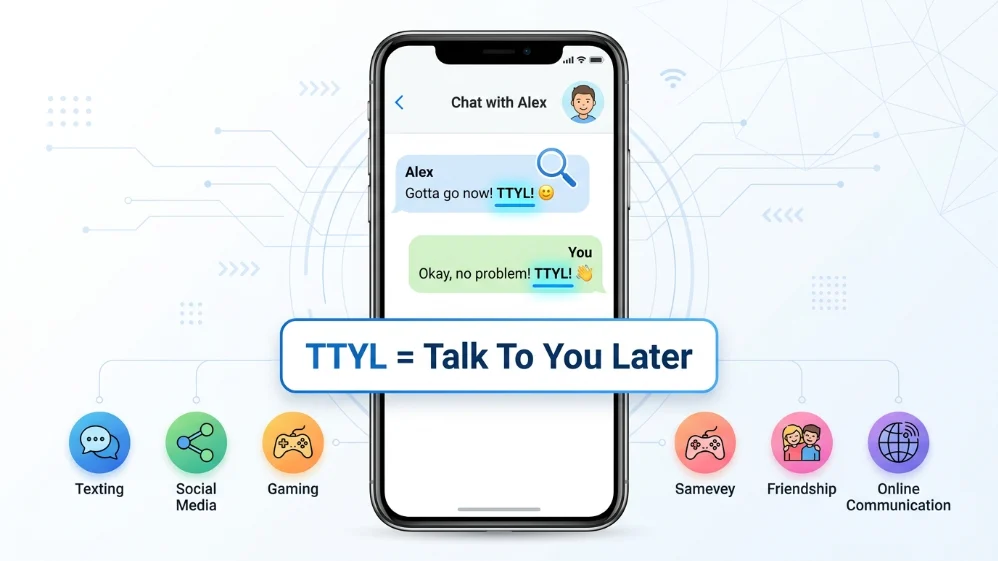
TTYL means “Talk To You Later.” People use it when they are ending a conversation for now but expect to talk again later.
You may see TTYL in text messages, Snapchat chats, Instagram DMs, WhatsApp conversations, gaming chats, and other casual online spaces. It can sound friendly, relaxed, and informal.
Understanding TTYL also helps you read the tone behind a message. Depending on the conversation, it can be a simple goodbye, a polite way to leave a chat, or a quick response when someone needs to go.
What Does TTYL Mean in Text?
TTYL stands for “Talk To You Later.”
It is an internet abbreviation used when someone wants to end a conversation temporarily. Instead of typing the full phrase, people use the four letters TTYL.
For example:
Alex: I have to finish my homework now.
Sam: Okay, TTYL!
Here, Sam means “Okay, talk to you later!”
TTYL usually does not mean that the person never wants to talk again. In most cases, it suggests that the conversation is ending for now.
The phrase can be used with friends, family members, classmates, online friends, and other people you regularly chat with.
TTYL Full Form
| Short Form | Full Form | Meaning |
|---|---|---|
| TTYL | Talk To You Later | I will talk with you again later |
| TTYL! | Talk To You Later! | Friendly goodbye |
| ttyl | Talk to you later | Casual version |
| TTYL 🙂 | Talk to you later | Friendly and warm goodbye |
The capitalization does not normally change the meaning.
You can write:
TTYL
or
ttyl
Both mean the same thing.
The choice usually depends on someone’s typing style.
What Does TTYL Mean From a Girl?
If a girl sends you “TTYL,” it usually means exactly what it says: “Talk to you later.”
It does not automatically mean that she is angry, annoyed, or losing interest.
Context matters.
For example:
You: Want to continue this conversation tonight?
Her: Sure, I have class now. TTYL!
This is a normal and friendly use.
However, if someone suddenly sends only “ttyl” after a tense conversation, you may wonder about their tone. In that case, look at the messages before it rather than assuming a hidden meaning.
What Does TTYL Mean From a Guy?
The meaning is the same when a guy uses it.
He may be busy, leaving the chat, going to sleep, starting work, playing a game, or simply taking a break.
For example:
You: Are you still coming online later?
Him: Yeah, ttyl.
The message simply means he plans to talk later.
Background and History of TTYL
TTYL became popular during the early days of internet chat and mobile texting.
Before smartphones became common, people used instant messaging services, chat rooms, SMS, and online forums to communicate. Typing on older mobile phones could take time, so abbreviations became useful.
Instead of typing:
“Talk to you later.”
someone could simply type:
“TTYL.”
This saved time and made conversations faster.
TTYL became especially common among younger internet users during the late 1990s and early 2000s. It appeared alongside other texting abbreviations such as LOL, BRB, OMG, IDK, and BTW.
TTYL in Early Texting Culture
Early mobile phones often had physical keypads. Typing a long sentence could require several button presses.
Texting culture therefore encouraged short forms.
People began using abbreviations for common phrases:
- BRB = Be Right Back
- LOL = Laughing Out Loud
- BTW = By The Way
- IDK = I Don’t Know
- TTYL = Talk To You Later
- OMG = Oh My God
These expressions became part of online communication.
Over time, smartphones made typing much easier. However, texting abbreviations did not disappear.
Instead, they became part of internet language and digital culture.
Today, TTYL can appear in:
- Text messages
- Snapchat
- Discord
- Facebook Messenger
- Gaming chats
- Online forums
- Dating apps
- Social media comments
The abbreviation is now widely understood by many English-speaking internet users.
How Is TTYL Used in Different Contexts?
TTYL is flexible. Its basic meaning stays the same, but its tone can change based on the situation.
TTYL in Text Messages
Texting is probably the most common place to see TTYL.
Mia: I need to cook dinner.
Jake: No problem. TTYL!
It provides a quick and friendly way to end the conversation.
TTYL on Social Media
You may also see TTYL in Instagram DMs, Snapchat, Facebook Messenger, or other social platforms.
A: Are you posting the pictures tonight?
B: Maybe later. I have work first. TTYL.
It works well when the conversation is casual.
TTYL in Gaming
Gamers often use short messages because they need to communicate quickly.
Player 1: I have to leave the match.
Player 2: All good. TTYL!
A gamer might also write:
“Dinner time. TTYL.”
The message means they are leaving the game or chat temporarily.
TTYL With Friends
Friends often use TTYL without any formal goodbye.
You: I’m heading to the gym.
Friend: Cool, ttyl.
It sounds relaxed and natural.
TTYL in Family Chats
Family members can use TTYL too.
Mom: Call me when you’re free.
Son: Sure. TTYL.
The abbreviation is not limited to teenagers or young adults.
TTYL in Casual Conversations
TTYL works best when the relationship is already informal.
It can communicate:
“I have to go now, but we’ll talk again later.”
That makes it useful when someone wants to leave without making the conversation feel final.
Common Misconceptions About TTYL
TTYL is simple, but people sometimes misunderstand its tone.
Misconception 1: TTYL Means Goodbye Forever
This is incorrect.
TTYL normally means the conversation is ending temporarily.
The word “later” suggests another conversation is expected.
Misconception 2: TTYL Always Means Someone Is Busy
Not necessarily.
Someone might use TTYL because they are:
- Busy
- Tired
- Going somewhere
- Starting work
- Going to sleep
- Leaving a game
- Ending a long conversation
- Simply taking a break
The exact reason depends on context.
Misconception 3: TTYL Is Always Friendly
Usually, TTYL is neutral or friendly.
But tone can change.
Compare:
“Okay! TTYL 😊”
with:
“Fine. ttyl.”
The first sounds warm.
The second could sound short or annoyed depending on what happened before it.
Misconception 4: TTYL Is Romantic
TTYL is not inherently romantic or flirty.
Someone you are dating may use it, but friends can use it too.
For example:
Friend: I have to study. TTYL.
There is nothing romantic about this.
Similar Terms and Alternatives to TTYL
Several abbreviations have meanings that are close to TTYL.
| Term | Meaning | Main Difference |
|---|---|---|
| TTYL | Talk To You Later | Ending a conversation temporarily |
| BRB | Be Right Back | Leaving briefly and returning soon |
| GTG | Got To Go | Need to leave |
| BBL | Be Back Later | Returning later |
| CYA | See Ya | Casual goodbye |
| CU | See You | Short goodbye |
| AFK | Away From Keyboard | Temporarily unavailable |
| L8R | Later | Very informal version of “later” |
TTYL vs BRB
TTYL usually ends the current conversation.
BRB usually means the person expects to return very soon.
Example:
BRB: I need to answer the door.
This suggests a short absence.
TTYL: I have to head to class.
This suggests the conversation will continue later.
TTYL vs GTG
GTG means “Got To Go.”
It focuses on leaving.
TTYL focuses more on talking again later.
GTG, my ride is here.
TTYL, my ride is here.
Both can work, but the second emphasizes future communication.
TTYL vs BBL
BBL means “Be Back Later.”
It suggests the person will return.
TTYL focuses on communication.
BBL, I need to eat.
means the person expects to return.
TTYL, I need to eat.
means the person expects to talk later.
How Should You Respond to TTYL?
There is no single correct response.
Your answer depends on your relationship with the person and the situation.
Casual Response
If a friend sends TTYL, keep it simple.
“Sure, ttyl!”
Other options include:
- “Okay, talk later!”
- “Sounds good!”
- “Later!”
- “Catch you later!”
Friendly Response
You can make your response warmer.
“Okay! Talk to you later 😊”
Or:
“Sure, have a good one!”
Funny Response
With a close friend, you can joke around.
“You better actually talk later 😂”
Or:
“Fine, but don’t disappear for three days 😂”
Only use humor when you know the person well.
Flirty Response
If you’re talking to someone you like, you can keep the conversation playful.
“Okay, I’ll be waiting 😉”
Or:
“Talk later. Don’t forget about me 😏”
The right response depends on the existing relationship.
Privacy Conscious Response
Sometimes you do not want to continue a conversation.
You can respond politely without giving personal details.
“Sure, talk later. Take care!”
You do not need to explain where you are going or what you are doing.
Regional and Cultural Differences
TTYL is an English abbreviation, so it is most common in English speaking online communities.
People in countries where English is widely used online may recognize it even when English is not their first language.
You may see TTYL in conversations involving people from:
- United States
- Canada
- United Kingdom
- Australia
- New Zealand
- India
- Pakistan
- Philippines
- Singapore
- Other international English speaking communities
However, not everyone uses English texting abbreviations.
Different languages have their own short forms.
For example, some people may simply translate the idea of “talk later” into their native language instead of using TTYL.
Why Cultural Context Matters
Online communication often mixes languages.
A person may write:
“Okay, TTYL, phir baat karte hain.”
The first part uses an English abbreviation. The second part means something like “we’ll talk later” in Urdu or Hindi.
This type of code switching is common in multilingual online conversations.
Therefore, TTYL can appear even when the rest of a conversation is not fully in English.
TTYL Compared With Similar Expressions
Understanding small differences can help you choose the right phrase.
| Expression | Full Meaning | Tone | Best Use |
|---|---|---|---|
| TTYL | Talk To You Later | Casual | Friends and online chats |
| Talk later | Talk to you later | Casual | Everyday conversation |
| See you later | Goodbye for now | Friendly | Friends and acquaintances |
| GTG | Got To Go | Very casual | Quick departure |
| BRB | Be Right Back | Casual | Short break |
| BBL | Be Back Later | Casual | Longer break |
| Goodbye | Formal farewell | Neutral/Formal | Most situations |
| Speak soon | Talk again soon | Polite | Casual or semi professional |
| Talk soon | Talk again soon | Friendly | Most informal settings |
| I need to go now | Need to leave | Direct | Any setting |
The main advantage of TTYL is speed.
It is short, clear, and familiar to many internet users.
TTYL in Online Communities and Dating Apps
TTYL appears frequently in online communities because digital conversations move quickly.
You might see it on messaging apps, social platforms, gaming servers, forums, and dating platforms.
TTYL on Dating Apps
On dating apps such as Tinder, someone might write:
“I have an early morning tomorrow. TTYL 😊”
This usually means they are ending the conversation for now.
It does not automatically mean rejection.
However, dating conversations require more attention to context.
Compare:
“I have to go now, but I enjoyed talking to you. TTYL!”
This sounds positive.
With:
“ttyl.”
The second message is much shorter. It may simply be casual, or it may suggest low engagement. You need to consider the entire conversation.
TTYL in Gaming Communities
Gaming chats rely heavily on abbreviations.
You may see:
“Dinner’s ready. TTYL.”
Or:
“GG everyone, ttyl!”
Here, the player is simply leaving the conversation or game.
TTYL on Social Media
People may use TTYL in DMs and comments when they need to leave a conversation.
It is usually better suited to casual communication than public professional posts.
Tips for Responding Online
When someone says TTYL:
- Don’t assume they are angry.
- Look at the conversation before the message.
- Consider their normal texting style.
- Avoid sending many follow up messages.
- Let them return when they are available.
- Match their casual tone when appropriate.
Does TTYL Have a Hidden or Offensive Meaning?
TTYL does not normally have a hidden offensive meaning.
Its standard meaning is simply:
Talk To You Later.
It is not generally considered a vulgar or insulting abbreviation.
Still, any phrase can sound different depending on context.
For example:
“TTYL ❤️”
sounds warm.
“Whatever. ttyl.”
may sound dismissive.
The problem is not the abbreviation itself. The surrounding language creates the tone.
Could TTYL Sound Rude?
It can sometimes feel abrupt.
Imagine someone writes:
“I’m done with this. TTYL.”
The message may sound cold because of the sentence before it.
But:
“I need to get ready for work. TTYL!”
sounds normal and friendly.
Does TTYL Mean Someone Is Avoiding You?
Not automatically.
You should not interpret a simple TTYL as evidence that someone is avoiding you.
People have different texting habits.
Some people send short messages because they are busy. Others naturally use abbreviations.
Context is more important than the abbreviation.
Is TTYL Appropriate for Professional Communication?
TTYL is generally not recommended for formal professional communication.
It is an informal texting abbreviation.
You might use it with a coworker if your workplace has a relaxed communication style, especially in casual internal chats. However, it is safer to avoid it in formal emails, business proposals, client communication, and official documents.
Avoid TTYL In:
- Formal emails
- Job applications
- Cover letters
- Client emails
- Business proposals
- Official notices
- Academic writing
- Legal documents
- Formal customer support
Instead, use professional alternatives.
Professional Alternatives to TTYL
You can write:
- “Speak with you later.”
- “I will follow up later.”
- “I will get back to you shortly.”
- “Let’s continue this discussion later.”
- “I look forward to speaking with you again.”
- “I will follow up with you soon.”
For example:
Instead of:
“TTYL.”
A professional message could say:
“I need to step away for now. I will follow up with you later today.”
This sounds clearer and more professional.
Can You Use TTYL With Coworkers?
It depends on your workplace.
A casual team chat might allow:
“Heading to lunch. TTYL!”
But a formal email to a client should not end with TTYL.
When in doubt, use the full phrase instead of the abbreviation.
TTYL in Different Types of Relationships
The meaning stays the same, but the tone may change.
With Friends
TTYL usually sounds relaxed.
“I’m going to the store. TTYL!”
With Family
It can sound casual and natural.
“Dinner’s ready, TTYL.”
With a Crush
It can be completely neutral or slightly playful.
“I have to study now. TTYL 😊”
Do not assume romance from TTYL alone.
With an Online Friend
It often works as a quick goodbye.
“I’m logging off. TTYL!”
With a Coworker
Use it only when the workplace communication style is informal.
With a Stranger
It can still work in a casual online conversation, but a simple “Talk later” may sound more natural.
Examples of TTYL in Real Conversations
Example 1: Friends
Emma: Are you coming to the movie tonight?
Liam: I think so. Let me check with my parents.
Emma: Okay.
Liam: TTYL!
Meaning: Liam will talk to Emma later.
Example 2: Gaming
Player 1: Anyone playing tonight?
Player 2: I can play for another hour.
Player 1: I have to go eat. TTYL.
Meaning: The player is leaving but may talk again later.
Example 3: Dating
You: Want to call tonight?
Them: Yeah, but I have to finish something first. TTYL ❤️
Meaning: They want to continue communicating later.
Example 4: School
Student 1: Did you finish the assignment?
Student 2: Almost. I need to finish one question. TTYL.
Meaning: The student is ending the chat temporarily.
Example 5: Family
Dad: Call me when you get home.
Son: Sure. TTYL.
Meaning: They will communicate again later.
Example 6: Social Media
Friend: I’m going offline for a while.
You: No worries. TTYL!
Meaning: Talk again later.
How to Know What Someone Means by TTYL
If you’re unsure about someone’s intention, examine the context.
Ask yourself:
What were we talking about?
Was the conversation friendly, serious, romantic, or tense?
What did they say before TTYL?
A warm message usually suggests a warm goodbye.
Do they normally use abbreviations?
If they always write “lol,” “brb,” and “ttyl,” there may be nothing unusual about the message.
Did they give a reason for leaving?
A reason such as work, school, sleep, or dinner usually makes the meaning clear.
Did they say they would contact you later?
That provides stronger evidence that the conversation is temporary.
TTYL Capitalization and Variations
You may see several versions online.
Common forms include:
- TTYL
- ttyl
- Ttyl
- TTYL!
- ttyl 🙂
- ttyl 😊
- ttyl lol
- okay ttyl
These all generally carry the same core meaning.
Capitalization is usually a personal typing preference.
Adding an emoji can change the emotional tone.
For example:
- “ttyl 😊” sounds friendly.
- “ttyl ❤️” may sound affectionate.
- “ttyl 😂” may sound playful.
- “ttyl.” can sometimes feel more serious or abrupt.
Again, context matters.
Why Do People Use TTYL Instead of the Full Phrase?
The main reason is convenience.
Digital communication encourages short messages.
Typing:
“Talk to you later.”
takes more effort than:
“TTYL.”
Abbreviations also fit naturally into fast conversations.
People may be:
- Walking
- Working
- Gaming
- Eating
- Driving as a passenger
- Getting ready
- Studying
- Multitasking
A short abbreviation lets them end the conversation quickly.
It also reflects the broader evolution of internet slang.
Online communication has created thousands of abbreviations that save time and express tone.
FAQs
What does TTYL mean in text?
TTYL means “Talk To You Later.” It is a casual abbreviation used when someone is ending a conversation but expects to talk again later.
What does TTYL mean from a girl?
It usually means “Talk to you later.” It does not automatically indicate flirting, anger, or rejection. The surrounding conversation determines the tone.
What does TTYL mean from a guy?
It has the same meaning: “Talk To You Later.” He may simply be leaving the conversation temporarily.
Is TTYL rude?
No, TTYL is not normally rude. It is a casual way to end a conversation. However, it can sound abrupt when used during a tense conversation.
Is TTYL flirting?
No. TTYL is not inherently flirty. A romantic tone comes from the rest of the conversation, not from TTYL itself.
Can I use TTYL at work?
You can use it in a relaxed workplace chat if that style is accepted. However, avoid it in formal emails and professional documents.
What is the difference between TTYL and BRB?
TTYL means “Talk To You Later,” while BRB means “Be Right Back.” TTYL usually ends the current conversation, while BRB suggests a short temporary absence.
Conclusion
TTYL means “Talk To You Later.” It is one of the most common casual abbreviations used in digital communication.
You can find it in text messages, social media DMs, gaming chats, dating conversations, and online communities. It usually means that someone is leaving the conversation for now but expects to communicate again later.
The abbreviation is generally friendly, casual, and informal. It does not automatically mean someone is angry, avoiding you, or flirting with you.
Remember that context controls tone. A message like “TTYL 😊” can feel warm, while “Fine. ttyl.” may feel more distant.
For formal communication, use phrases such as “I will follow up later” or “Speak with you later.”
Once you know the meaning, TTYL is simple: the conversation is not necessarily over. It is just paused until later.