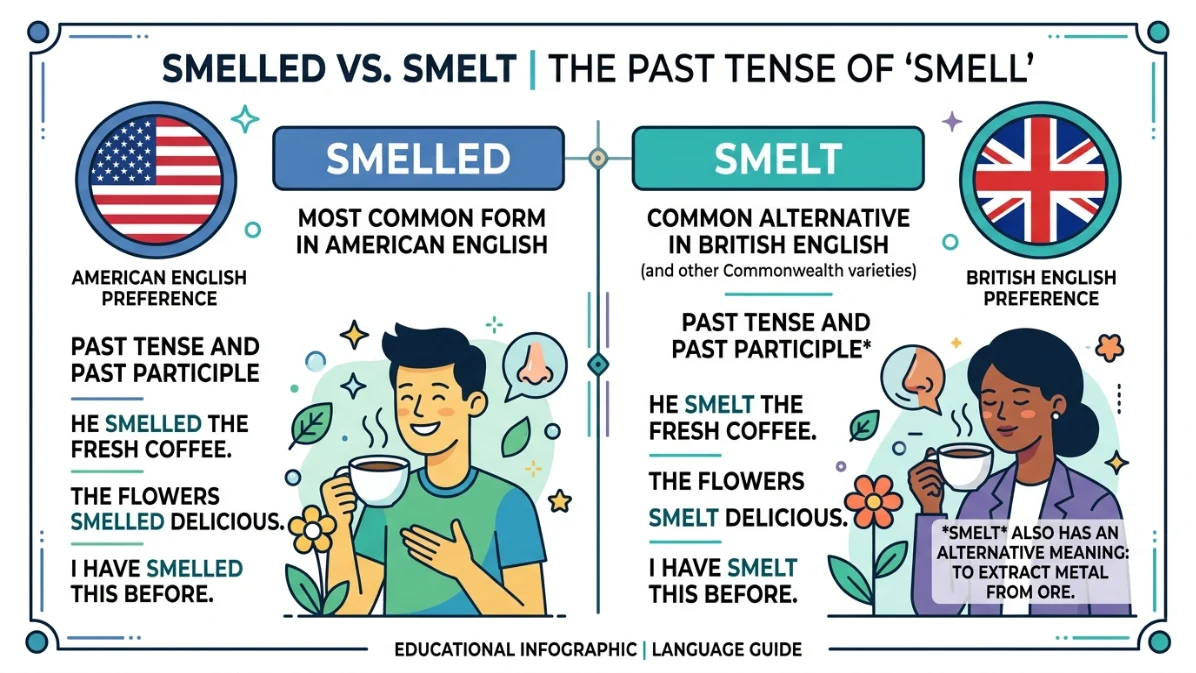

Smelled and smelt are both correct past tense forms of smell. Smelled is more common in American English, while smelt is more common in British English.
Smelled or smelt? Both words can be correct, but the right choice often depends on where and how you use English. That is what makes this pair confusing for many writers and learners. Smelled is the more common form in American English. Smelt is widely used in British English and other varieties of English.
So, are smelled and smelt interchangeable? In many sentences, yes. Both are past tense and past participle forms of smell. However, regional grammar preferences can make one sound more natural than the other. Understanding this small difference can help you write with greater accuracy and confidence.
In this guide, you will learn the meaning of smelled and smelt, their key differences, grammar rules, and correct usage. You will also see simple examples from everyday conversations and formal writing. Whether you are checking smelled vs. smelt, wondering which spelling is correct, or trying to understand when to use each form, this guide will make the choice much easier.
Definition & Meaning
Smelled and smelt are both past tense and past participle forms of the verb smell.
The verb smell means to detect or notice an odor with your nose. It can also describe the way something has a particular odor.
- Smelled: The more common past form in American English.
- Smelt: A common alternative in British English and some other varieties of English.
Examples
- I smelled fresh coffee in the kitchen.
- I smelt fresh coffee in the kitchen.
- She smelled something strange.
- She smelt something strange.
The meaning of these sentences is essentially the same. The main difference is regional usage and style.
Simple definition:
Smelled or smelt means noticed, detected, or had a particular smell in the past.
Full Form and Meaning
Smelled and smelt do not have a full form because they are not abbreviations or acronyms.
They are different past-tense forms of the verb smell.
- Smell = the base verb
- Smelled = past tense/past participle, especially common in American English
- Smelt = past tense/past participle, especially common in British English
So, there is no expanded “full form” for smelled or smelt. Their meaning comes from the verb smell, which relates to detecting or experiencing an odor.
Quick Answer
Both smelled and smelt are correct.
They are past tense and past participle forms of the verb smell.
Examples
American English:
I smelled smoke coming from the kitchen.
British English:
I smelt smoke coming from the kitchen.
Both sentences are grammatically correct.
Smelled or Smelt Difference
| Feature | Smelled | Smelt |
|---|---|---|
| Correct spelling | Yes | Yes |
| Past tense of smell | Yes | Yes |
| Past participle of smell | Yes | Yes |
| Common in American English | Yes | Less common |
| Common in British English | Yes | More common |
| Formal writing accepted | Yes | Yes |
Key Point
The main difference is regional preference rather than meaning.
What Does Smell Mean?
The verb smell refers to detecting an odor through the nose.
It can also mean giving off an odor.
Examples
I smell fresh bread.
The flowers smell wonderful.
She smelled smoke.
The soup smelled delicious.
Smelled Meaning Explained
Smelled is the regular past tense form of smell.
It follows the common English pattern of adding ed to a verb.
Examples
I smelled coffee this morning.
She smelled perfume in the hallway.
They smelled gas and called for help.
We smelled fresh rain in the air.
Smelt Meaning Explained
Smelt is an irregular past tense form of smell.
It has the same meaning as smelled.
Examples
I smelt coffee this morning.
She smelt smoke outside.
They smelt something burning.
We smelt fresh bread from the bakery.
How to Pronounce Smelled and Smelt
Smelled
Pronunciation:
/smeld/
Sounds like:
smelled
Smelt
Pronunciation:
/smelt/
Sounds like:
smelt
The pronunciation difference is very small.
This is one reason many learners become confused.
Why People Confuse Smelled and Smelt
Several factors contribute to confusion.
Both Are Correct
Unlike many grammar questions, both options are acceptable.
Different Regional Usage
Americans usually write smelled.
British writers often choose smelt.
Similar Meaning
The words mean exactly the same thing.
School Grammar Rules
Many students are taught only one form, making the other seem incorrect.
Grammar Rule Depth
The verb smell belongs to a group of verbs that can have two acceptable past tense forms.
Regular Form
smell → smelled
Irregular Form
smell → smelt
English contains several similar examples.
| Base Verb | Regular Form | Irregular Form |
|---|---|---|
| Learn | Learned | Learnt |
| Dream | Dreamed | Dreamt |
| Burn | Burned | Burnt |
| Smell | Smelled | Smelt |
Both forms are accepted by major dictionaries.
British English vs American English Usage
This is where the biggest difference appears.
American English
American English strongly prefers:
Smelled
Example:
The dog smelled something unusual.
British English
British English often uses:
Smelt
Example:
The dog smelt something unusual.
Comparison Table
| Region | Preferred Form |
|---|---|
| United States | Smelled |
| Canada | Mostly Smelled |
| United Kingdom | Smelt |
| Australia | Often Smelt |
| New Zealand | Often Smelt |
Which Form Should You Use?
The answer depends on your audience.
Writing for American Readers
Use:
Smelled
Writing for British Readers
Use:
Smelt
Writing for Global Readers
Smelled is generally the safer choice because it is more widely recognized internationally.
Most Important Rule
Choose one style and remain consistent throughout your writing.
The Origin of Smelled and Smelt
The word smell comes from Old English.
Over time, English developed both regular and irregular past tense forms.
The regular form became:
Smelled
The shorter irregular form became:
Smelt
Both survived into modern English.
That is why dictionaries continue to accept both versions.
Why Smelled Is Becoming More Common
Language changes over time.
Many irregular verbs gradually become regular.
Examples include:
learned
burned
dreamed
Because of this trend, smelled has become increasingly common worldwide.
Many modern publications prefer regular verb forms.
Is Smelt Ever a Different Word?
Yes.
Smelt can also be a completely different word.
Smelt as a Verb
Past tense of smell.
Example:
I smelt smoke.
Smelt as a Metalworking Term
To extract metal from ore using heat.
Example:
Ancient workers smelted iron ore.
Smelt as a Noun
A small fish.
Example:
The fishermen caught smelt in the river.
Context usually makes the meaning clear.
Real World Usage of Smelled and Smelt
Everyday Conversation
I smelled smoke.
I smelt smoke.
Both are correct.
Emails
I smelled a problem with the proposal.
Business Writing
Analysts smelled an opportunity in the market.
Academic Writing
Participants smelled several test samples.
News Writing
Witnesses smelled gas before the explosion.
Social Media
I smelled fresh cookies and immediately got hungry.
Common Phrases Using Smell
- Smell a rat
- Smell trouble
- Smell success
- Smell danger
- Smell fear
Examples
She smelled trouble immediately.
The detective smelled a rat.
The company smelled success after the product launch.
Common Mistakes With Smelled or Smelt
Mistake 1 Thinking Smelt Is Wrong
Incorrect belief:
Smelt is wrong.
Correct:
Smelt is acceptable, especially in British English.
Mistake 2 Mixing Styles
Example:
I smelled smoke and later smelt gas.
This creates inconsistency.
Choose one style.
Mistake 3 Confusing Smelt With Metal Processing
Smelt can refer to metal extraction.
Context determines meaning.
Similar British and American English Differences
Smelled and smelt are not unique.
Other verbs show the same pattern.
| American English | British English |
|---|---|
| Learned | Learnt |
| Burned | Burnt |
| Dreamed | Dreamt |
| Spoiled | Spoilt |
| Smelled | Smelt |
Learning these pairs helps improve English fluency.
Usage Trends and Popularity
Smelled appears more often globally.
Reasons include:
American English influence
regular verb preference
international publishing standards
Smelt remains common in:
British publications
Australian English
New Zealand English
Traditional writing styles
Memory Tricks to Remember Smelled and Smelt
Trick 1
Remember:
Both are correct.
Trick 2
Think:
America prefers ED.
Britain often prefers T.
Trick 3
Link these pairs:
learned → learnt
burned → burnt
smelled → smelt
Trick 4
Use audience location to decide.
American audience = smelled
British audience = smelt
Smelled or Smelt Summary
Correct:
Smelled
Correct:
Smelt
Meaning:
Past tense of smell
American English:
Smelled
British English:
Smelt
Best rule:
Match your audience.
Exercise 1 Choose the Correct Word
Yesterday I ______ smoke from the kitchen.
Answer:
smelled
or
smelt
Both are correct.
The dog ______ something unusual.
Answer:
smelled
or
smelt
Both are correct.
We ______ fresh bread from the bakery.
Answer:
smelled
or
smelt
Both are correct.
Exercise 2 Correct the Sentence
I smell smoke yesterday.
Answer:
I smelled smoke yesterday.
or
I smelt smoke yesterday.
Both are correct.
She smell gas before the leak was discovered.
Answer:
She smelled gas before the leak was discovered.
or
She smelt gas before the leak was discovered.
Both are correct.
FAQs
Is smelled or smelt correct?
Both are correct past tense forms of smell.
What is the difference between smelled and smelt?
The main difference is regional usage. Americans usually prefer smelled, while British speakers often use smelt.
Is smelt old fashioned?
Not necessarily. It remains common in British English.
Which form is more common worldwide?
Smelled is generally more common globally.
Can I use smelled and smelt interchangeably?
Yes, but consistency is recommended.
Is smelt a different word?
Yes. Smelt can also refer to metal extraction or a type of fish.
Which form should I use in professional writing?
Use the form preferred by your target audience. For international readers, smelled is often the safest choice.
Conclusion
Understanding the difference between smelled or smelt is easier than many grammar questions because both forms are correct. The choice depends mainly on regional preference rather than meaning. American English generally favors smelled, while British English often prefers smelt.
Both words function as the past tense and past participle of smell. They can be used in conversations, emails, academic writing, business communication, and professional publications. The most important consideration is consistency. If you choose smelled, use it throughout your document. If you choose smelt, keep that choice consistent as well.
For global audiences, smelled is often the safest option because it appears more frequently in international publications. However, British readers will find smelt completely natural and correct. Understanding this difference helps you write with greater confidence and accuracy.