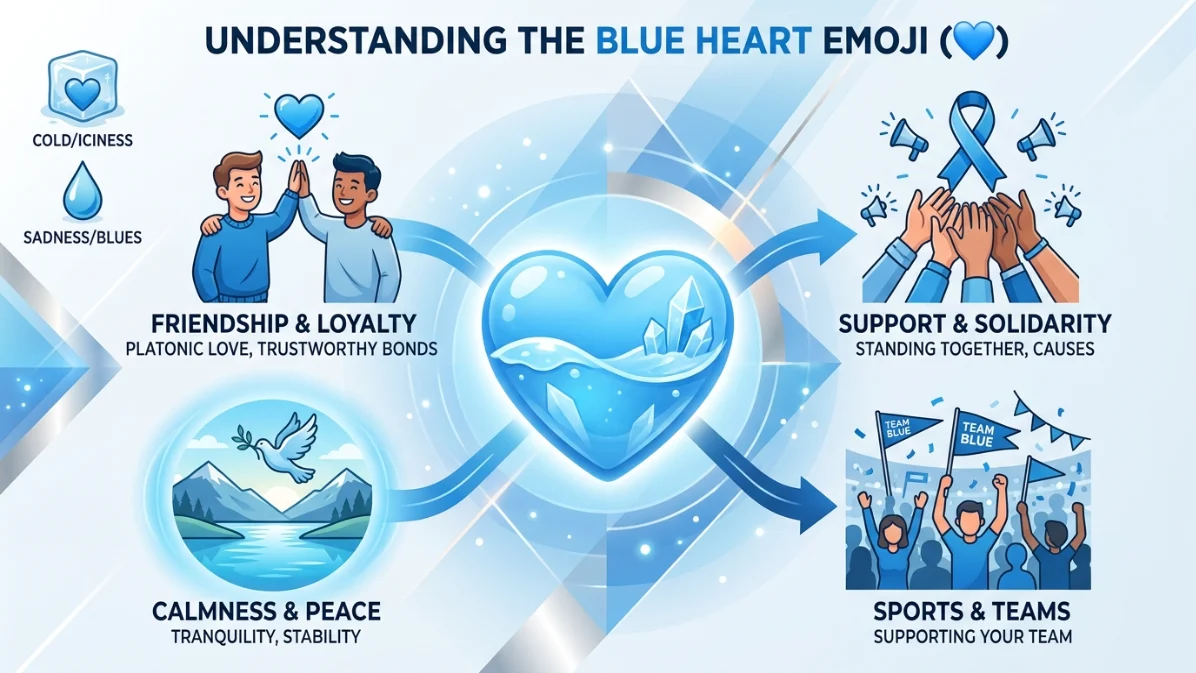

The blue heart emoji 💙 usually expresses affection, support, appreciation, or a positive emotional connection. It often feels calm, friendly, and less openly romantic than the red heart ❤️. However, it can still mean love when it comes from a partner, close friend, or family member.
Context matters more than the color alone. The words around the emoji, your relationship with the sender, and the sender’s usual texting style help reveal what they intended.
Quick Answer
💙 most commonly means:
- Friendly affection or appreciation
- Emotional support and encouragement
- A calm or steady form of love
- Connection to something associated with the color blue
- Romantic affection in the right context
A blue heart does not automatically mean friendship, romance, sadness, or rejection. Heart colors have common associations, but they do not have fixed rules.
What Does the Blue Heart Emoji Usually Mean?
The official Unicode name of 💙 is Blue Heart. Like other colored hearts, it can communicate love, affection, gratitude, happiness, sympathy, or support.
Many people choose it when they want to show warmth without making a message feel intensely romantic. This can give the blue heart a calm, friendly, or emotionally steady tone.
For example:
Thanks for always being there for me 💙
Here, the heart probably shows gratitude and sincere affection.
I hope your appointment goes well today 💙
In this message, it adds care and emotional support.
I love you so much 💙
The words clearly make the message loving. Depending on the relationship, that love could be romantic, familial, or platonic.
Merriam-Webster notes that the blue heart can express several types of affection and does not have one set meaning. It is also used somewhat less for direct romantic or family love than red and pink hearts, although it can still appear in those situations.
Blue Heart Meaning in a Text Message
In texting, 💙 often softens a message or makes it feel more caring. It can turn a simple reply into one that feels warmer and more personal.
Compare these two messages:
Thank you.
Thank you 💙
The first is polite but neutral. The second may feel more affectionate, supportive, or appreciative.
Friendship and appreciation
A friend may send 💙 to show that they value you without creating an obviously romantic tone.
You’re the best. Thanks for helping me today 💙
This likely means sincere appreciation and friendly affection.
Emotional support
The blue heart can accompany reassuring words when someone is having a difficult day.
Take all the time you need. I’m here for you 💙
In this context, it communicates comfort, patience, and support.
Love and closeness
A partner, family member, or close friend may use the emoji as a personal version of “I love you.”
Goodnight. Love you 💙
The relationship and the words make the meaning more important than the heart’s color.
Color-based connection
People also use 💙 for teams, schools, organizations, products, clothing, places, and other things linked with blue.
Great win tonight! 💙🤍
The hearts may represent team colors rather than a personal relationship.
Emojipedia also notes that the blue heart is used for appreciation of people, groups, places, objects, or ideas associated with the color blue. Brands may choose it as a relatively neutral heart color in promotional messages.
What Does a Blue Heart Mean From Someone?
When someone sends you 💙, look at the full conversation instead of reading the emoji by itself.
Consider:
- What did the message actually say?
- How close are you to the sender?
- Does the person use hearts with everyone?
- Was the conversation emotional, playful, romantic, or practical?
- Did the person send only the emoji or include loving words?
- Is blue connected to a team, event, outfit, or shared interest?
A single blue heart after “thank you” usually suggests appreciation. A blue heart after “I miss you” may feel more emotionally intimate. Several blue hearts beside a team name may simply represent team colors.
The sender’s gender does not create a special meaning. A blue heart from a woman, man, friend, partner, coworker, or relative should be understood through the same clues: the relationship, wording, timing, and normal communication style.
Is the Blue Heart Friendly or Flirty?
The blue heart is often friendly, but it can be flirty.
By itself, 💙 is usually less direct than ❤️ in romantic conversations. That makes it a common choice for warm messages that do not clearly declare romantic interest.
Friendly example:
Glad you made it home safely 💙
Possible flirty example:
I had such a good time with you tonight 💙
The second message may feel romantic because of the wording and situation, not because the blue heart always means flirting.
Other signs may matter more than the emoji:
- Romantic compliments
- Plans for one-on-one dates
- Messages about missing you
- Pet names
- A clear change in the sender’s usual tone
- Repeated affectionate messages over time
Do not treat one heart emoji as proof that someone is attracted to you. People use heart colors in personal and inconsistent ways.
Blue Heart Message Examples and Likely Meanings
“Happy birthday! Hope you have an amazing day 💙”
Likely meaning: Warm birthday wishes and friendly affection.
Why context matters: The heart supports a positive celebration message. It does not necessarily suggest romance.
“I’m sorry you’re going through this 💙”
Likely meaning: Sympathy, comfort, and emotional support.
Why context matters: The surrounding words make the heart caring rather than playful.
“You looked really good tonight 💙”
Likely meaning: A compliment that could be friendly or flirty.
Why context matters: Your relationship and previous conversations will determine whether it feels romantic.
“We did it! Champions! 💙🤍”
Likely meaning: Support for a team, school, or group whose colors include blue and white.
Why context matters: The hearts represent colors and shared pride rather than personal affection.
“Okay, talk later 💙”
Likely meaning: A warm or friendly end to the conversation.
Why context matters: Some people regularly use hearts when saying goodbye, so it may not signal a deeper message.
“I love you 💙”
Likely meaning: Genuine love or strong affection.
Why context matters: The words state the feeling directly. The relationship reveals whether the love is romantic, familial, or platonic.
Blue Heart Compared With Similar Heart Emojis
| Emoji | Official Name | Common Meaning | Tone | Where or When It Is Used |
|---|---|---|---|---|
| 💙 | Blue Heart | Affection, support, appreciation, or a blue-color connection | Calm, caring, friendly | Supportive texts, friendships, relationships, team colors, brand messages |
| 🩵 | Light Blue Heart | Gentle affection, sweetness, or appreciation connected with light blue | Soft, light, peaceful | Casual affection, cute messages, color themes, heart combinations |
| ❤️ | Red Heart | Love, strong affection, or emotional warmth | Direct, loving, sometimes romantic | Partners, family, close friends, heartfelt reactions |
| 🩷 | Pink Heart | Sweet affection, fondness, or romantic warmth | Cute, tender, affectionate | Loving messages, celebrations, close friendships, flirting |
| 💛 | Yellow Heart | Happiness, appreciation, or cheerful affection | Bright, friendly, positive | Friendship, congratulations, thankful messages |
| 💜 | Purple Heart | Affection, support, admiration, or a purple-color connection | Warm, expressive, supportive | Fan communities, close bonds, personal color themes |
| 💚 | Green Heart | Affection or support linked with the color green | Friendly, fresh, supportive | Nature topics, teams, organizations, green color themes |
| 🤍 | White Heart | Love, gentle support, remembrance, or a white-color connection | Soft, sincere, comforting | Sympathy, memorial posts, weddings, peaceful messages |
| 🖤 | Black Heart | Affection with a dark, serious, stylish, or humorous tone | Dramatic, dry, intense | Dark humor, fashion, grief, close relationships |
| 💕 | Two Hearts | Mutual affection, excitement, or sweet emotional closeness | Playful, loving, upbeat | Romantic texts, close friendships, compliments, celebrations |
The biggest possible confusion is between 💙 and 🩵. The Blue Heart is darker and may feel steadier or more neutral. The Light Blue Heart often appears softer or more delicate, but there is no official emotional rule separating them. Light Blue Heart was added much later, as part of Unicode 15.0 in 2022.
Compared with ❤️, the blue heart usually feels less direct or intense in romantic situations. Compared with 💛, it may feel calmer and less cheerful. With 🤍, it is less strongly associated with memorial or remembrance messages. The White Heart is more commonly used when discussing someone who has died.
These differences are common patterns, not strict definitions. The same person may use several heart colors with exactly the same meaning.
When the Blue Heart May Be Misunderstood
Assuming it means “just friends”
Some people select 💙 because it feels friendly. Others use it with romantic partners. It does not automatically place someone in the friend zone.
Assuming it proves romantic interest
A heart can add warmth without being a confession of attraction. Look for clear words and consistent behavior rather than relying on one emoji.
Treating blue as a sign of sadness
Blue can be associated with sadness in some expressions, but 💙 does not usually mean “I am sad” by itself. Sadness is more clearly shown through the message or emojis such as 😢, 😞, or 💔.
Ignoring color-based uses
A blue heart beside a sports logo, school name, uniform, flag, or product may simply match the subject’s color.
Giving every heart color a fixed code
Online guides sometimes assign exact relationship meanings to each color. Real use is much less organized. Research has found that emojis can be ambiguous without surrounding text, so context remains essential.
How to Respond to a Blue Heart Emoji
Your response can match the tone of the message without assuming too much.
Supportive message
Thank you. That really means a lot 💙
I appreciate you being here for me.
Friendly message
You’re welcome! 💙
Anytime. I’m glad I could help!
Romantic message
Love you too 💙
I miss you too ❤️
Use the heart color that feels natural to you. You do not have to return the same color.
When the meaning is unclear
That’s sweet of you. What made you think of me?
Aww, thank you! 💙
A warm but neutral answer gives the conversation room to continue. When the issue matters, asking directly is more reliable than trying to decode a single symbol.
Does the Blue Heart Look Different on Different Devices?
The basic symbol remains a blue heart, but its exact shade, shine, outline, and shape can vary across Apple, Google, Samsung, Microsoft, and other platforms. Unicode defines the character, while individual companies create their own artwork.
These visual differences usually do not change the meaning of 💙, although platform designs can sometimes affect how an emoji’s tone is perceived.
Official Name, Code Point, and Copy-and-Paste
Emoji: 💙
Official name: Blue Heart
Unicode code point: U+1F499
Unicode version: Unicode 6.0
Approved: 2010
Added to Emoji: Emoji 1.0 in 2015
The Unicode Consortium lists the character as “blue heart.” Emojipedia records its approval in Unicode 6.0 in 2010 and its addition to Emoji 1.0 in 2015.
Copy and paste: 💙
Frequently Asked Questions
Does the blue heart emoji mean friendship?
It often expresses friendship, appreciation, or supportive affection. However, it can also be used between partners, family members, customers, teams, and organizations. The conversation provides the real clue.
Does 💙 mean “I love you”?
It can. When it appears beside words such as “I love you,” “I miss you,” or “goodnight,” it may communicate genuine love. The type of love depends on the relationship.
Is a blue heart less romantic than a red heart?
It often feels less openly romantic than ❤️, especially when sent without other romantic words. Still, people can choose blue as their personal heart color in a romantic relationship.
Can 💙 be used for flirting?
Yes, but it does not prove flirting on its own. Compliments, teasing, romantic wording, conversation history, and the relationship are stronger clues.
What is the difference between 💙 and 🩵?
💙 is the darker Blue Heart, while 🩵 is officially called Light Blue Heart. The light blue version may look softer or more playful, but neither has a guaranteed relationship meaning.
Does the blue heart mean loyalty or trust?
It can suggest a steady, supportive, or loyal connection in some conversations. However, loyalty and trust are informal interpretations rather than official definitions.
Is the blue heart appropriate for sympathy?
Yes. A blue heart can add care to a comforting message. For memorial or remembrance posts, some people may choose 🤍 because the White Heart has a stronger association with loss and remembrance.
Conclusion
The blue heart emoji 💙 most often communicates affection, appreciation, friendship, or emotional support. It may also represent romantic love or something connected with the color blue.
Its meaning cannot be determined by color alone. Read the words around it, consider your relationship with the sender, and pay attention to how that person normally communicates.