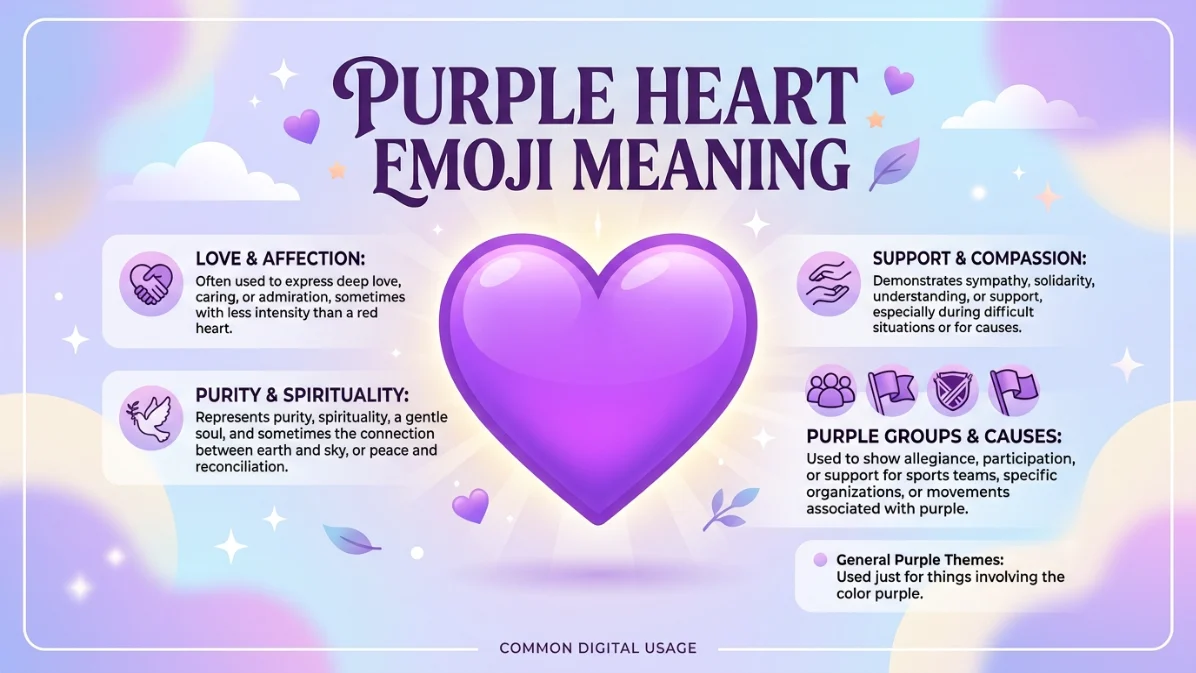

The purple heart emoji 💜 is a classic heart shape filled with purple. People most often use it to express affection, support, loyalty, or care in a way that feels warmer than neutral but usually less intensely romantic than the red heart ❤️.
Like other colored hearts, its exact meaning depends heavily on the conversation, the relationship between the people texting, and any shared references. It has no single fixed definition that applies everywhere.
Quick Answer :💜 typically signals positive feelings such as love, appreciation, or solidarity. It is frequently linked to BTS fans (“I purple you”), the U.S. military Purple Heart medal, and things connected to the color purple. Context decides whether it feels friendly, supportive, or more personal.
What the Purple Heart Emoji Usually Means
The official Unicode name is simply Purple Heart. It was approved in Unicode 6.0 in 2010 and added to Emoji 1.0 in 2015. On most platforms it appears as a solid purple heart, though earlier Android versions briefly rendered it closer to pink.
In everyday texting and social media, 💜 commonly conveys:
- Affection or appreciation that is genuine but not necessarily romantic
- Support or sympathy during hard times
- Loyalty or a close bond
- Love for something or someone associated with purple (sports teams, fashion, causes, or fandoms)
Purple has long been linked with royalty, creativity, and spirituality in broader culture, so the emoji can sometimes carry a slightly elegant or distinctive tone compared with other hearts. Still, most people use it simply as a friendly or caring heart in a different color.
How Context Changes the Meaning
Surrounding words and the existing relationship matter more than the emoji alone.
- Friendly or supportive: “Thinking of you today 💜” or “You’ve got this 💜” usually feels caring and solid without strong romantic intent.
- Close bonds or family: It often works as a softer alternative to ❤️ when someone wants to show love without the classic romantic weight.
- Fandom or shared interest: Among BTS ARMY fans it strongly references the phrase “I purple you” (and the Korean borahae), coined by member V in 2016. He described purple as the last color of the rainbow, representing lasting love and trust. In those circles the emoji carries special emotional weight.
- Military or honor: In the United States it can refer to the Purple Heart medal awarded to service members wounded or killed in action. Messages honoring veterans or sharing related news sometimes include 💜.
- Color-specific references: People use it for purple-themed teams (such as the Minnesota Vikings), fashion, or awareness days connected to purple.
- Playful or lighter tone: When mixed with other emojis or casual language, it can simply mean “I like this” or “sending good vibes.”
It is less commonly used for straightforward romantic declarations than the red or pink hearts, though individual couples or close friends may adopt it as their preferred heart.
Text Message Examples
Supportive message “I’m really sorry you’re going through this. Sending love 💜” Likely meaning: genuine care and empathy. The emoji softens the message and shows emotional presence.
Friendly appreciation “Thanks for always checking in on me 💜” Likely meaning: gratitude and closeness between friends or family. Feels warmer than a plain thank-you but not heavily romantic.
Fandom context “I purple you forever 💜” Likely meaning: the special BTS-related expression of lasting affection and loyalty within the ARMY community.
Casual reaction “That outfit is perfect 💜” Likely meaning: simple admiration or approval, often tied to liking the color or the overall vibe.
These are illustrative examples only. Real conversations depend on the people involved and prior history.
Related Heart Emojis and Their Meanings
| Emoji | Official Name | Common Meaning | Tone | Where or When It Is Used |
|---|---|---|---|---|
| 💜 | Purple Heart | Affection, support, loyalty, color purple | Caring, distinctive | Texts, fandom posts, supportive messages, military references |
| ❤️ | Red Heart | Classic love, strong affection | Romantic or deep | Romantic messages, close family, strong emotion |
| 🩷 | Pink Heart | Soft love, sweetness, playfulness | Gentle, affectionate | Flirty or cute texts, friendships, compliments |
| 💙 | Blue Heart | Trust, loyalty, calm support | Steady, reliable | Friendships, team support, cooler affection |
| 💛 | Yellow Heart | Friendship, happiness, positivity | Warm, light | Platonic messages, cheerful reactions |
| 💚 | Green Heart | Growth, health, sometimes envy or nature | Fresh, neutral-positive | Eco topics, wellness, casual support |
| 🧡 | Orange Heart | Enthusiasm, warmth, friendship | Energetic, friendly | Supportive chats, group enthusiasm |
| 🖤 | Black Heart | Dark humor, mourning, or edgy affection | Somber or ironic | Tough situations, alternative style, humor |
| 🤍 | White Heart | Pure or peaceful love, neutrality | Soft, clean | Supportive or spiritual messages |
The purple heart stands out mainly through its color associations and cultural links (especially BTS and the military medal). The red heart remains the default for intense or romantic love. Blue and yellow hearts lean more clearly toward friendship and calm support. Pink often feels softer or cuter. Choosing among them is usually about matching the exact emotional shade you want rather than following strict rules.
Is the Purple Heart Emoji Flirty?
It can feel mildly flirty if the rest of the conversation already has romantic energy, but it is generally milder than ❤️ or 🩷. Many people use it freely with friends, family, and acquaintances without romantic intent. Overinterpreting a single 💜 as a clear romantic signal often leads to misunderstanding. Look at the full message history and how the person usually communicates instead.
How to Respond to 💜
Match the tone of the original message:
- Supportive reply: “Thank you, that means a lot 💜” or “Appreciate you ❤️”
- Friendly reply: “Aww thanks 😊” or simply return a 💜
- Clarifying if unsure: Keep the conversation going naturally and see how they respond rather than assuming strong intent.
A simple matching heart or a short warm acknowledgment usually works well.
Frequently Asked Questions
What does 💜 mean from someone? It most often means they feel positively toward you—affection, support, or appreciation. The exact flavor depends on your relationship and the words around it.
Does the purple heart emoji mean the same as the red heart? Not exactly. Both express positive feelings, but ❤️ is more commonly associated with strong or romantic love, while 💜 frequently feels a step softer or more specific to color, fandom, or support.
Is 💜 only for BTS fans? No. While it is very popular within the BTS ARMY community, many people use it for general affection, support, or simply because they like purple.
Can 💜 refer to the military medal? Yes. In U.S. contexts it sometimes represents the Purple Heart awarded for wounds received in combat. Context usually makes this clear.
Brief Takeaway
The purple heart emoji 💜 is a flexible way to show care, loyalty, or appreciation. Its most distinctive associations are with BTS fans and the U.S. military medal, but everyday use simply treats it as a heart in a different color. Context, relationship, and surrounding words determine the precise feeling far more than any single fixed definition.