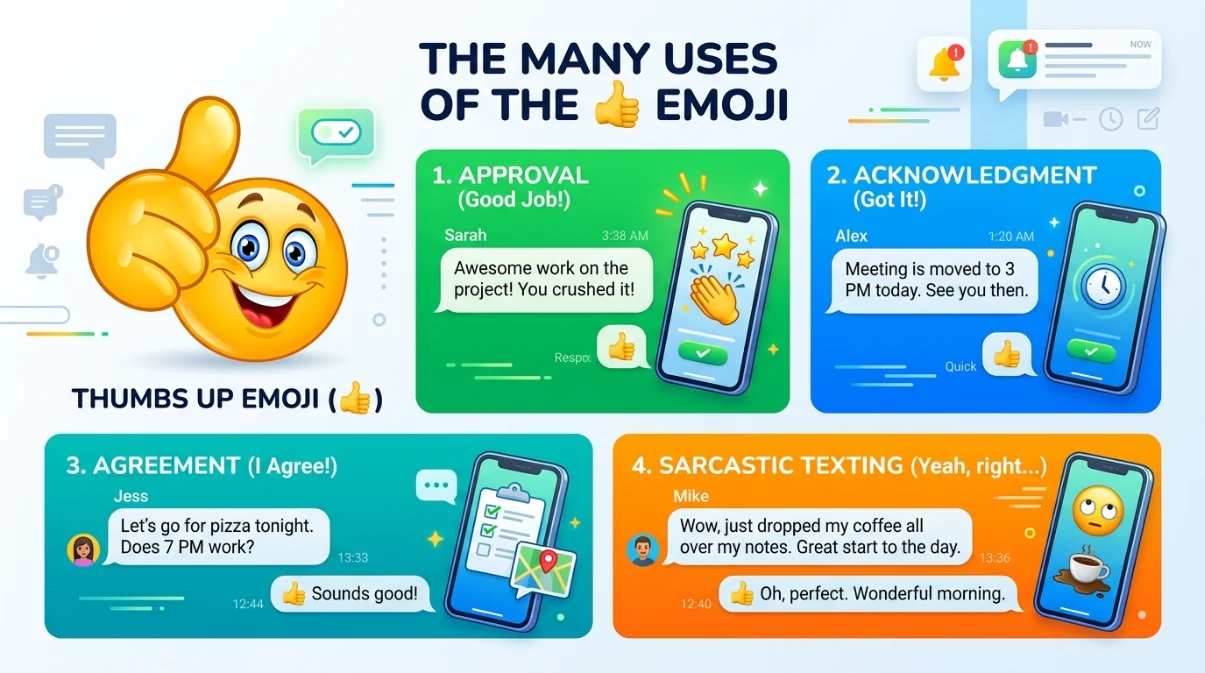

The 👍 thumbs up emoji most commonly expresses approval, agreement, acknowledgment, encouragement, or “okay.” It is often used as a quick response when a full sentence is unnecessary.
However, the same emoji can feel sarcastic, dismissive, or passive-aggressive in certain tense conversations. Emojipedia recognizes both its basic approval meaning and this contextual sarcastic use.
A thumbs up by itself therefore does not prove that someone is annoyed.
Quick Answer
👍 usually means:
- yes
- okay
- agreed
- good
- approved
- understood
- got it
- nice job
In a tense conversation, it can sometimes communicate a curt “fine” or sarcastic acknowledgment.
What Does 👍 Mean in Texting?
A thumbs up works especially well for simple confirmations.
“Can we meet at 6?”
“👍”
Likely meaning: yes.
“I emailed you the file.”
“👍”
Likely meaning: received or understood.
“Great job today 👍”
Likely meaning: encouragement or approval.
These are ordinary positive uses consistent with the gesture’s standard meaning.
Does 👍 Mean “Got It”?
Yes.
This is one of its most useful conversational functions.
If someone says:
“The door code is 4821.”
and you answer:
“👍”
you are likely communicating:
“I’ve got it.”
“I understand.”
“Okay.”
It can efficiently close a small conversational loop.
Is 👍 Rude?
Not automatically.
The emoji itself represents approval. But short responses can feel different depending on what the other person said.
Compare:
“Meeting moved to 10.” — “👍”
Perfectly normal.
Now compare:
“I’m really hurt by what happened.” — “👍”
The second response can feel emotionally cold because the situation calls for empathy rather than a simple acknowledgment.
The problem is not necessarily the emoji’s dictionary meaning. It is the mismatch between the emotional message and the brief response.
Can 👍 Be Passive-Aggressive?
Yes.
Emojipedia notes that the thumbs up can be interpreted as passive-aggressive or sarcastic in certain contexts, even though it remains widely used sincerely for approval.
For example:
“Fine, do whatever you want.”
“👍”
After an argument, the emoji might communicate resignation or sarcasm rather than enthusiastic approval.
Another example:
“Thanks for finally showing up on time 👍”
The wording already sounds sarcastic, so the emoji reinforces that tone.
Does 👍 Mean Someone Is Mad at You?
Not by itself.
If the person normally replies with thumbs-up reactions, there may be nothing unusual about it.
Look for stronger clues:
- Did you just argue?
- Is their wording unusually short?
- Did their normal texting style suddenly change?
- Is there clear sarcastic language?
- Does the conversation already contain tension?
Without those clues, interpreting 👍 as anger may be overthinking it.
Emojis Similar to 👍
| Emoji | Official Name | Common Meaning | Tone | Where or When It Is Used |
|---|---|---|---|---|
| 👍 | Thumbs Up | Approval, yes, acknowledgment | Positive or neutral | Quick replies, reactions |
| 👎 | Thumbs Down | No, disapproval | Negative | Disagreement, ratings |
| 👌 | OK Hand | Okay, good, acceptable | Casual, positive | Agreement and reassurance |
| ✅ | Check Mark Button | Correct, completed, confirmed | Practical | Tasks and confirmations |
| 🙌 | Raising Hands | Celebration, excitement | Enthusiastic | Good news and congratulations |
| 👏 | Clapping Hands | Applause, praise | Positive | Achievements and reactions |
| 🤝 | Handshake | Agreement, cooperation | Respectful | Deals and teamwork |
| 💯 | Hundred Points | Strong approval or emphasis | Enthusiastic | Praise and agreement |
If you want more enthusiasm than 👍 provides, 🙌, 👏, or words such as “Amazing!” may communicate the tone more clearly.
What Does 👍 Mean From Someone You Like?
It still usually means acknowledgment or approval.
For example:
“Had a great time tonight ❤️”
“👍”
may feel less romantic than you expected, but one reply still does not prove disinterest.
On the other hand:
“You looked amazing tonight 👍”
contains a compliment but is not automatically a confession of attraction.
Relationship meaning should come from the overall conversation.
How to Respond to 👍
Often, no response is necessary.
If you wrote:
“See you at 8.”
and receive:
“👍”
the conversation may already be complete.
If you need to continue:
“Perfect, see you then.”
If you think the sender is upset:
“Are we okay?”
is more reliable than trying to decode the emoji indefinitely.
Skin Tone Versions
Thumbs Up supports Unicode skin-tone modifiers, allowing users to select several skin-tone variants. The underlying communicative function remains the thumbs-up gesture. Unicode lists these standardized sequences in its emoji data.
Official Name and History
The official name is Thumbs Up. It was approved as part of Unicode 6.0 in 2010 under the name “Thumbs Up Sign” and added to Emoji 1.0 in 2015.
Frequently Asked Questions
What does 👍 mean from someone?
Usually “yes,” “okay,” “good,” “approved,” or “I understand.”
Is a thumbs up passive-aggressive?
It can be in a tense or sarcastic conversation, but it is not automatically passive-aggressive.
Is 👍 a rude reply?
Usually not. It may feel too brief when the message requires a more thoughtful emotional response.
Does 👍 mean someone does not want to talk?
Not necessarily. Many people simply use it as a fast acknowledgment.
Can 👍 mean sarcasm?
Yes, especially when paired with sarcastic wording or sent after disagreement.
Conclusion
The 👍 thumbs up emoji is primarily a quick sign of approval, agreement, or acknowledgment. It can also become sarcastic or passive-aggressive when the surrounding conversation is tense. Rather than assuming a negative meaning from the emoji alone, consider the message, situation, and sender’s normal communication style.