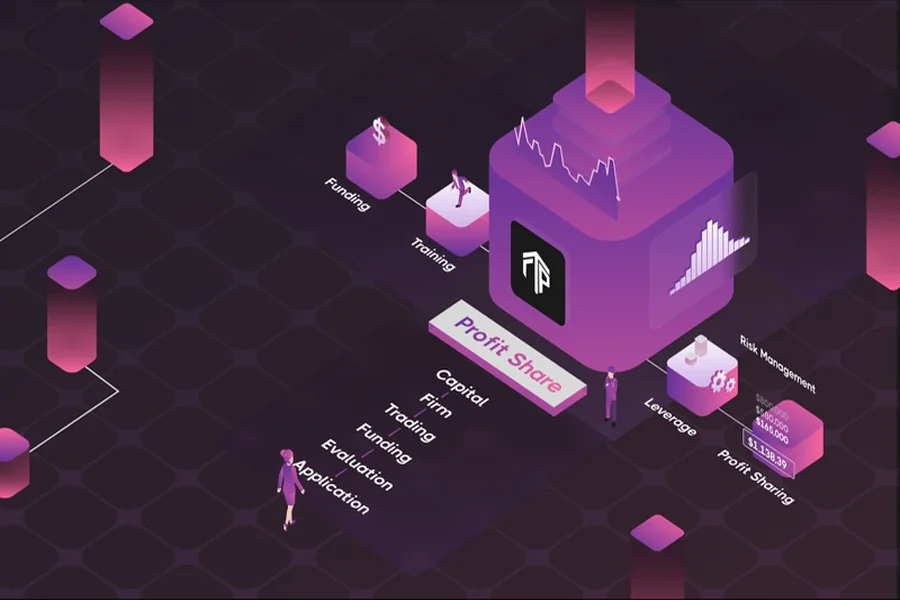

Cryptocurrency trading attracts traders looking to benefit from price movements across digital assets such as Bitcoin and Ethereum. However, trading with personal funds can expose individuals to significant financial risks, particularly in a volatile market. Proprietary trading, commonly known as prop trading, offers an alternative model in which traders demonstrate their skills through an evaluation process to qualify for access to a firm’s trading account.
A crypto trading platform designed for prop trading typically provides the tools and rules traders need to participate in challenges, monitor performance and manage risk. Understanding how this model works, what it costs and which conditions apply can help traders decide whether it aligns with their experience and financial goals.
What Is Crypto Prop Trading?
Crypto prop trading is a model in which a proprietary trading firm evaluates a trader’s ability to follow a strategy, control risk and generate consistent results. Traders generally complete an assessment or challenge before qualifying for a funded trading arrangement.
Unlike conventional cryptocurrency trading, where individuals buy and sell assets using their own capital, prop trading programmes may provide access to a simulated account with a specified balance. Traders must follow predetermined objectives, including profit targets and drawdown limits.
The exact structure varies by firm. Some programmes have one evaluation stage, while others require two stages. Certain firms also offer instant-funding options, which may have different fees, rules and reward structures.
How Does Crypto Prop Trading Work?
1. Choose a Trading Challenge
The process usually begins with selecting a challenge that matches the trader’s experience, preferred risk level and budget. Firms may offer several account sizes, each with a corresponding entry fee and performance requirements.
Before registering, traders should examine the rules carefully. These may include profit targets, maximum daily losses, overall drawdown limits, permitted trading strategies and payout conditions. Choosing a larger account does not automatically make trading easier or guarantee higher earnings.
2. Complete the Evaluation
During the evaluation stage, traders attempt to meet a specified profit target without violating risk limits. The purpose is to assess their ability to trade systematically rather than rely on a few unusually profitable positions.
For example, a challenge may require a trader to reach an 8% profit target while remaining within a daily loss limit. The actual percentages and conditions depend on the programme selected.
Some firms impose minimum trading-day requirements, while others allow traders to complete a challenge as soon as they meet its objectives. Traders should confirm these details before beginning.
3. Gain Access to a Funded Account
After successfully completing the required assessment stages, a trader may receive access to a funded account. However, it is important to establish whether the account uses real or simulated capital.
In a simulated model, trades are executed in a virtual environment using live market data, rather than directly placing the trader’s orders into the market. The firm may then calculate performance-based rewards according to its agreement.
Therefore, the term “funded account” does not always mean that the trader is directly managing real market capital. Reading the firm’s terms helps clarify how trades, rewards and withdrawals are handled.
4. Trade Within the Rules
Once qualified, traders must continue following the firm’s conditions. These can include restrictions on position sizes, leverage, holding periods, simultaneous trades and particular strategies.
Risk limits are especially important. A trader may be disqualified if the account crosses a maximum loss threshold, even when some positions remain open or the overall trading strategy has previously been profitable.
Maintaining a trading journal, using stop-loss orders where appropriate and avoiding oversized positions can help traders make more disciplined decisions.
5. Receive Performance-Based Rewards
Eligible traders may receive a percentage of the profits calculated under the programme’s rules. This arrangement is often called a profit split or reward split.
The percentage, payout schedule, minimum activity requirements and verification procedures vary between firms. Traders should also check whether fees are refundable, when withdrawals can be requested, and what circumstances could delay or prevent a payout.
Rewards are not guaranteed. A successful evaluation does not ensure that every subsequent trading period will be profitable.
Benefits and Risks of Crypto Prop Trading
One potential benefit is the opportunity to demonstrate trading skills without committing a large amount of personal trading capital. Simulated accounts can also encourage traders to follow structured risk-management rules and review their decisions against measurable objectives.
However, prop trading is not risk-free. Traders may lose the challenge fee if they fail to meet the requirements. Market volatility, emotional decisions and inconsistent strategies can make it difficult to achieve the targets. Even when personal trading capital is not directly exposed, time, fees and effort are still at stake.
A further consideration is the firm’s reliability and transparency. Traders should review the terms of service, payout policies, account structure and dispute-resolution process before paying for a challenge. They should avoid treating projected rewards as dependable income.
How to Choose a Suitable Crypto Prop Trading Firm
Choosing a firm requires more than comparing account sizes or advertised profit splits. Traders should assess the following factors:
- Transparent rules: Check profit targets, drawdown calculations, fees and disqualification conditions.
- Trading tools: Review charting features, supported assets, order types and platform reliability.
- Risk management: Understand leverage limits, position restrictions and loss thresholds.
- Payout conditions: Verify eligibility requirements, payout schedules and the firm’s review process.
- Account structure: Confirm whether trading takes place with real or simulated capital.
- Customer support: Check how the firm handles account questions, payment concerns and disputes.
Comparing these details can help traders make a more informed decision and avoid choosing a programme based solely on marketing claims.
Conclusion
Crypto prop trading provides a structured way for traders to demonstrate their abilities, follow predefined risk limits and potentially earn performance-based rewards. However, the model requires discipline, a tested strategy and a clear understanding of evaluation rules, fees and payout conditions. Anyone exploring prop trading USA options should also check the firm’s eligibility requirements, applicable regulations and service terms before participating.
Bitfunded is a crypto-focused proprietary trading firm that offers evaluation challenges and simulated trading accounts. According to its website, traders can access cryptocurrency and selected traditional-market pairs in a simulated environment, with performance-based rewards subject to programme rules. Prospective participants should review the current terms and verify all relevant conditions before deciding whether the programme suits their needs.