
Have you ever opened a job posting, scanned a text from a friend, or scrolled through social media only to see the acronym WFH pop up? If you find yourself wondering what it stands for, you are certainly not alone. Whether you are a job seeker trying to understand the modern labor market, a student navigating new communication styles, or just someone who wants to keep up with the latest digital shorthand, this term is essential to understand.
It has become a permanent fixture in our vocabulary, appearing in everything from casual group chats to formal professional contracts. Understanding this simple abbreviation helps you navigate the modern landscape of employment and lifestyle choices with confidence. In this article, we will break down exactly what this term represents, how it evolved, and how to use it correctly in your daily life. 🏠
Defining the WFH Acronym
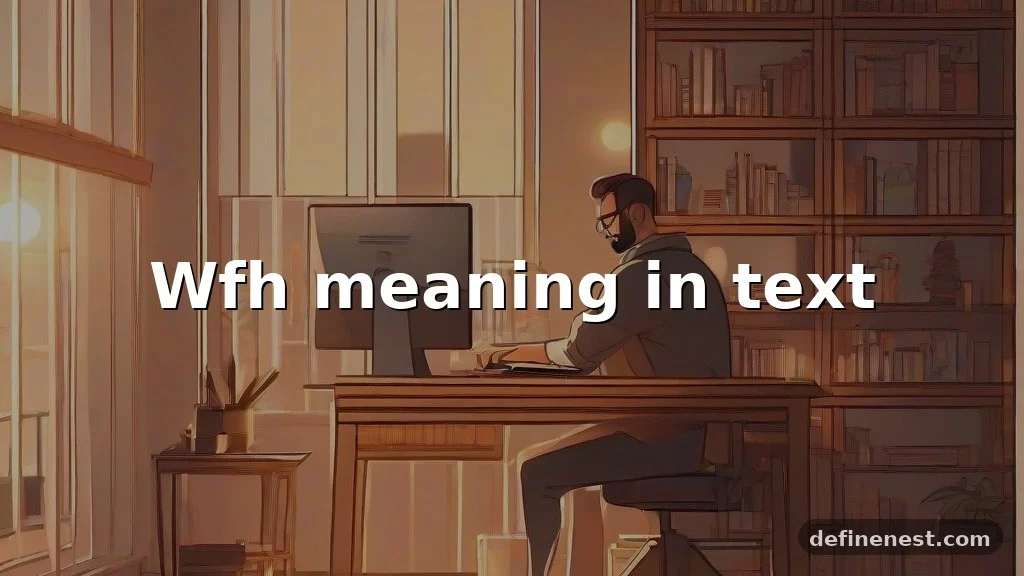
At its core, the acronym WFH stands for Work From Home. It is a simple yet powerful term used to describe a professional arrangement where an individual performs their job duties outside of a traditional corporate environment. Instead of commuting to a central headquarters, a cubicle, or a factory, the person completes their tasks from their own residence or a location of their choosing.
This phrase is more than just a label for a desk in a spare bedroom. It represents a shift in how we view productivity. For many, it means having a dedicated home office, while for others, it might mean working from a kitchen table or a neighborhood coffee shop.
Because the term is so brief, it is perfect for fast-paced digital communication. You will see it used in email subject lines, calendar invites, and quick instant messages. When someone says, “I am WFH today,” they are providing a clear update on their location and their availability.
It removes the guesswork from scheduling meetings or planning social interactions. Essentially, it communicates that you are reachable electronically, even if you are not physically present in the shared workspace. By adopting this shorthand, people save time and keep their communication efficient. 💻
The History and Evolution of Remote Labor
The concept of working away from a central office is not actually new, but the widespread use of the term WFH is a relatively modern phenomenon. Decades ago, the idea of a professional role being performed outside of a company building was rare and often reserved for specific creative or freelance positions.
During the late 20th century, the rise of the personal computer and the internet began to change the landscape. Suddenly, the physical distance between a worker and their files became less of a barrier.
However, the massive surge in the popularity of this term occurred during the global health events of the early 2020s. As offices closed their doors, millions of people transitioned to their homes overnight. The term WFH moved from being a niche corporate buzzword to a household phrase used by parents, teachers, and children alike.
It became part of our collective consciousness. Today, it has evolved even further to include the concept of hybrid arrangements. Many companies now offer a mix of office days and home days.
This shift has changed the way we design homes, the way we dress for work, and the way we balance our personal lives. You can find more information on the history and impact of these labor shifts through the Bureau of Labor Statistics, which tracks how employment trends affect the broader economy. 📈
How to Use the Term in Daily Conversations
Because WFH is a versatile acronym, it fits into many different social and professional settings. You might use it in a text message to a colleague, a post on a social media platform, or even in a casual conversation with a friend. The key is to keep it brief and relevant.
Consider these examples of how the term functions in natural dialogue:
“Hey, are you coming into the building tomorrow?”
“No, I have a WFH day scheduled to focus on my writing project.”
“Why didn’t you join us for lunch?”
“Sorry, I am WFH today, so I stayed near my house.”
“Do you think the team will switch to a hybrid model?”
“I hope so! I really enjoy the balance of WFH and office days.”
The acronym acts as a shorthand
In these instances, the acronym acts as a shorthand that saves time. It is particularly useful when you are typing on a mobile device where brevity is appreciated. Using the term effectively shows that you are comfortable with modern workplace terminology and that you understand the nuances of current labor trends. 📱
Common Misconceptions and Clarifications
One common misconception about WFH is that it means the person is not actually working. Some people mistakenly assume that being at home equates to taking a day off or being available for personal errands.
This is rarely the case. In a professional setting, WFH is a legitimate work status where the individual is expected to remain productive and responsive during business hours.
Another point of confusion is the difference between WFH and being a freelancer. While a freelancer might work from home, the acronym WFH is often used by employees who have a traditional contract with a company but are allowed to perform their duties remotely. It is also important to clarify that WFH does not necessarily mean “remote work” in every single context.
Remote work can imply working from anywhere in the world, while WFH specifically implies that the home is the base of operations. Understanding these subtle differences helps avoid misunderstandings during salary negotiations or when setting expectations with a manager. Always ensure your team understands your specific arrangement to keep communication clear. ⚠️
Similar Terms and Alternatives
The English language is full of synonyms for working away from the office. Depending on the setting, you might want to use a different phrase to be more precise. Here is a quick breakdown of how these terms compare:
| Term | Context |
|---|---|
| Remote | General, implies any non-office location |
| Telecommuting | Older, formal term for traveling via technology |
| Hybrid | Mix of office and home |
| Distributed | Used for teams spread across different cities |
| Digital Nomad | Someone who travels while working |
Using these alternatives can help you be more descriptive. For instance, if you are a manager, telling your team you are “remote” might sound more professional than just saying “WFH.”
If you are writing a resume, using “remote work experience” is usually preferred over using slang acronyms. Each term carries a slightly different vibe, so pick the one that matches your audience. 📋
Responding to WFH Updates
How you respond to someone mentioning their WFH status depends entirely on your relationship with them. If it is a professional contact, you should keep your response focused on work logistics. If it is a friend, you can be more casual.
Professional Response:
“Thanks for the update. I will send the files to your email so you can access them while you are WFH.”
Casual Response:
“Nice! Enjoy the extra time without the commute today.”
Funny/Lighthearted Response:
“WFH? Don’t forget to wear your pajama bottoms during the Zoom call!”
Privacy-Conscious Response:
“Understood. Let me know if you need any support while you are working remotely.
By tailoring your response, you show
By tailoring your response, you show emotional intelligence. You acknowledge the information provided without making the conversation awkward or overly formal when it doesn’t need to be. 💬
Regional and Cultural Variations
The term WFH is widely understood in English-speaking countries, but its usage can vary. In some cultures, the focus is more on the “remote” aspect rather than the “home” aspect. For example, in parts of Europe or Asia, people might prefer the term “teleworking” or “mobile work.”
In regions where English is a second language, the acronym WFH might not be as common in casual speech, though it is frequently used in international business environments. If you are communicating with someone from a different country, it is often safer to spell out “work from home” to ensure there is no confusion. Regional slang also plays a role.
In some places, people might say “home office” instead of using the acronym. Being aware of these cultural nuances prevents confusion and ensures that your message is received exactly as you intended. 🌍
Usage in Dating Apps and Online Communities
If you are active on dating apps or social media, you have likely seen WFH in profiles. On platforms like Tinder or Bumble, people often include this to show that they have a stable job and perhaps a flexible lifestyle. It can be a conversation starter.
In gaming communities or on Twitter, the term is often used to joke about the lifestyle. You might see memes about “WFH attire” or the struggles of balancing work with home life. When responding to someone who mentions they are WFH on a dating app, keep it light.
You could ask, “How do you like the work-from-home life?” or “Does your cat make a good coworker?” It is a low-pressure way to engage with someone and learn more about their daily routine. Just remember that in these settings, the tone should remain friendly and respectful of their professional boundaries. 🎮
Addressing Potential Misunderstandings
While WFH is generally harmless, context is everything. In some very formal or traditional industries, using acronyms can be seen as unprofessional if it is overused in a serious setting. If you are emailing a high-level executive or a client, it is usually better to write out “working from home” to maintain a polished appearance.
There are also rare instances where the term could be misinterpreted. For example, if you say “I am WFH” in response to a request for help, it might sound like you are using your location as an excuse to avoid a task. Always follow up with a clear statement about your availability or your plan to complete the work.
Tone matters significantly. By maintaining a professional and proactive attitude, you ensure that the term WFH is associated with productivity and reliability rather than laziness or evasion. 🛡️
Professional Communication Standards
When deciding whether to use WFH in a professional email or report, consider the company culture. Tech companies and startups often embrace the use of such acronyms, viewing them as efficient and modern. Conversely, law firms, banking institutions, or government bodies may prefer more formal language.
If you are unsure, err on the side of caution. A simple rule of thumb is to match the tone of the person you are communicating with. If they use the acronym in their emails to you, it is safe to use it back.
If they use formal, full-sentence language, you should mirror that approach. Professionalism is about clear, respectful, and effective communication.
Using the right term at the right time is a small but important part of that. Always prioritize clarity over speed when you are communicating with supervisors or external partners. 👔
Frequently Asked Questions
1. Is WFH an official business term?
Yes, it is widely recognized in business and human resources, though it is technically an abbreviation.
2. Can I use WFH in a formal contract?
It is better to use the full phrase “work from home” or “remote work arrangement” in legal documents to avoid any ambiguity.
3. Does WFH mean I have to be available 24/7?
No, WFH refers to your location, not your working hours. You should still adhere to your agreed-upon schedule.
4. Is there a difference between WFH and hybrid?
Yes. WFH usually implies working from home full-time, while hybrid implies a combination of office and home days.
5. Is WFH used in medical contexts?
In some medical literature, it might be used to describe the environment of a patient, but it is not a standard medical term.
Why do people use WFH instead
6. Why do people use WFH instead of just saying home?
It specifies that you are working, which is a crucial distinction for your colleagues and friends.
7. Is WFH considered professional?
It is perfectly professional in internal communications and modern business settings.
Summary and Key Takeaways
Understanding the acronym WFH opens up a world of clarity in your daily communications. Whether you are using it to explain your schedule to a teammate, chatting with friends about your day, or navigating the complexities of modern job hunting, knowing what this term means is a valuable skill. Remember that while the acronym is efficient, the context remains the most important factor in how it is perceived.
Always consider your audience, be mindful of your tone, and use the term to enhance your communication rather than replace full, thoughtful sentences. By mastering the use of this simple, three-letter abbreviation, you align yourself with the fast-paced, flexible, and digital-first nature of the modern world. Keep this guide in mind whenever you are unsure, and you will navigate the professional and personal landscape with ease and confidence. 🌟