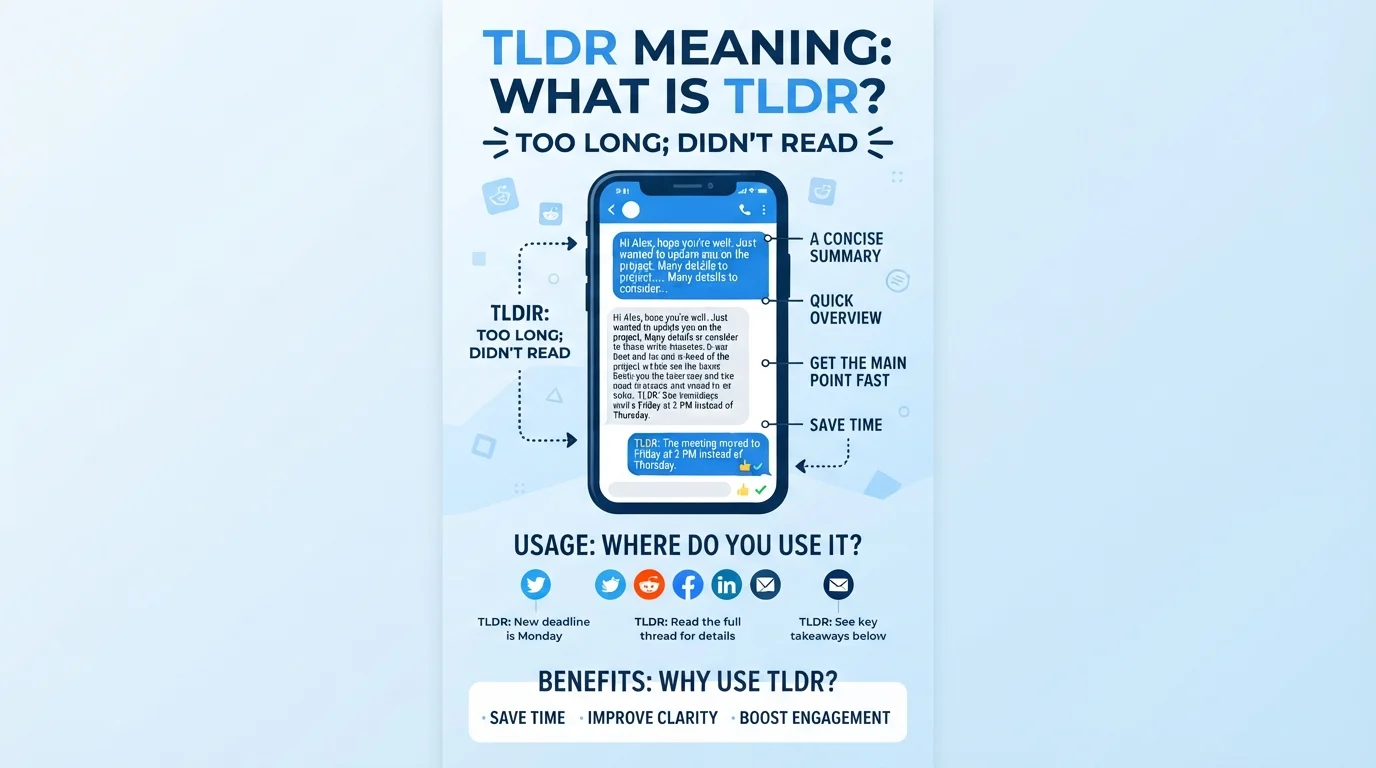

You read a long message, scroll halfway through it, and then see “TLDR:” followed by one short sentence. That shortcut has a simple purpose: TLDR means “too long; didn’t read.” It usually introduces a brief summary of a longer message, post, article, or discussion.
The phrase can sound blunt at first, but it isn’t automatically rude. Online, people often use TLDR to help readers understand the main point quickly. Your interpretation depends on who wrote it, what came before it, and how the phrase is used.
What Does TLDR Mean?
TLDR is an internet abbreviation for “too long; didn’t read.” It is commonly used in chats, social media posts, forums, emails, and online discussions to provide or request a short summary.
| Detail | Explanation |
|---|---|
| Most Common Meaning | Too Long; Didn’t Read |
| Full Form | Too Long; Didn’t Read |
| Common Use | Short summary of a longer message |
| Tone | Usually casual, neutral, or slightly humorous |
| Common Platforms | Texts, Reddit, Discord, social media, email, forums |
| Formal or Informal | Mostly informal |
For example:
TLDR: The project deadline was moved to Monday.
Here, the writer gives you the key information without making you read the entire explanation.
TLDR Meaning In Text And Online Chat
In text messages, TLDR meaning is usually straightforward. Someone may send a long explanation and then add a short summary at the end.
You might see:
TLDR: I can’t make it tonight, but I’m free tomorrow.
The abbreviation can also appear in a message from someone who wants you to summarize something:
TLDR this for me?
That means “Give me the short version.”
People generally use TLDR because they want to save time, highlight the important point, or make long information easier to scan. It doesn’t always mean the person literally refused to read something.
How TLDR Is Normally Used
TLDR can appear at the beginning or end of a message.
At the beginning, it acts like a quick answer:
TLDR: We are meeting at 3 PM instead of 2 PM.
At the end, it summarizes the details above:
The train was delayed because of a signal problem, so I arrived late.
TLDR: The train delay caused me to miss the meeting.
You may also see variations such as TL;DR, TLDR, or TL DR. The version with punctuation is especially common, but people often leave punctuation out in casual typing.
The meaning stays the same.
Does TLDR Have Another Meaning?
The established meaning is “too long; didn’t read.” However, people also use TLDR as a label for the summary itself.
For example:
TLDR: Save your work before restarting your computer.
In this use, TLDR doesn’t describe what the writer personally did. It simply signals, “Here is the short version.”
That distinction matters because the phrase has developed a practical function online. TLDR can describe both the original expression and the summary that follows it.
There is no need to invent a different full form just because the abbreviation appears in a different setting.
How Context Changes The Meaning
The words around TLDR help you understand the writer’s intent.
When It Introduces A Summary
TLDR: The restaurant closes at 10 tonight.
This is neutral and useful. The writer wants you to see the main point quickly.
When Someone Requests A Summary
I have to study this chapter. TLDR?
Here, the person is asking you to shorten the information.
When It Sounds A Little Blunt
TLDR your story?
Without any extra wording, this can sound impatient because the writer is openly asking for the short version.
When It Is Used Humorously
TLDR: I spent three hours fixing something that wasn’t broken.
The phrase can add a playful tone, especially when the summary jokes about the longer story.
Context, punctuation, emojis, and your relationship with the sender can all affect how the message feels.
TLDR Meaning On Different Platforms
The basic meaning stays consistent across major platforms, so you usually don’t need a platform-specific definition.
On text messages and WhatsApp, TLDR often introduces a quick summary of a long message.
On Reddit, Discord, and online forums, users frequently use it to summarize longer discussions, comments, or explanations.
On TikTok and Instagram, the abbreviation may appear in captions or comments when someone summarizes a longer story or explanation.
In gaming chats, TLDR can quickly reduce a long strategy explanation to its key instruction, such as:
TLDR: Push the left lane first.
The platform may change the context, but not the basic meaning.
Real Conversation Examples
Example 1: Friends
Person A: “I wrote you a huge message about what happened at the party.”
Person B: “TLDR?”
Meaning: Person B is asking for the short version.
Example 2: Group Chat
Person A: “The bus route changed, the pickup time moved, and we need to meet near the library instead.”
Person B: “TLDR: Library at 4?”
Meaning: Person B is confirming the main point in a shorter form.
Example 3: Online Discussion
Person A: “I tested three different settings and compared them for several days.”
Person B: “TLDR: Which setting worked best?”
Meaning: Person B wants the main result rather than the full explanation.
Is TLDR Rude?
TLDR is not automatically rude, but it can sound blunt in some situations.
When you use it to help someone find the main point, it is often neutral. When you write only “TLDR” after somebody shares something personal or detailed, it may sound dismissive.
For sensitive conversations, a softer phrase such as “Can you give me the short version?” may feel more considerate.
Your relationship with the person matters, too. Friends may use TLDR casually without any negative intention.
Is TLDR Flirty?
TLDR is not normally a flirty expression. Its meaning is about shortening information, not romantic interest.
However, flirting can still happen around the word depending on the conversation. A playful message such as “TLDR: I missed you” may carry a romantic tone, but the emotional meaning comes from the rest of the message.
The abbreviation itself does not signal flirting.
Is TLDR Offensive?
TLDR is generally not an offensive term or swear word.
Its tone can become negative when someone uses it to mock a long message, dismiss someone’s explanation, or avoid a serious conversation. The problem would be the context and attitude, not the abbreviation itself.
How To Reply To TLDR
Your response should match what the sender is asking.
Friendly Replies
- “Sure, TLDR: We’re meeting Friday.”
- “Yep. The main point is that plans changed.”
- “Basically, everything moved to tomorrow.”
- “Short version: I’ll handle it.”
Funny Replies
- “TLDR: I made a terrible decision.”
- “TLDR: Chaos won.”
- “TLDR: It started badly and got worse.”
- “TLDR: I should’ve stayed home.”
Replies When You Are Confused
- “Do you want a summary?”
- “Which part do you want me to shorten?”
- “Do you mean the quick version?”
These replies work better than guessing what the other person wants.
When To Use TLDR
TLDR works well in casual texts, group chats, social media, online communities, forums, and gaming conversations.
It is especially useful when a message contains several details but you want to make the main takeaway obvious.
You can also use it when summarizing information for busy readers. A short TLDR can help someone decide whether they need to read the full message.
The key is audience familiarity. Use the abbreviation when the people reading it are likely to understand it immediately.
When To Avoid TLDR
You don’t need to avoid slang completely, but clearer language can work better in formal settings.
Consider writing “Summary”, “Key Point,” or “In Brief” in professional emails, academic work, formal announcements, and client communication.
You should also be careful in sensitive conversations. If someone is discussing grief, conflict, a relationship problem, or another serious issue, a blunt “TLDR?” may come across as dismissive.
The goal is clarity without losing the right tone.
Common Mistakes About TLDR
| Common Mistake | Correct Understanding |
|---|---|
| Thinking TLDR always means the writer refused to read | It often introduces a summary rather than describing literal behavior |
| Assuming TLDR is always rude | Tone depends on context, wording, and relationship |
| Believing it has different full forms on each platform | The standard meaning remains “too long; didn’t read” |
Another common mistake is treating the abbreviation as a formal term. TLDR belongs mainly to informal online communication, even though the concept of giving a short summary is useful in professional writing too.
Similar Slang Terms
| Term | Meaning | Main Difference |
|---|---|---|
| TL;DR | Too Long; Didn’t Read | Usually labels or requests a summary |
| BTW | By The Way | Adds another piece of information |
| FYI | For Your Information | Shares information without asking for action |
| IMO | In My Opinion | Signals a personal viewpoint |
| IDK | I Don’t Know | Expresses uncertainty or lack of knowledge |
| IRL | In Real Life | Refers to offline life or situations |
These abbreviations can appear together in the same conversation, but each serves a different purpose.
Origin And Popularity Of TLDR
The exact first use of TLDR is difficult to pin down with certainty. The abbreviation developed within online communication as people looked for shorter ways to summarize lengthy posts and discussions.
Over time, TL;DR became recognizable across forums, social platforms, chats, and other internet communities. Different users may format it as TLDR, TL;DR, or TL DR, but the intended meaning is generally unchanged.
Rather than treating one spelling as the only correct version, focus on the context in which it appears.
Quick Recap
- TLDR means “too long; didn’t read.”
- It commonly introduces a short summary of a longer message.
- Someone can also write “TLDR?” to request the main point.
- The abbreviation is usually casual and isn’t inherently rude or offensive.
- Context determines whether it sounds helpful, blunt, funny, or dismissive.
- For formal communication, “Summary” or “In Brief” may be clearer.
Frequently Asked Questions
What does TLDR mean in text?
TLDR means “too long; didn’t read” and usually introduces or requests a short summary of lengthy information.
Is TLDR rude?
TLDR is usually neutral, but it can sound dismissive when used without care during serious or personal conversations.
What does TLDR mean on TikTok?
On TikTok, TLDR generally means “too long; didn’t read” and can introduce a brief summary in comments or captions.
How should you reply to TLDR?
You can reply with a concise summary, clarify what needs shortening, or provide the main point directly.
Can TLDR have different meanings?
TLDR usually has one established meaning, although people sometimes use it simply as a label for a summary.
Final Thoughts
The TLDR meaning is simple: “too long; didn’t read.” In everyday online communication, it usually points readers toward the shortest version of a longer message. You may also see someone use “TLDR?” when they want you to summarize something.
The abbreviation is generally casual and harmless, but tone still matters. A quick summary can be helpful in a group chat or forum, while the same wording may feel dismissive during a serious conversation. When you understand the context, relationship, and purpose behind the message, TLDR is easy to interpret and use naturally.