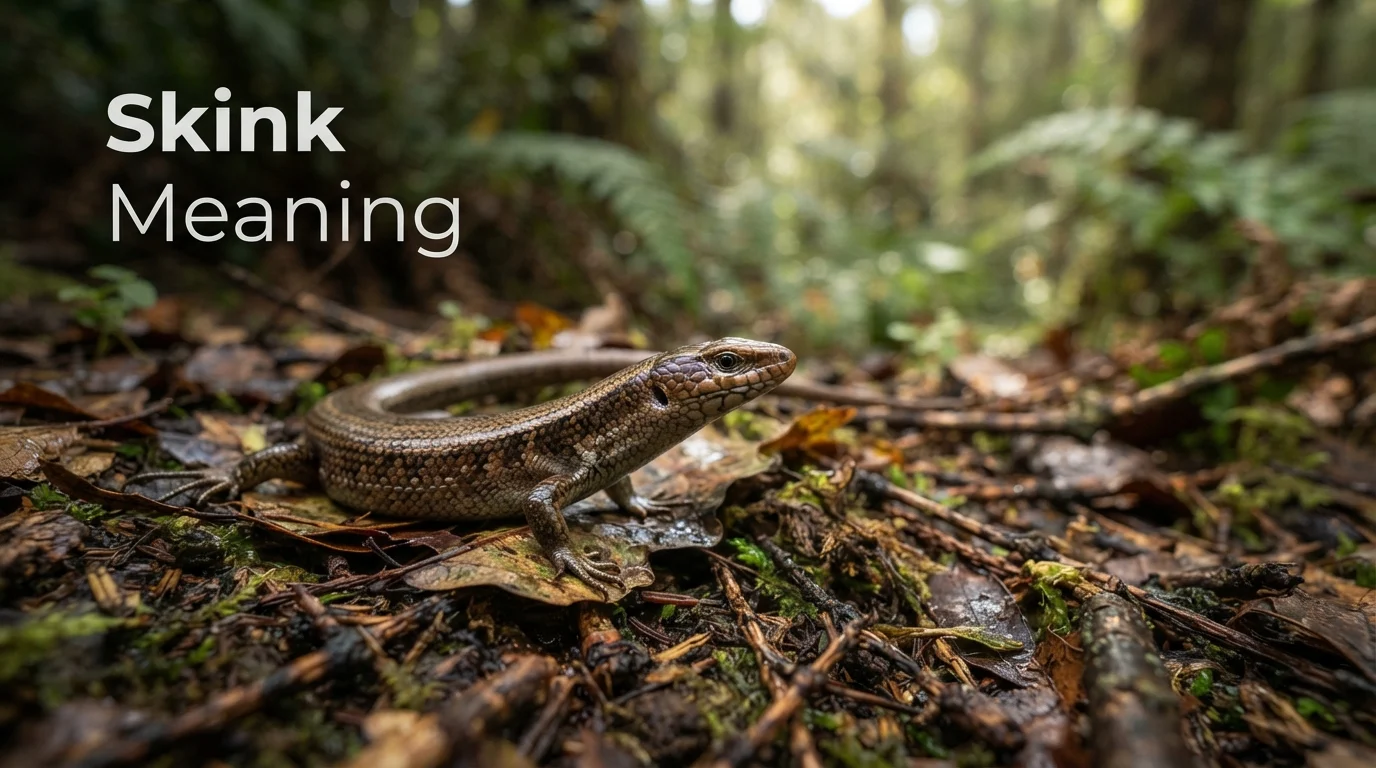

Someone may type “skink” in a message and leave you wondering whether it is slang, an abbreviation, or simply a word you have never seen before. Skink usually means a type of small to medium-sized lizard in the family Scincidae. It is a normal English word, not a standard texting abbreviation or acronym.
The meaning is usually straightforward when the conversation involves animals, nature, reptiles, pets, or wildlife. However, online conversations can make ordinary words look like slang. Below, you’ll see what skink means, how it appears in texts and social media, how to recognize the intended meaning, and which terms people sometimes confuse with it.
What Does Skink Mean?
Skink refers to a group of lizards known for their elongated bodies, smooth-looking scales, and relatively short legs in many species. Skinks come in many sizes and appearances, so the word does not describe one single species.
| Detail | Explanation |
|---|---|
| Most Common Meaning | A type of lizard |
| Full Form | None; skink is an ordinary word, not an acronym |
| Tone | Neutral |
| Common Contexts | Animals, wildlife, pets, nature, social media |
| Formal or Informal | Standard English word |
For example, someone might text:
“I saw a skink near the backyard fence.”
Here, the sender is simply talking about a lizard. There is no hidden abbreviation or special slang meaning.
Skink Meaning in Text and Chat
When you see skink meaning in text, the safest interpretation is still the literal animal. Unlike expressions such as “LOL,” “TBH,” or “WYLL,” skink does not normally stand for a longer phrase.
A message might say:
“There was a tiny skink under my porch.”
That sentence clearly refers to an animal.
The word can also appear in casual conversation about reptiles. Someone could mention seeing one outdoors, keeping certain reptiles, identifying an animal from a photo, or discussing a nature trip.
Context becomes especially useful when a message contains little information. If someone simply sends “skink,” they may be naming an animal, reacting to an image, answering a trivia question, or referring to something visible nearby.
Is Skink Slang?
Skink is not generally recognized as mainstream texting slang. It is primarily a standard noun used for a type of lizard.
That distinction matters because internet users sometimes assume every unusual word has a hidden slang definition. A term can appear in memes, usernames, comments, gaming communities, or private jokes without gaining a universal meaning.
For example, if a friend sends you a photo of a reptile with the caption:
“Found a skink!”
the meaning is almost certainly literal.
If the word appears in an unrelated joke, the sender may have a personal or context-specific meaning. In that situation, the surrounding conversation matters more than the word alone.
How Context Changes the Meaning
The easiest way to understand skink meaning is to look at the words around it. The subject of the conversation usually gives you the answer.
Animal or Nature Context
“What kind of lizard is that?”
“I think it’s a skink.”
Here, skink clearly identifies an animal.
Social Media Photo
“Posted this little guy from my hike.”
“That looks like a skink.”
The commenter is using the word to identify or describe the reptile.
Pet Conversation
“My cousin keeps reptiles.”
“Does she have a skink?”
Again, the meaning is literal and related to animals.
Unclear One-Word Message
“Skink.”
A one-word message gives you less information. You may need to look at the previous messages, image, meme, or conversation topic before deciding what the sender intended.
This is why punctuation, emojis, and timing can matter. A message like “Skink 😂” might be reacting humorously to an animal photo, while “Is this a skink?” is clearly asking for identification.
What Does Skink Mean on Different Platforms?
The meaning generally does not change dramatically across major social platforms. Unlike platform-specific slang, skink normally keeps its literal meaning.
Text Messages
In ordinary texting, skink usually refers to the lizard.
Example: “There’s a skink in the garage.”
TikTok
On TikTok, skink can appear in wildlife videos, reptile content, educational clips, or humorous animal posts. There is no broadly established TikTok-only meaning that replaces the standard definition.
Example: “This skink has such a cool pattern.”
Snapchat
On Snapchat, someone may use skink while sharing a picture or video of a reptile they spotted.
Example: “Guess what I found outside? A skink.”
Instagram users may use the word in captions, comments, or reptile-related posts.
Example: “Spotted this skink during our walk.”
In all four cases, the surrounding content usually makes the intended meaning obvious.
Real Conversation Examples
Example 1: Friends
Person A: “Did you see that lizard by the steps?”
Person B: “Yeah, I think it was a skink.”
Meaning: Person B is identifying the lizard as a skink.
Example 2: Social Media
Person A: “What animal is this? I’ve never seen one like it.”
Person B: “Looks like a skink to me.”
Meaning: Person B is suggesting that the animal shown is a skink.
Example 3: Casual Chat
Person A: “My brother wants a reptile for his room.”
Person B: “A skink could be one option.”
Meaning: Person B is discussing a type of lizard as a possible pet.
Is Skink Rude?
Skink is normally neutral and not considered a rude word. Its standard meaning simply describes an animal.
Tone can change when people use animal names as insults, but that is different from the ordinary definition of the word. If someone uses “skink” while criticizing a person, the surrounding sentence would determine whether they are making a personal insult or using an inside joke.
For example:
“You really look like that skink meme 😂”
This could be playful teasing between friends rather than a standard slang expression.
The relationship between the speakers, the wording, and emojis can change how such a message feels.
Is Skink Flirty?
Skink does not have a widely recognized flirty meaning in texting. If someone uses it during a romantic conversation, the term itself does not automatically signal attraction.
A playful meaning could exist inside a specific relationship or private joke, but you should not assume a romantic message from the word alone.
Is Skink Offensive?
The word skink is not inherently offensive. It is simply the common name for a group of lizards.
However, any ordinary word can become part of an insult when someone deliberately uses it to mock another person. That interpretation comes from the sentence and situation, not from a standard slang definition of skink.
How to Reply to Skink
Your response should match the context rather than treating skink like an abbreviation.
Friendly Replies
- “Oh, really? What did it look like?”
- “Nice! Did you get a picture?”
- “I’ve seen a few around here too.”
- “Was it a small one?”
These work well when someone is sharing an animal sighting.
Funny Replies
- “Sir, that tiny reptile pays no rent.”
- “Okay, wildlife photographer, I see you.”
- “That skink just became the star of your day.”
These replies fit playful conversations where the animal is part of a joke.
Replies When You Are Confused
- “Do you mean the lizard?”
- “What do you mean by skink?”
- “Are you talking about an animal?”
These are useful when the message has no surrounding context.
When to Use the Term
You can use skink naturally in casual conversations about reptiles, hiking, gardening, wildlife, pets, nature photography, or animal identification.
It also works perfectly well in educational writing when you’re discussing these lizards. Because skink is a standard English word, you do not need to avoid it simply because the conversation is informal.
The main consideration is clarity. If you’re speaking with someone who may not know the term, adding “a type of lizard” can make your meaning immediately clear.
For example:
“I saw a skink, which is a type of lizard, near the trail.”
That wording removes any confusion.
When to Avoid the Term
There is no broad rule saying skink must be avoided in formal communication. In fact, the word can be completely appropriate in scientific, educational, or wildlife-related writing.
You may want to use a short explanation when addressing an unfamiliar audience. In a professional email unrelated to animals, replacing it with something clearer may make more sense simply because the word is irrelevant to the topic.
The issue is not formality. Relevance and clarity matter more.
Common Mistakes
| Common Mistake | Correct Understanding |
|---|---|
| Assuming skink is an acronym | It is normally the name of a type of lizard |
| Treating it as universal slang | It does not have one widely recognized texting slang meaning |
| Assuming it is rude | The standard word is neutral |
| Confusing it with another similar word | Context helps distinguish skink from terms such as skank or generic lizard names |
One especially common mistake is assuming skink has a secret full form. It does not. Adding an invented phrase to the word can create confusion and misinformation.
Similar Terms to Skink
| Term | Meaning | Main Difference |
|---|---|---|
| Lizard | Broad group of reptiles | More general than skink |
| Gecko | A type of lizard | Refers to a different group of lizards |
| Chameleon | Specialized lizard group | Often known for color-changing abilities |
| Skank | A slang term with a different meaning | Similar spelling but unrelated to skink |
The difference between skink and skank is particularly worth remembering. They look somewhat similar when typed quickly, but they are not interchangeable words.
A skink is an animal. Skank has separate slang uses and should not be treated as a variation of skink.
Origin and Popularity
There is no clear need to assign an internet slang origin to skink, because its primary use is not a modern abbreviation or social-media expression.
The word belongs to established English vocabulary for lizards in the skink family. Online usage simply carries that ordinary meaning into newer communication formats, including text messages, captions, comments, and posts.
Claims that skink is a newly created texting acronym or viral abbreviation should be treated cautiously unless the specific community provides clear context.
Quick Recap
- Skink usually means a type of lizard.
- It is not a standard texting acronym or abbreviation.
- The word normally has a neutral tone.
- Texts, TikTok posts, Snapchat messages, and Instagram captions usually keep the literal meaning.
- Context becomes essential when someone sends the word without explaining what they mean.
- If you’re confused, simply ask whether they mean the lizard.
Frequently Asked Questions
What does skink mean in text?
In text, skink usually means the small lizard, unless the sender clearly provides another context.
Is skink rude?
No, skink is not a standard rude expression; it normally names an animal.
What does skink mean on TikTok?
On TikTok, skink generally keeps its literal animal meaning rather than having a widely recognized platform-specific definition.
How should you reply to skink?
Reply naturally by asking what they mean if the word appears without clear animal-related context.
Can skink have different meanings?
Yes, skink can appear differently in dictionaries or communities, but the lizard meaning is the main modern use.
Final Thoughts
The skink meaning is usually simple: it refers to a type of lizard. Unlike many internet terms, it is not normally an acronym, texting shortcut, or platform-specific slang expression. When you see the word in a message, photo caption, or social media comment, the surrounding context will usually confirm the intended meaning.
If the conversation involves reptiles, wildlife, pets, hiking, or animal photos, the literal definition is the natural choice. When the context is unclear, asking a quick clarification is better than guessing.