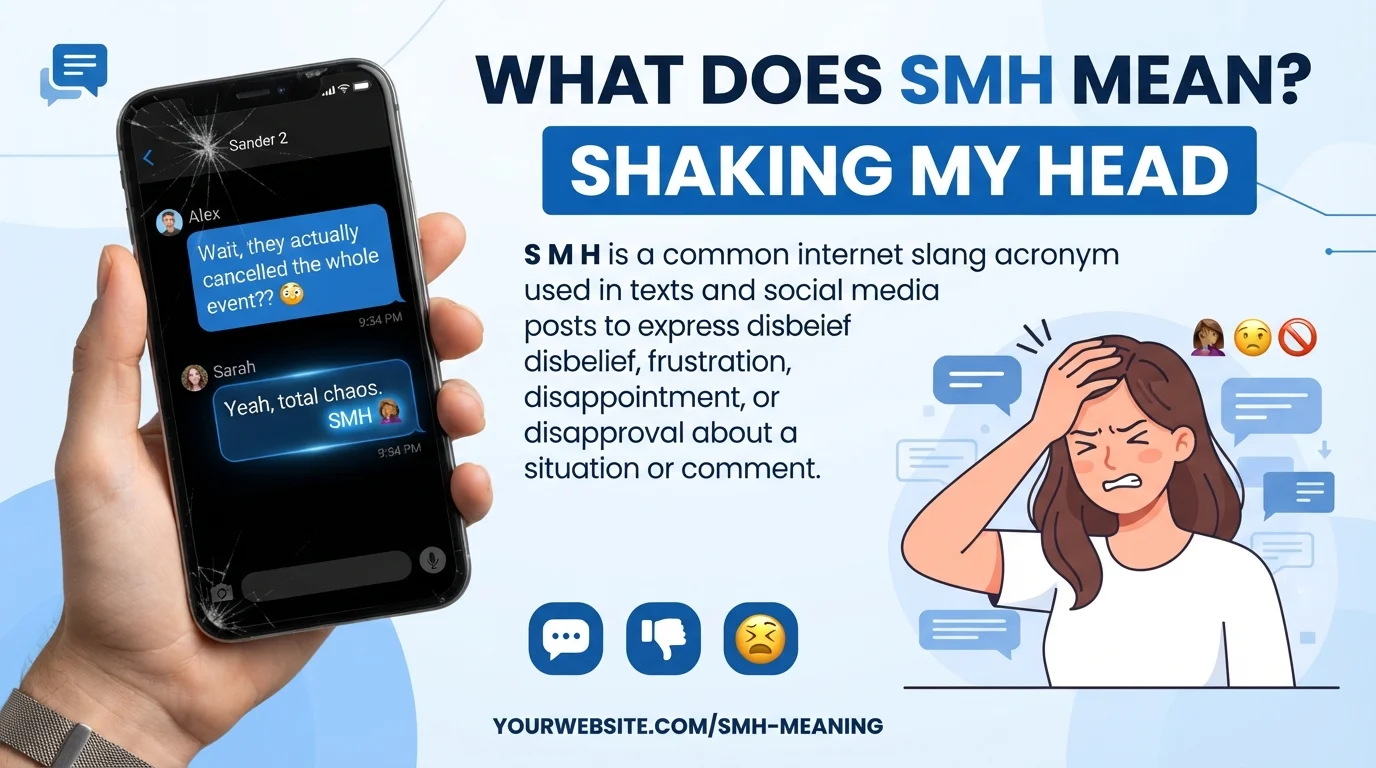

You receive a text that says, “You forgot your keys again… smh,” and suddenly you’re wondering whether the person is joking, annoyed, or both. The smh meaning is usually “shaking my head.” People use it in texts, comments, and online conversations to show disbelief, disappointment, frustration, or mild disapproval.
The exact tone depends on what happened and how the message is written. A friend may use “smh” as a playful reaction, while someone else may use it to express genuine annoyance. Below, you’ll see what SMH means, how it works in different contexts, how to reply, and when it’s better to use clearer wording.
What Does SMH Mean?
SMH stands for “shaking my head” or, in some uses, “shake my head.” It describes the familiar gesture people make when they cannot believe something, disagree with it, or feel frustrated by it. Cambridge Dictionary defines SMH as an abbreviation used in texts and social media when someone does not believe or approve of something.
| Detail | Explanation |
|---|---|
| Most Common Meaning | Shaking my head |
| Full Form | Shaking my head |
| Tone | Disappointed, frustrated, disapproving, amused, or sarcastic |
| Common Platforms | Texting, social media, group chats, comments |
| Formal or Informal | Informal |
For example:
“You seriously watched the whole movie without me smh.”
Here, SMH shows playful disappointment. The sender probably isn’t furious. They’re reacting to something that seems silly or inconsiderate.
How People Use SMH in Conversation
The meaning of SMH often comes from the emotion behind the reaction. It can express frustration, disbelief, disappointment, embarrassment, or simple amusement.
Someone might write:
“He brought the wrong charger again. SMH.”
That message suggests frustration.
Another person might say:
“I just walked into the wrong classroom smh 😂.”
Now the tone is more self-deprecating and funny.
SMH can appear at the beginning, middle, or end of a sentence. You may see it as smh, SMH, or smh…. Capitalization usually does not change the basic meaning, but punctuation and emojis can affect the emotional tone.
How Context Changes the SMH Meaning
Context matters because SMH does not automatically mean someone is angry.
Look at the surrounding message, the relationship between the speakers, and the situation.
Example 1
Person A: “I accidentally ordered 12 pizzas.”
Person B: “SMH 😂”
Meaning: The response is probably playful disbelief.
Example 2
Person A: “I never submitted the application.”
Person B: “smh…”
Meaning: The sender likely feels disappointed or frustrated.
Example 3
Person A: “He said the Earth is flat.”
Person B: “SMH.”
Meaning: The sender strongly doubts or disapproves of the statement.
Example 4
Person A: “I left my phone in the fridge.”
Person B: “SMH, how do you even do that?”
Meaning: The phrase adds humorous disbelief rather than serious criticism.
Emojis are especially useful here. A laughing emoji can soften SMH, while a period or ellipsis can make it sound more serious.
Is SMH Rude?
SMH can sound rude, but it is not inherently rude. The tone depends heavily on the relationship and the situation.
Among close friends, it may be teasing:
“You forgot your own birthday plans? SMH 😂”
In a tense conversation, it can sound dismissive:
“You still don’t understand? SMH.”
That second example can make the other person feel criticized.
For this reason, avoid assuming that a friendly meaning will carry over into every conversation. Familiarity, wording, punctuation, and emotional context all matter.
Is SMH Flirty?
SMH is not normally a flirty expression. It can appear in playful conversations between people who are flirting, but the abbreviation itself does not communicate romantic interest.
For example:
“You’re really going to make me pick the restaurant again? smh 😂”
That could be playful flirting, but the flirtation comes from the broader interaction rather than SMH itself.
Is SMH Offensive?
SMH is generally not a swear word or inherently offensive term. However, it can feel insulting when someone uses it to mock, belittle, or dismiss another person.
A message like “smh, you’re hopeless” carries a sharper tone than simply “smh 😂.”
The words around the abbreviation often matter more than the abbreviation itself.
SMH on TikTok, Snapchat, Instagram, and WhatsApp
The SMH meaning usually stays the same across major social platforms and messaging apps. It commonly means “shaking my head” and signals disbelief, frustration, disappointment, or exasperation. Dictionary.com also describes it as internet slang used to express feelings such as disappointment, disapproval, frustration, or impatience.
On TikTok, it may appear in captions or comments reacting to a surprising or ridiculous video.
On Snapchat, someone might send “smh” as a quick reaction to a friend’s message.
On Instagram, it can appear in comments when users disagree with or laugh at something.
On WhatsApp, it is common in casual one-to-one chats and group conversations.
The platform changes the setting, but not usually the core definition.
Other Meanings of SMH
The dominant internet slang meaning is “shaking my head.” A few less common interpretations exist, but they should not be assumed without context.
| Meaning | Context | Tone | Example |
|---|---|---|---|
| Shaking My Head | Texting and social media | Disbelief or frustration | “You did that again? SMH.” |
| Scratching My Head | Uncommon informal use | Confusion | “SMH, I can’t figure this out.” |
| So Much Hate | Rare slang use | Disdain or negativity | “There’s so much hate online, smh.” |
The first meaning is overwhelmingly the one readers should consider when they encounter SMH in ordinary texting or social media. Rare interpretations require stronger contextual clues.
SMH can also appear in contexts unrelated to internet slang. For example, SMH is associated with the initials of the Sydney Morning Herald. That is a completely different use and would normally be obvious from a news or media context.
Real Conversation Examples
Friends
Person A: “I left my wallet at home again.”
Person B: “SMH 😂”
Meaning: The friend is teasing them about making the same mistake again.
Group Chat
Person A: “Our meeting starts at 8. I thought it was 10.”
Person B: “SMH, read the group chat.”
Meaning: The response shows mild frustration or disbelief.
Social Media
Person A: “Someone posted a recipe and forgot to include the main ingredient.”
Person B: “SMH.”
Meaning: The commenter is reacting to something they find ridiculous or poorly done.
How to Reply to SMH
Your best response depends on whether the sender is joking, annoyed, or genuinely confused.
Friendly Replies
Try these when the conversation is casual:
“I know, I know 😂.”
“Don’t judge me.”
“I swear it made sense at the time.”
“Okay, I deserved that one.”
Funny Replies
Use humor when the sender is clearly teasing:
“Please save your judgment for later.”
“My brain clocked out today.”
“I’m choosing chaos, apparently.”
“SMH right back at you.”
Replies When You Are Confused
When you cannot tell what they mean, ask directly:
“Wait, what did I do?”
“Are you joking or actually annoyed?”
“What part are you shaking your head at?”
These replies are useful because they clarify tone instead of turning a small misunderstanding into a bigger one.
When to Use SMH
SMH works best in casual digital conversations where the other person understands internet slang.
You can use it with friends, classmates, relatives you regularly text, group chats, social media comments, gaming communities, and familiar online contacts.
It is especially useful when a simple “I can’t believe this” feels too formal or too long.
For example:
“You seriously forgot the password again? smh.”
The abbreviation keeps the reaction brief while adding emotional tone.
When to Avoid SMH
Clearer language is usually better in professional emails, job applications, academic writing, formal announcements, and client communication.
It can also be risky in sensitive conversations. If someone is discussing a serious mistake, personal problem, or emotional issue, “SMH” may sound dismissive even when you intended humor.
When the audience may not know internet slang, write the actual thought instead.
For example, instead of:
“SMH, this process makes no sense.”
a workplace message could say:
“I’m confused by this process and would appreciate some clarification.”
That communicates the same concern with much less room for misunderstanding.
Common Mistakes About SMH
| Common Mistake | Correct Understanding |
|---|---|
| Assuming SMH always means anger | It can also express amusement, disbelief, disappointment, or mild frustration. |
| Treating SMH as automatically rude | Tone depends on wording, relationship, punctuation, and situation. |
| Believing every unusual expansion | “Shaking my head” is the standard meaning; rare alternatives need clear context. |
Another common mistake is reading SMH in isolation. A single abbreviation rarely tells you the speaker’s complete emotional intent.
Similar Slang Terms
| Term | Meaning | Main Difference |
|---|---|---|
| SMDH | Shaking my damn head | Usually stronger or more emphatic than SMH |
| SMFH | Shaking my fucking head | A much stronger, profane version |
| Facepalm | Reaction to something embarrassing or ridiculous | Often emphasizes embarrassment or disbelief |
| WTF | What the fuck | Stronger surprise, confusion, or outrage |
| IDK | I don’t know | Expresses uncertainty rather than disapproval |
These terms can overlap emotionally, but they are not interchangeable in every sentence.
Origin and Popularity
The exact origin of SMH is uncertain, as is the case with many internet abbreviations. Dictionary.com notes that the expression emerged in digital communication during the 2000s and later became common in internet culture.
Its meaning comes directly from the physical gesture of shaking your head, which commonly signals disagreement, disbelief, or disapproval.
Rather than relying on a supposed creator or single invention date, it is more accurate to describe SMH as slang that developed through online and text-based communication.
Quick Recap
SMH usually means “shaking my head.”
It expresses disbelief, frustration, disappointment, disapproval, or playful amusement.
The tone can change depending on punctuation, emojis, wording, and the relationship between speakers.
It works best in casual texts, chats, comments, and familiar online conversations.
When replying, match the sender’s tone or ask for clarification if the message feels ambiguous.
Frequently Asked Questions
What does SMH mean in text?
SMH means “shaking my head,” expressing disbelief, frustration, disappointment, or disapproval in casual digital communication.
Is SMH rude?
SMH is not inherently rude, but it can sound dismissive or insulting when used during tense or sensitive conversations.
What does SMH mean on TikTok?
On TikTok, SMH usually means “shaking my head” and reacts to something surprising, frustrating, ridiculous, or disappointing.
How should you reply to SMH?
You can reply playfully, explain yourself, or ask what prompted the reaction when the intended tone is unclear.
Can SMH have different meanings?
SMH usually means “shaking my head,” although uncommon alternative interpretations exist in specific contexts.
Final Thoughts
The smh meaning is straightforward: “shaking my head.” People use it as a quick written reaction to disbelief, frustration, disappointment, or something they find ridiculous. Still, the abbreviation does not carry exactly the same emotional weight in every conversation. A laughing emoji can make it playful, while a serious sentence can make it sound critical. Use SMH with people who understand casual internet slang, and choose clearer wording when the situation is formal or sensitive. When you see it in a message, read the surrounding words before deciding what the sender really means.