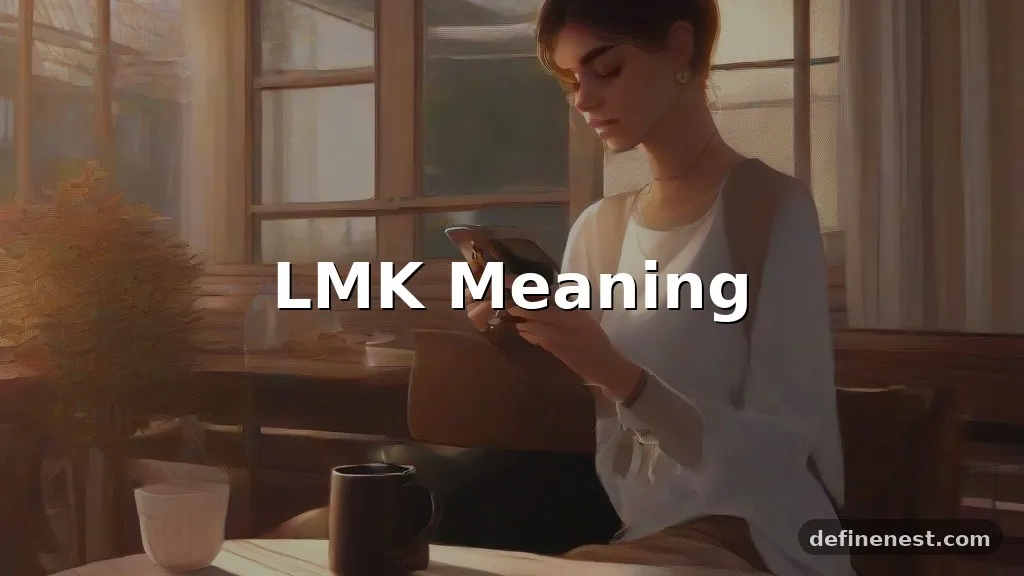

Ever received a text that ends with “LMK” and wondered what it means? You are not alone. LMK is one of those common texting abbreviations that can feel confusing when you first see it. The good news is that its meaning is simple.
LMK means “Let Me Know.” People use it in texts, chats, comments, DMs, and social media when they want someone to share information, make a decision, or give an update. For example, a friend might text, “LMK when you get home.” This simply means, “Let me know when you get home.”
In everyday digital communication, LMK is usually casual and friendly. It can be used between friends, coworkers, classmates, and online contacts, depending on the situation. This guide explains LMK meaning in text, its full form, how people use it, what it means in different conversations, and easy examples you can understand right away.
Definition & Meaning of LMK
LMK is a texting abbreviation that means “Let Me Know.”
It is used when someone wants another person to provide information, give an answer, confirm something, or share an update.
Example:
“LMK if you’re free tonight.”
Meaning:
“Let me know if you’re free tonight.”
In simple words, LMK is a quick way to ask someone to tell you something later or respond when they have an answer.
Full Form and Meaning of LMK
LMK Full Form: Let Me Know
LMK Meaning: A casual way of asking someone to give you information, an answer, confirmation, or an update.
Example:
“LMK what time you’re coming.”
Meaning:
“Let me know what time you’re coming.”
It is commonly used in text messages, WhatsApp chats, Instagram DMs, Snapchat, TikTok comments, and other online conversations.
Definition and Core Meaning of LMK
The term lmk is a very common abbreviation used in digital spaces. It stands for the phrase let me know. In its simplest form, it is a request for information or a confirmation.
When someone sends this to you, they are asking you to provide an update in the future. It is a way to keep a conversation open without demanding an immediate answer. This makes it a very flexible tool for social planning and information gathering.
People use it because it is much faster to type three letters than the full three words. In the world of fast texting, every second counts. This term serves as a placeholder for a future decision.
You can use this term in many different ways. It often appears at the end of a sentence. For example, someone might say, “I am going to the movies tonight, lmk if you want to come.”
In this case, the person is giving you an invitation. They are not forcing you to say yes or no right this second. They are simply asking for an update when you have made up your mind.
It removes the pressure from the interaction. It suggests that the sender is being casual and flexible.
This is why it is so popular among friends and family. It signals a low-stress request for feedback.
The meaning can also shift slightly depending on the context. Sometimes it is used as a way to end a conversation that has reached a stalemate. If two people cannot decide where to eat, one might say, “I’ll be home all evening, so just lmk what you decide.”
Here, the term acts as a hand-off. The responsibility for the next step in the communication has been moved to the other person.
It is a polite way to say that you are waiting on them. Understanding this nuance helps you navigate social expectations more effectively.
Background and History of the Abbreviation
The history of this term is tied closely to the history of the internet itself. It did not appear out of thin air. It grew out of a need for efficiency.
In the early days of the internet, people used chat rooms and bulletin board systems. These platforms often had character limits. Even when they did not, typing was slower on older keyboards.
Users began to shorten common English phrases to save time. This is where many famous acronyms like LOL or BRB started.
The term lmk followed a similar path. It became a staple of early writing in digital spaces because it was so practical.
When mobile phones became popular, the use of this abbreviation exploded. Early cell phones used T9 texting. This was a system where you had to press number keys multiple times to get a single letter.
Typing out “let me know” was a long and annoying process. Using three letters instead was a massive relief for users. This period of time solidified the term in our daily vocabulary.
Even as smartphones with full keyboards arrived, the habit stayed. It had become a part of the cultural fabric of the digital age. People were already using it so much that it felt natural.
Today, the term has moved beyond just text messages. It is used on every social media platform imaginable. You will see it in YouTube comments, on Twitter, and in Instagram captions.
It has even started to bleed into spoken language for some younger generations. While it started as a technical shortcut, it is now a linguistic style. It represents a shift toward more informal and rapid exchange of ideas.
It shows how technology can actually change the way we use the English language over time. The evolution of this term is a perfect example of how humans adapt their tools to fit their lifestyle.
Usage in Various Contexts and Dialogue Examples
Understanding how to use this abbreviation requires looking at different social situations. It is not a one size fits all term. The way you use it with a best friend is different from how you might use it with a casual acquaintance.
In a texting environment, it is almost always lowercase. This keeps the tone light and breezy. If you use all caps, it can feel more urgent or even loud.
Context is everything when you are using shorthand like this. Let us look at some specific examples of how this looks in a real conversation.
In a casual texting scenario between friends, the dialogue might look like this:
Sarah: “Hey, I might go to the park later to read.”
Mike: “That sounds nice! I have some chores to do first but lmk when you are heading out.”
Sarah: “Will do!”
Mike is expressing interest without making
In this example, Mike is expressing interest without making a firm commitment. He is using the term to tell Sarah that he wants to be kept in the loop. It is a very friendly and non-demanding way to interact.
In a gaming context, the term is often used for coordination. Players need to move fast and share info quickly. A dialogue might look like this:
Player 1: “I am going to check the north gate for enemies.”
Player 2: “Okay, lmk if you see anyone so I can help.”
Here, the term is vital for strategy. It is a functional command that helps the team work together. It is less about being casual and more about being efficient.
In social media settings, you might see a creator post a photo with a caption like, “Thinking of doing a Q&A session tomorrow, lmk what questions you have!” This opens the floor for people to engage with the content.
It invites a community to participate in the creative process. As you can see, the term is incredibly versatile across different platforms.
Common Misconceptions and Clarifications
One of the biggest misconceptions about this term is that it is always rude. Some people from older generations might feel that abbreviations are lazy. They might think that the sender does not care enough to type the full phrase.
However, this is rarely the case in modern communication. For most users, it is simply a sign of digital fluency. It shows that you understand the unspoken rules of the internet.
It is important to realize that the intent is usually to be helpful and quick, not disrespectful. If someone uses it with you, they are likely just trying to be efficient.
Another misunderstanding involves the timing of the response. Because the term asks you to “let them know,” some people think they must respond immediately. This can cause unnecessary stress.
In reality, the term usually implies that you should respond whenever you have the answer. It is a “whenever you are ready” kind of request. Unless the sender adds “ASAP” to the end, you generally have some breathing room.
Clarifying this can help reduce “texting anxiety” for many people. You should not feel pressured to have an answer the second you see those three letters.
There is also a rare misconception that the term has a hidden sexual or offensive meaning. In the vast majority of cases, this is false. It is one of the safest and most neutral abbreviations on the web.
It is not like some other slang terms that can be double entendres. However, context still matters. If someone you do not know sends it to you in a strange context, you should always be cautious.
But for general use, you do not need to worry about any secret or bad meanings. It is a straightforward tool for people to stay connected. You can find more about the general rules of digital acronyms on sites like Merriam-Webster which covers many common phrases.
Similar Terms and Alternatives
While lmk is very popular, it is not the only way to ask for an update. Depending on who you are talking to, you might want to avoid abbreviations entirely. There are many other phrases that carry a similar weight.
Some are more formal, while others are even more casual. Knowing these alternatives allows you to tailor your message to your audience. This is a key part of being a good communicator.
You would not talk to your boss the same way you talk to your younger brother. Choosing the right words is a sign of social intelligence.
For example, “keep me posted” is a great alternative. It sounds a bit more mature than the abbreviation. It implies a continuous stream of information rather than a single answer.
“Update me” is another option that feels a bit more direct. If you are in a professional setting, you should use the full phrase “please let me know.”
This maintains a level of decorum. Below is a table that compares these different options to help you choose the best one for your needs.
| Term | Tone | Best Context |
|---|---|---|
| lmk | Casual | Texting, Friends, Social Media |
| Keep me posted | Semi-Formal | Colleagues, Long-term plans |
| Let me know | Neutral | Emails, New acquaintances |
| Update me | Direct | Project management, Tasks |
| Ping me | Tech-Casual | Office chats, Instant messaging |
As you can see, each term has its own “flavor.” If you want to sound more professional, you should avoid the shortened version. If you are trying to be as quick as possible with a close friend, the abbreviation is perfect.
Using a variety of these terms prevents your writing from sounding repetitive. It also shows that you have a strong grasp of the English language and its various social layers. Experiment with these alternatives to see which ones feel most natural to you in different situations.
How to Respond to This Term
Receiving an “lmk” message requires a response, but the type of response depends on your situation. You do not always need to have the final answer immediately. Sometimes, the best response is simply to acknowledge that you received the message.
This lets the other person know that you are thinking about it. It prevents them from feeling ignored.
Digital communication is all about maintaining a flow. Even a short reply can go a long way in keeping a relationship healthy.
If you have the answer right away, a casual response is best. You can say something like, “Will do!” or “For sure, I will tell you soon.” If you are using a more funny or playful tone, you might say, “You will be the first to know, boss!”
This adds a bit of personality to the chat. However, if you are busy and cannot decide yet, it is okay to be honest. You could reply, “I am not sure yet, but I will lmk by tonight.”
This uses the same language back at them, which creates a sense of rapport. It shows you are on the same page.
In a more privacy conscious or professional situation, your response should be more structured. If a client asks you to “lmk” about a project, do not just send back those three letters. Instead, use a full sentence.
You might say, “I will review the documents and let you know my thoughts by tomorrow morning.” This provides a specific timeline. It makes you look organized and reliable.
Providing a clear window for your follow up is always better than leaving things vague. It gives the other person a clear expectation of when they will hear from you again. This reduces the need for them to send follow up messages.
Regional and Cultural Differences
The use of this abbreviation is mostly centered in English speaking countries. However, because the internet is global, it has spread far and wide. You will find people in Europe, Asia, and Africa using it if they are communicating in English.
It is a universal part of “Internet English.” But it is important to remember that slang does not always translate perfectly.
In some cultures, being this brief can be seen as a sign of distance. It might not be as common in cultures that value very formal and flowery language in their daily interactions.
Even within English speaking regions, there are small variations. In the UK, you might hear people say “give me a shout” instead of “let me know.” While they might still use the abbreviation in text, the spoken equivalent is different.
In Australia, you might hear “give us a bell.” These regional flavors make language interesting. However, the abbreviation remains a steady constant across the digital world.
It acts as a sort of bridge between different dialects. Most people who spend time online will understand it regardless of where they live.
When you are talking to someone who is a non-native speaker, you should be careful. They might not be familiar with every abbreviation you use. If you notice they are using full sentences, you might want to do the same.
This ensures that there is no confusion. It is a polite way to adapt to their communication style. On the other hand, many young people learning English actually learn these slang terms first.
They see them on TikTok or Instagram and want to use them to sound more natural. In that case, using the term can actually help you bond with them. It shows you are part of the same digital culture.
Comparison with Similar Expressions
It is helpful to compare this term with other similar expressions to see where it fits. For instance, how does it differ from “RSVP”? An RSVP is a formal request for an answer to an invitation.
It usually has a hard deadline. You see it on wedding invites or for big parties. In contrast, lmk is much more casual.
You would use it for a trip to the grocery store or a casual hang out. One is rigid and official, while the other is flexible and friendly. Mixing them up can lead to social awkwardness.
Another comparison is with the term “ASAP.” While lmk is a request for info, ASAP adds a layer of urgency. If you say “lmk ASAP,” you are telling the person that you need the answer right now.
This can sometimes come across as bossy or stressed. Without the ASAP, the term is much softer. It is also different from “FYI” (For Your Information).
FYI is about giving info, while lmk is about receiving it. They are two sides of the same coin.
One pushes data out, and the other pulls data in. Understanding these directions of communication is very helpful.
We can also look at “TBA” (To Be Announced). This is usually used for events where the details are not set yet. A concert might have a date but the venue is TBA.
This is a passive statement. On the other hand, lmk is an active request. It asks a specific person to take action.
It creates a bridge between two people. While TBA is a broadcast to a crowd, lmk is a personal connection.
This personal touch is why it remains so popular in one on one text conversations. It feels more intimate than a general announcement.
Usage in Online Communities and Dating Apps
If you spend any time on dating apps like Tinder or Bumble, you will see this term everywhere. It is a favorite for people who are trying to set up dates. This is because it is a “low pressure” phrase.
In the world of dating, nobody wants to seem too desperate or pushy. By saying “lmk if you want to grab a drink,” the sender is leaving the door open. They are giving the other person the power to decide.
It makes the invitation feel more like a suggestion than a demand. This is a very effective social strategy in the early stages of dating.
In gaming communities, the term is used for coordination and speed. In a fast paced game, you do not have time to type long sentences. You might see it in a chat box during a match.
“I found a health pack, lmk if you need it.” This is a quick way to support your teammates. It shows that you are a team player.
In these communities, being able to use and understand these shortcuts is a sign of experience. It shows that you are not a “noob” or a beginner. It is a small way to earn respect from other players.
On platforms like Twitter or TikTok, the term is used to spark engagement. Influencers use it to get their followers to comment. They might ask for advice on a new outfit or a movie recommendation.
By using lmk, they make their followers feel like their opinion matters. It turns a one way broadcast into a two way conversation. This is the secret to building a loyal online following.
It is all about making people feel included. If you want to grow your own social media presence, try using this term to ask your audience for their thoughts. You might be surprised at how well it works.
Hidden or Offensive Meanings
As we mentioned earlier, this term is generally very safe. It does not have a history of being used as an insult. It is not a slur and it does not target any specific group.
However, you should always consider the tone of your conversation. In some cases, a very short “lmk” can feel dismissive. If someone pours their heart out to you in a long message and you just reply “lmk,” it might seem like you are not listening.
In this context, the brevity can be hurtful. It can make the other person feel like they are not worth your time.
The key is to match the energy of the person you are talking to. If they are being very detailed and emotional, you should avoid using short abbreviations. Use full sentences to show that you care.
On the other hand, if the conversation is already fast and casual, the abbreviation is perfectly fine. It is all about “social mirroring.” This is the act of matching the communication style of the other person.
It helps build trust and understanding. If you use shorthand when the other person is being formal, it can create a sense of friction.
There are also very rare cases where people might use it sarcastically. If someone says “Oh sure, lmk when you finally decide to be a nice person,” they are using the term as a weapon. In this case, the meaning is flipped.
They are not actually looking for an update. They are making a point about the other person’s behavior. This shows that words are just tools.
Their meaning comes from the intent behind them. Always look at the whole conversation before you decide how to feel about a specific word. Most of the time, though, you have nothing to worry about with this specific term.
Suitability for Professional Communication
Is it okay to use this abbreviation at work? The answer is: it depends. If you are using a platform like Slack or Microsoft Teams, it is usually acceptable.
These platforms are designed for quick, internal chats. Many modern offices have a very relaxed culture. In these settings, using shorthand can actually make you seem more efficient.
It shows that you are focused on getting things done quickly. However, you should still look at how your coworkers and bosses communicate first. If everyone else is being formal, you should follow their lead.
In a formal email to a client or a superior, you should avoid using lmk. Emails are generally held to a higher standard of writing. Using abbreviations in an email can make you look unprofessional or lazy.
It might give the impression that you are not taking the job seriously. For these situations, always type out “let me know” or “please inform me.” This shows a level of respect for the recipient.
It also ensures that there is no chance of a misunderstanding. Clear and formal language is always the safest bet in a high stakes professional environment.
If you are unsure, a good rule of thumb is to never be the first person to use an abbreviation. Wait for the other person to use one first. This is a safe way to gauge the “vibe” of the professional relationship.
If your boss sends you a message with “lmk,” then it is perfectly fine for you to use it back. This shows that you are adaptable and can follow the company culture. Professional communication is as much about social cues as it is about the actual words.
Being aware of these subtle rules will help you succeed in any career. Always prioritize clarity and respect over speed when you are at work.
Frequently Asked Questions
Is LMK capitalized or lowercase?
In most casual settings, it is written in lowercase as “lmk.” This feels more relaxed.
In professional or urgent settings, you might see it as “LMK.” Both are correct, but lowercase is much more common in daily text messages.
Can I use LMK in an email?
It is best to avoid it in formal emails. Use the full phrase “let me know” instead.
However, if you are emailing a close colleague you talk to every day, it might be acceptable. Always consider your relationship with the person first.
What is the difference between LMK and RSVP?
LMK is casual and does not usually have a strict deadline. RSVP is formal and is used for official events with a specific date for a response. Use LMK for lunch with a friend and RSVP for a wedding.
Does LMK mean something bad?
No, it is a very safe and neutral term. It simply stands for “let me know.” There are no hidden offensive meanings to worry about in general use.
How do I respond to LMK?
You can respond with a simple “Will do!” or “I’ll let you know soon.” If you have the answer, just give it. If you don’t, tell them when you think you will have the answer.
Is LMK used in other languages?
It is an English abbreviation, but it is used globally by people who speak English online. Other languages have their own versions of shorthand for similar phrases.
Conclusion
In summary, lmk is a simple yet powerful tool in our digital vocabulary. It stands for “let me know” and serves as a flexible way to request information. We have seen how it evolved from early internet chat rooms to become a staple of modern communication.
It is used in everything from casual texts and dating apps to fast paced gaming environments. While it is generally a casual term, its use in professional settings requires a bit more care. By matching the tone of your conversation and being mindful of your audience, you can use this abbreviation effectively.
It helps keep your interactions smooth and low pressure. Now that you understand the history, meaning, and etiquette of this term, you can use it with confidence.
Digital language is always changing, but these core abbreviations are the building blocks of how we connect today. Keep exploring and learning, and you will never feel lost in a text thread again.