
Have you ever scrolled through your social media feed and felt a bit confused? You see a funny picture of a cat looking tired. The caption simply says TFW.
You might wonder what those three letters mean. You are not alone in this. Internet slang moves very fast.
It can feel hard to keep up with every new word. This article is written for you. Whether you are a parent trying to understand your teen or a professional looking to stay current, I have you covered.
We will explore the heart of digital culture together. You will learn how to use this term in your daily life. We will look at its use in texting, gaming, and even dating apps.
By the end of this page, you will be an expert on this popular phrase. Let’s get started and clear up the mystery once and for all.
The Meaning and Definition of TFW
The acronym TFW stands for That Feel When. It is a very common phrase used on the internet. People use it to share a specific emotion or a physical sensation.
It is often paired with an image, a GIF, or a video. The visual part of the post shows the feeling the person is talking about. Even though the grammar is a bit strange, it is very popular.
In standard English, we would say “that feeling when.” However, the internet likes to shorten things.
Using the word feel instead of feeling makes it sound more casual. It also makes it feel more like an inside joke among friends.
When you use this term, you are trying to find common ground with others. You are saying that a specific situation creates a universal emotion. For example, imagine you just finished a very long day at work.
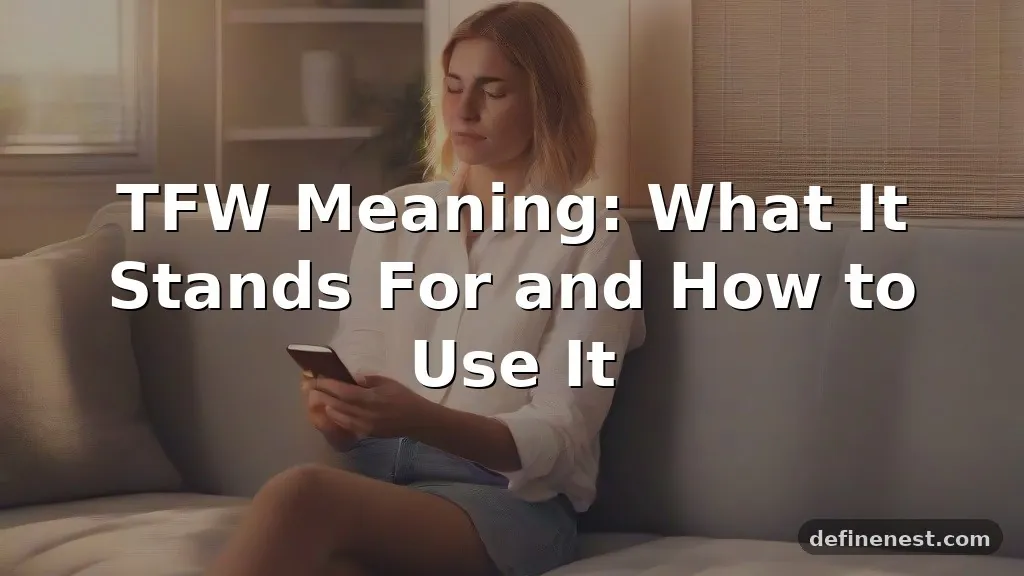
You get home and sit on your favorite couch. You might post a photo of someone relaxing with the caption TFW you finally sit down. Your friends will see this and think about how they feel in that same moment.
It creates a sense of community. It shows that we all go through similar things in our daily lives.
The term is not just for happy moments. It is used for many different things. You can use it for awkward situations.
You can use it for sad moments. You can even use it for very specific or weird feelings that are hard to describe with just one word. The beauty of this slang is its flexibility.
It allows you to express complex ideas very quickly. In a world where we communicate with short texts, being quick is very important. It helps us get our point across without writing a whole paragraph.
The Role of Visuals
The visual element is key to the meaning of this phrase. Without a picture, the text can feel a bit empty. The image provides the context.
If you say TFW you eat a lemon, the reader needs to see a face puckering up to really get the joke. This is why you see it so often on platforms like Instagram and Twitter.
These sites are built for sharing images and short bits of text. The combination of the two is what makes the meme work so well.
The Background and History of TFW
The history of TFW is quite interesting. It did not start on big sites like Facebook. It actually began in the corners of the internet where meme culture is born.
Most experts point to imageboards like 4chan as the starting place. In the late 2000s, users on these sites began using the phrase That Feel When. It was often used in a very specific way.
One of the most famous early versions was “TFW no GF.” This meant “that feel when you have no girlfriend.” It was a way for lonely users to bond over their shared experience.
Over time, the phrase began to change. It moved away from its original niche and became more general. People realized they could use it for any situation.
By the early 2010s, it started appearing on Reddit. From there, it exploded in popularity. It moved to Twitter and Tumblr.
As it moved, it lost some of its darker or more cynical roots. It became a tool for everyone to use. It turned into a way to talk about everyday life.
This evolution is common for many internet terms. They start small and then grow to reach the whole world.
The term eventually became so common that it entered the mainstream. Major brands started using it in their social media ads. This is often a sign that a slang term has reached its peak.
Even the Merriam-Webster dictionary has written about it. They track how these words move from the internet into our daily speech.
It is a great example of how digital culture influences the way we talk in real life. Today, you can find this term used by people of all ages and backgrounds.
From Niche to Mainstream
The transition to the mainstream changed the word slightly. Originally, it was mostly used for sad or self-deprecating humor. Now, it is used for almost anything.
You might see a celebrity use it to describe their red carpet experience. You might see a teacher use it to describe the last day of school. This shift shows how language is a living thing.
It adapts to the needs of the people using it. The internet has simply made this process much faster than it used to be in the past.
Usage in Various Contexts
You will see TFW in many different places. Each place has its own slightly different vibe. In texting, it is used to share quick updates with friends.
It is a shorthand way to be funny or relatable. For example, if you are stuck in traffic, you might text a friend a photo of the road. You add the caption TFW you are late for everything.
It is a quick way to vent your frustration. It also lets your friend know why you are running behind without a long explanation.
On social media, the usage is a bit more public. People use it to get likes and comments. They want to post something that other people will find relatable.
On Twitter, you might see a post like TFW the coffee kicks in. This will usually have a GIF of someone with a lot of energy. This type of post is easy to share.
It helps people feel connected to others who are having the same experience at that same time of day. It is all about building a digital community through shared feelings.
In the gaming world, the term is very common too. Gamers use it to describe specific moments in a match.
These moments are often very intense. Let’s look at a dialogue example in a gaming chat:
Player 1: TFW you run out of ammo right before the boss dies.
Player 2: Oh man, that is the worst. I hate when that happens.
Player 1: I almost threw my
Player 1: I almost threw my controller!
This dialogue shows how the term starts a conversation. It allows the players to bond over a shared frustration. It is a quick way to describe a complex situation that every gamer understands.
Casual Conversations
In casual face to face talk, people rarely say the letters out loud. They usually say the full phrase. However, younger generations might actually say the letters T-F-W.
This is less common than seeing it written down. Most of the time, the term lives on screens. It is a visual and written form of communication.
It relies on the speed of the internet to make sense. If you say it in person, you might have to explain it to someone who is not online much.
Common Misconceptions and Clarifications
One of the biggest sources of confusion comes from your phone. Many people look at the top corner of their iPhone or Android screen. They see the letters TFW next to their signal bars.
They think their phone is trying to tell them a joke. This is not the case. In this context, TFW stands for TracFone Wireless.
This is a very popular mobile phone carrier. It has nothing to do with internet memes or feelings. If you see this on your phone, it just means you are using that specific network.
Another common mistake is mixing it up with other similar acronyms. People often confuse TFW with MFW. While they are related, they are not the same.
TFW is about the internal feeling. MFW stands for “My Face When.” MFW is specifically about the physical reaction on your face.
You would use MFW when you have a funny photo of yourself. You use TFW when you are talking about the emotion inside. Knowing the difference helps you use the right term at the right time.
Some people also think the term is always negative. This is a misconception. While it started with sad memes, it is now used for positive things too.
You can use it to describe the joy of eating a great meal. You can use it to describe the relief of finishing a hard task. It is a neutral tool that takes on the mood of the person using it.
Do not assume someone is upset just because they used those three letters. Always look at the picture or the rest of the sentence to understand the true meaning.
Clarifying the Intent
Context is everything when it comes to slang. If you use TFW without an image, people might get confused. They might not know what feeling you are trying to describe.
It is always best to pair it with something visual. This ensures your message is clear. If you are ever unsure, it is okay to ask.
Most people are happy to explain what they mean. The internet is a place of constant learning for everyone.
Similar Terms and Alternatives
There are many other terms that are like TFW. These terms help people express themselves in different ways. One of the most popular is HIFW.
This stands for “How I Feel When.” It is almost the same as TFW. People use them interchangeably.
Another one is MRW, which stands for “My Reaction When.” This is used when you want to show how you reacted to a specific piece of news or an event. It usually involves a GIF of someone doing something, like clapping or crying.
If you want to sound more modern, you might just use the word Mood. This has become a very popular way to say “I relate to this.” If someone posts a picture of a tired person, you can just comment “Mood.”
It conveys the same idea as TFW but in a much shorter way. Another alternative is Relatable. This is more direct.
It tells the person that you have felt the same way before. These terms all serve the same purpose. They help us connect through our emotions in a digital space.
Sometimes, you might want to use more formal language. In those cases, you would avoid these acronyms entirely. You would say something like “I know exactly how that feels” or “I have had a similar experience.
These phrases are better for work or for talking to people you do not know well. Slang is great for friends, but it can be unprofessional in the wrong setting. It is important to know your audience before you start using these words.
Table of Related Terms
| Term | Full Form | Best Use Case |
|---|---|---|
| TFW | That Feel When | Describing a general emotion or vibe. |
| MFW | My Face When | Showing a specific facial expression. |
| MRW | My Reaction When | Showing an action in response to something. |
| HIFW | How I Feel When | A direct alternative to TFW. |
| IRL | In Real Life | Comparing an online feeling to reality. |
How to Respond to This Term
Knowing how to respond to TFW is just as important as knowing what it means. Your response depends on who sent the message and what the mood is. If a friend sends you a funny TFW meme, a casual response is best.
You can reply with an emoji, like the laughing face or the heart. You could also send a meme back. This keeps the fun going.
If the meme is about something relatable, you can say “Same” or “I feel that.” These are quick ways to show you get the joke.
If someone uses it to talk about something serious, you should be more supportive. For example, if a friend posts TFW you fail a test, don’t just send a laughing emoji. Instead, you could say “I am so sorry, that is the worst” or “Do you want to talk about it?”
In this case, the acronym is a way for them to open up about their feelings. Your response should match their level of emotion. Being a good friend means knowing when to be funny and when to be kind.
In a professional or semi-professional setting, you should be careful. If a coworker uses it in a casual Slack channel, you can respond with a simple “Haha” or “Relatable.” However, you should probably not use it yourself unless you are sure it is okay.
If you want to be privacy-conscious, you might choose not to engage with personal TFW posts on public social media. You can always send a private message instead. This shows you care without making a big scene in public.
Response Examples
Scenario 1: Casual Text
Friend: TFW you find a fry at the bottom of the bag.
You: The best surprise ever! 🍟
Scenario 2: Funny Social Media Post
User: TFW you walk into a room and forget why you are there.
You: This is my life every
You: This is my life every single day.
Scenario 3: Gaming Chat
Teammate: TFW the lag kills you right before a win.
You: RIP. That is so tilting.
Regional and Cultural Differences
The term TFW is mostly used in English speaking countries. However, because the internet is global, it has spread everywhere. You will see people in Europe, Asia, and South America using it too.
They might use it in English even if they are speaking another language. This is because internet slang often acts as a universal language.
It connects people from different cultures who share the same online spaces. It is a sign of how connected our world has become.
In some cultures, the way people express feelings is different. Some places might have their own versions of this term. For example, in some Spanish speaking communities, people might use phrases that mean the same thing but in their own language.
However, the use of English acronyms is very common in global youth culture. It is seen as “cool” or “trendy” to use these terms. This can sometimes lead to a mix of languages, which is often called “Spanglish” or similar names depending on the region.
The meaning can also change slightly based on the local culture. In some places, self-deprecating humor is very popular. In those areas, TFW might be used mostly for embarrassing stories.
In other places, it might be used more for bragging or showing off a good life. The core idea of “that feel when” stays the same, but the “what” changes.
It is always interesting to see how different groups of people take a global term and make it their own. It shows that even though we use the same words, our unique backgrounds still shine through.
Global Reach of Slang
The rise of platforms like TikTok has made these terms spread even faster. A video made in the United States can be seen in Japan in seconds. If that video uses TFW, the Japanese viewers will learn it.
They might then start using it in their own videos. This fast exchange of culture is a hallmark of the modern age.
It makes the world feel smaller. It also makes it easier for us to understand each other, even if we live thousands of miles apart.
Comparison with Similar Expressions
It is helpful to compare TFW with other expressions to see where it fits best. We have already talked about MFW and MRW. Let’s look at how it compares to more traditional phrases.
For example, compare it to “I know the feeling.” This traditional phrase is very polite and clear. TFW is much more casual and often more humorous.
You would use the traditional phrase at a funeral or a business meeting. You would use the slang version in a group chat with your best friends.
Another comparison is with the phrase “That moment when” (TMW). TMW is very similar to TFW. The main difference is that TMW focuses on the event.
TFW focuses on the feeling caused by the event. If you say TMW you win the lottery, you are talking about the act of winning. If you say TFW you win the lottery, you are talking about the rush of excitement.
It is a small difference, but it matters. TFW is more personal and emotional. This is why it is so popular for memes that try to be relatable.
Finally, let’s look at “Like a boss.” This was a very popular phrase a few years ago. It was used to describe doing something very well.
While TFW can be used for success, it is much broader. “Like a boss” is only for one specific type of situation. TFW can be used for failure, success, boredom, or confusion.
This versatility is why TFW has lasted longer than many other slang terms. It does not get old as quickly because it can be used in so many different ways.
Key Differences Summary
- TFW: Focuses on the internal emotion.
- TMW: Focuses on the specific event or moment.
- MFW: Focuses on the visual facial expression.
- Mood: A one-word way to agree with a vibe.
- Relatable: A more formal way to express shared experience.
Usage in Online Communities and Dating Apps
Online communities like Reddit and Twitter are the natural home of TFW. On Reddit, you will see it in the titles of many posts. Users do this to quickly tell people what the post is about.
It acts as a hook to get people to click. If a post says TFW you find a hidden secret in a game, other gamers will want to see it.
It creates a sense of curiosity. It also tells the reader that the post will be about a shared experience.
On dating apps like Tinder or Bumble, the term is used to show personality. People might put it in their bio to seem funny or relatable. For example, someone might write TFW you are the only one of your friends not married.
This shows they have a sense of humor about their life. It can be a great conversation starter.
If you see this on someone’s profile, you can message them and say “I totally feel that!” It is a low pressure way to start a chat with someone new.
In gaming communities, it is used to vent. Gaming can be very frustrating. When things go wrong, players need a way to express it.
Using TFW helps turn that frustration into a joke. It makes the bad experience feel a bit better. It also helps the community bond.
When everyone agrees that a certain moment is annoying, they feel more like a team. This is why you see it so often in Discord servers and in-game chats. It is a tool for social bonding in a digital world.
Tips for Dating App Usage
If you use TFW on a dating app, keep it light. You want to seem fun and easy to talk to. Avoid using it for very negative or bitter things.
For example, don’t write TFW everyone on this app is boring. That will make people want to swipe left. Instead, use it for something cute or funny.
TFW you find someone who likes the same weird movies as you is much better. It shows what you are looking for in a positive way. It makes you seem much more approachable.
Hidden or Offensive Meanings
Most of the time, TFW is completely harmless. It is just a fun way to talk about feelings. However, like any word, it can be used in a mean way.
Sometimes people use it to mock others. For example, someone might post a picture of a person crying with the caption TFW you are a loser. This is obviously hurtful.
It is important to look at the tone of the post. If the goal is to make fun of someone, then the term is being used in an offensive way.
There is also the concept of irony. Some people use TFW in a way that is the opposite of what they mean. This can be confusing if you are not used to internet humor.
For example, someone might post a picture of a disaster with the caption TFW everything is going great. They are being sarcastic. They are using the term to show how bad things really are.
Understanding irony is a big part of getting internet slang. You have to look past the literal words to see the true message.
In some niche groups, the term might be linked to controversial ideas. This goes back to its roots on 4chan. While the mainstream use is safe, some old versions of the meme were used by toxic groups.
However, this is very rare today. Most people who use it have no idea about that history. They just see it as a normal part of the dictionary of the internet.
As long as you use it in a kind and funny way, you don’t have to worry about being offensive. Just be mindful of the images you pair it with.
The Importance of Tone
Tone is hard to read in text. This is why emojis and images are so helpful. If you are worried someone might take your TFW post the wrong way, add a smiley face.
This clarifies that you are being friendly. If you are using it to complain, make sure it is clear you are complaining about a situation, not a person.
Being clear with your intent helps prevent misunderstandings. It makes the internet a better place for everyone.
Suitability for Professional Communication
Is TFW okay to use at work? The short answer is usually no. Most professional settings require a more formal tone.
Using internet slang can make you look unprofessional. It might seem like you are not taking your job seriously. If you are writing an email to a client or your boss, it is best to avoid it.
Stick to clear and standard English. You want your words to be taken seriously. Slang can sometimes distract from your actual message.
However, there are some exceptions. If you work in a very casual office, like a tech startup or a creative agency, it might be okay. Many modern companies use Slack or Microsoft Teams for internal chat.
These platforms are often more casual. If your coworkers are using memes and slang, you can probably join in. Just make sure you read the room first.
See how others are talking before you start using TFW. It is always better to be too formal than too casual when you are new to a job.
If you want to express a shared feeling at work, there are better ways to do it. Instead of TFW, you can say “I think we have all been there” or “I can certainly relate to that challenge.” these phrases convey the same sense of empathy without the slang. They are safe for any environment.
They show that you are a team player who understands the situation. Learning how to switch between casual and professional speech is a very important skill. It helps you navigate different social circles with ease.
Professional Alternatives
- “I understand how you feel.”
- “That is a very relatable situation.”
- “I have experienced something similar.”
- “Many of us feel the same way about this.”
- “I appreciate you sharing that perspective.”
FAQs
What does TFW mean in texting?
In texting, TFW stands for “That Feel When.” It is used to share a relatable emotion or situation with the person you are messaging. It is usually meant to be funny or to show empathy.
Is TFW the same as MFW?
No, they are different. TFW focuses on the feeling inside.
MFW stands for “My Face When” and focuses on the physical expression on someone’s face. They are often used in similar ways but have different meanings.
Why does my phone say TFW at the top?
If you see TFW on your phone’s status bar, it stands for TracFone Wireless. This is the name of your mobile service provider. It has nothing to do with the internet slang term.
Is TFW dead or still popular?
TFW is still very popular. While it is an older slang term, it has become a staple of internet language. People of all ages still use it every day on social media and in chats.
Can I use TFW in a business email?
It is generally not a good idea. TFW is very casual slang. In a professional setting, it is better to use more formal language to ensure you are taken seriously by your colleagues and clients.
Where did TFW come from?
The term started on internet imageboards like 4chan in the late 2000s. It originally was used for more niche and often sad memes before becoming a mainstream way to express any relatable feeling.
Conclusion
In summary, TFW is a powerful little acronym that has changed the way we communicate online. It stands for That Feel When and serves as a bridge between our internal emotions and the digital world. We have seen how it evolved from a niche meme into a global phenomenon.
It is a tool for building community, sharing a laugh, and finding common ground in our busy lives. While it can be confused with mobile carriers like TracFone, its place in our vocabulary is solid. Remember to use it in casual settings and pair it with a great image for the best effect.
Avoid it in formal business settings to stay professional. Now that you know the meaning, history, and usage of this term, you can navigate the internet with confidence. Go ahead and share your next TFW moment with the world!