
You have probably seen this three-letter word popping up everywhere lately. Whether you are scrolling through TikTok, checking your Twitter feed, or listening to the latest chart-topping hits, the term is impossible to miss. If you are wondering what it actually stands for and why everyone is suddenly chanting it, you are in the right place.
This guide is for anyone who feels slightly out of the loop with modern digital slang or pop culture phenomena. We are here to break down the origins, the cultural significance, and the real-world usage of this term.
Understanding why a simple word becomes a massive trend helps you stay connected in our fast-paced digital world. Let’s look at why this specific term has captured the attention of millions across the globe and what it means for your daily interactions.
Defining the Term and Its Core Meaning
At its simplest level, the term is an abbreviation for the word apartment. In the context of the recent global phenomenon involving Rosé and Bruno Mars, it refers to a specific type of social setting.
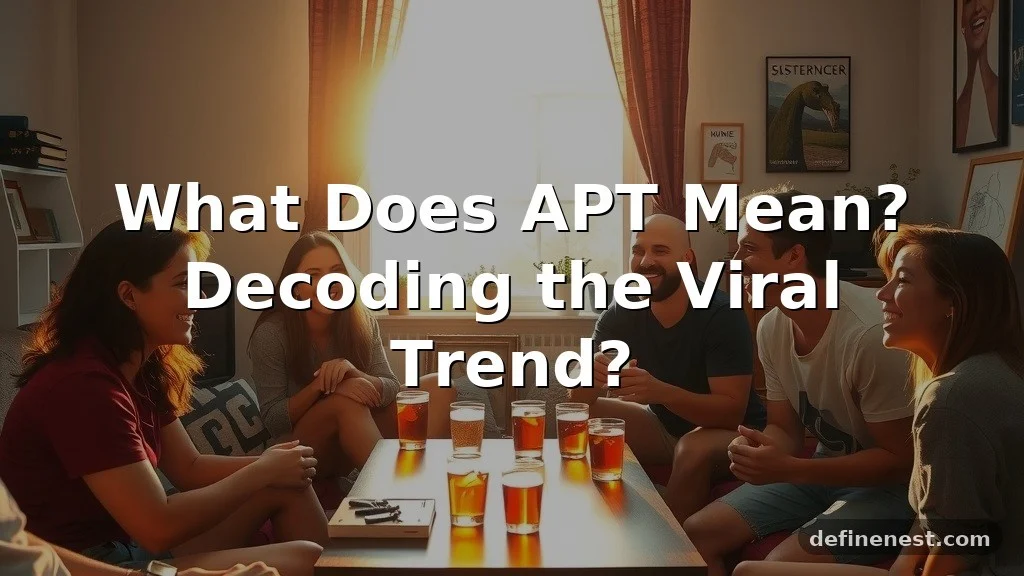
The word is used to describe a location where people gather to socialize, play games, and relax. While it sounds like a plain noun, the way it is used in the song and across social media elevates it into a symbol of fun and community.
Think of it as shorthand for a hangout spot. When someone says they are going to the apartment, they are usually implying a private, comfortable space where friends can be themselves. In the viral song, the term is pronounced as Apateu.
This is the Korean pronunciation of the English loanword. Because the Korean language often adds vowel sounds to English words to make them fit local phonetic rules, the word evolved from a standard English noun into a rhythmic, catchy hook.
You might see this used in text messages like this:
“Hey, are you coming over to the apt later?”
“I left my keys at the apt, can you let me in?”
In these cases, it is just a functional abbreviation. However, the current cultural usage is much more specific. It refers to the excitement of a gathering, the anticipation of a party, and the shared experience of a drinking game.
It is a word that carries a sense of invitation. When you hear it now, it is almost always associated with the upbeat energy of the track and the specific Korean drinking culture that inspired the lyrics.
The Background and Evolution of the Term
The term itself is not new, but its current massive popularity is rooted in a unique intersection of language and pop culture. For decades, the word apartment has been shortened to apt in written English.
It is standard shorthand in real estate listings, classified ads, and informal texting. However, the transformation into a cultural catchphrase is a direct result of South Korean culture being exported to the world through music and media.
The specific usage stems from a popular Korean drinking game. In this game, participants chant the word Apateu while stacking their hands in a specific rhythm.
The game is a staple of Korean drinking culture, often played at bars or during house parties to build rapport and break the ice. By bringing this game to the forefront of a global music video, the artists have bridged the gap between local traditions and international pop music.
This evolution shows how language changes when it moves across borders. The word started as a simple descriptive noun. It then became a localized slang term for a game.
Now, it has become a global pop culture marker. It is a perfect example of how K-pop acts as a vehicle for cultural exchange.
People who might never have known about Korean drinking games are now familiar with the rhythm and the meaning behind the term. It has evolved from a boring abbreviation into a vibrant piece of modern vocabulary.
Usage in Various Contexts
You will find this word used in many different ways depending on where you are looking. On social media platforms like Instagram or TikTok, it is often used as a hashtag or a caption to signal that a party or a fun event is happening.
It has become a synonym for a good time with friends. In gaming communities, players might use it to describe a specific map location or a virtual hangout spot.
Let’s look at how this sounds in natural conversation:
Person A: “Are you heading to the party tonight?”
Person B: “Yeah, we are meeting at the apt around eight. You should come!”
Or, in a more digital context:
“Just posted the new video. The energy in the apt was wild!”
In these examples, the word functions as a shorthand for a social hub. It is casual, friendly, and implies a sense of belonging. Even if you are not referring to the specific song, the term has gained enough cultural weight that people immediately understand you are talking about a place where people gather to hang out.
It is important to note that the context changes the meaning slightly. In a text to a landlord, it means a rental unit.
In a text to a best friend, it means the center of the night’s entertainment. Always consider who you are talking to before choosing to use the slang version.
Common Misconceptions and Clarifications
One of the biggest misconceptions is that the term is a complex code or a secret message. In reality, it is quite literal. Some people worry that the word has a hidden, darker meaning because it is associated with a drinking game.
While it is true that the term is linked to alcohol-related games, it is not inherently offensive or problematic. It simply describes a social activity that happens to involve drinking.
Another common point of confusion is the pronunciation. People often try to force the English pronunciation onto the word when they see it in the context of the song.
However, the charm of the term in this specific context relies on the Korean pronunciation of Apateu. If you are trying to participate in the trend, using the correct pronunciation makes a big difference in how you are perceived by fans.
It is also not a term that should be used in formal business communication. Do not use it in an email to your boss or a client, even if you are trying to be friendly. It is strictly a casual term.
If you are confused about whether to use it, just remember the golden rule of slang: if you are in a professional setting, stick to the full word. If you are with your friends on a Friday night, the slang version is perfectly acceptable and even encouraged.
Similar Terms and Alternatives
If you are looking for other ways to describe a hangout spot or a party, there are plenty of alternatives. Depending on the vibe you want to convey, you might choose a different word entirely. Below is a list of terms that serve a similar purpose in casual conversation:
* Pad: A classic term for a home or apartment. It sounds a bit retro but is still widely understood.
* Crib: A very popular slang term for a house or apartment.
It implies a place where you hang out and chill.
* Spot: A versatile word that can mean any place where you spend time. “My spot” is a very common way to refer to your home.
* Hangout: The most descriptive and neutral term for a place where people gather.
* Base: Often used in gaming or among close groups to describe the main meeting area.
| Term | Context | Vibe |
|---|---|---|
| APT | Social/Drinking Game | Trendy/Pop Culture |
| Pad | Housing | Retro/Casual |
| Crib | Housing | Urban/Cool |
| Spot | General | Neutral/Personal |
These terms are excellent alternatives if you want to avoid the specific pop culture baggage that comes with the term in question. Using the right word for the right situation is key to effective communication.
How to Respond to This Term
Knowing how to respond when someone mentions the term depends entirely on your relationship with them and the platform you are using. If a friend sends you a video of the song, a simple, enthusiastic response is best. You want to match their energy.
Casual Response:
“Oh, I love that track! It’s been stuck in my head all day.”
Funny Response:
“I’m currently living in my own apt, but it’s definitely not as fun as that one.”
Professional Response:
If someone uses the term in a professional setting, it is best to pivot back to formal language. You can acknowledge the trend without adopting the slang yourself.
“I’ve seen that song trending lately. It seems like a massive hit for the artists involved.”
Privacy-Conscious Response:
If someone is asking where you live or trying to get you to disclose your location:
“I keep my private life pretty low-key, but I’m always down for a public meetup!”
By tailoring your response, you maintain
By tailoring your response, you maintain your boundaries while still showing that you are culturally aware and engaged with the conversation.
Regional and Cultural Differences
The term’s usage is highly dependent on where you live. In South Korea, the word is deeply tied to the specific game and the local social customs. It is a part of the fabric of social interaction among young people.
In the West, the term has been imported through the lens of international popularity. People in the United States, Europe, and elsewhere are using the word because of the music video, not necessarily because they are familiar with the specific history of the game.
This creates a fascinating cultural divide. For a South Korean listener, the word evokes nostalgia for specific nights out with friends. For an international listener, it evokes the excitement of a new, catchy pop song.
This difference is important to keep in mind. You should not assume that everyone you talk to knows the history of the word.
Some people might just think it is a weird way to say apartment. Being aware of this gap helps you avoid misunderstandings when you are talking to people from different backgrounds.
Language is never static. As this term continues to circulate, it may lose its connection to the specific song and simply become a common way for people to describe their homes.
Or, it might fade away once the song loses its grip on the charts. Only time will tell how the regional usage settles.
Usage in Online Communities and Dating Apps
On platforms like Tinder or Hinge, you might see people using the term in their bios to signal that they are fun, outgoing, and maybe a bit of a music fan. It is a great conversation starter. If someone has “Meet me at the APT” in their bio, they are likely referencing the song and inviting you to chat about it.
In gaming communities, especially in titles that involve social hubs or player housing, the term is used to identify the area where players congregate. It is a way of creating a community feel within a digital space. When you see it in these environments, it is almost always a positive, inclusive signal.
Tips for responding:
1. Be curious: Ask them if they like the song or if they are just using the slang.
2. Be playful: If the setting is casual, use a lyric from the song to show you are in on the joke.
3. Be respectful: If they are using it in a way you do not understand, it is perfectly fine to ask for clarification. People usually love explaining the things they are passionate about.
Online communities thrive on shared language. Using this term correctly can help you build rapport with others who share your interests.
Hidden or Offensive Meanings
You might be wondering if the term has any hidden, offensive, or inappropriate meanings. Generally speaking, the term is harmless. It is a standard abbreviation and a pop culture reference.
However, context is always king. If someone is using the word to pressure you into an uncomfortable social situation or to mock your living situation, then the word itself is not the problem, but the intent is.
Always look at the tone of the conversation. Is the person being friendly? Are they trying to include you?
If the answer is yes, then there is no hidden meaning to worry about. If the tone feels aggressive, dismissive, or exclusionary, then the term is being used as a weapon, regardless of its dictionary definition.
It is also worth noting that because the term is associated with a drinking game, some people might associate it with irresponsible behavior. If you are in a professional environment, keep this association in mind.
You do not want to accidentally imply that you are encouraging excessive drinking. Keep the usage light and fun, and you will avoid any negative connotations.
Suitability for Professional Communication
Is this term appropriate for work? In short: no.
Professional communication requires clarity and a level of formality that slang simply does not provide. While you might have a great relationship with your colleagues, using internet slang in emails, reports, or client meetings can make you appear unprofessional or out of touch with business standards.
If you are talking to a colleague about their living situation, just say “apartment.” If you are discussing the music industry or pop culture trends with your team, you can certainly mention the song, but do so with a professional tone.
You could say, “Have you seen how that new song is driving engagement? It’s a perfect example of how global trends are shifting.”
By keeping your professional vocabulary separate from your social media vocabulary, you maintain your credibility. You can be fun and culturally aware without sacrificing the professional image you have worked hard to build.
Remember, your boss does not need to know that you are obsessed with the latest TikTok trend. They need to know that you can communicate clearly and effectively in a corporate environment.
Frequently Asked Questions
1. Does APT always refer to the song?
No, it is a standard abbreviation for apartment in real estate and general writing.
2. Is it offensive to use the term?
Not at all. It is a common word that has been adopted into pop culture.
3. How do I pronounce the term in the song?
It is pronounced as Apateu, reflecting the Korean adaptation of the word.
4. Can I use this word in a formal email?
It is best to avoid it in professional settings and stick to the full word apartment.
5. Why is the song so popular?
The song features a highly catchy chorus and a fun, energetic vibe that resonates with global audiences.
6. Are there other meanings for the acronym?
Yes, in some technical or medical contexts, APT can stand for various things, but in current social media usage, it refers to the apartment/social gathering trend.
7. Is the drinking game dangerous?
Like any drinking game, it should be played responsibly and in moderation.
Conclusion
The journey of this three-letter word from a boring real estate abbreviation to a global pop culture sensation is a testament to how connected our world has become. Through the power of music and social media, a simple piece of Korean drinking culture has found its way into the daily lives of people across the globe. Understanding the term is about more than just knowing what it stands for; it is about recognizing how language evolves and how we use it to connect with one another in a digital age.
Whether you are using it to reference the viral hit or simply to describe your home, remember to keep your audience in mind and enjoy the social energy that the word currently carries. Stay curious, stay connected, and keep exploring the fascinating ways that culture shapes the words we speak every single day.