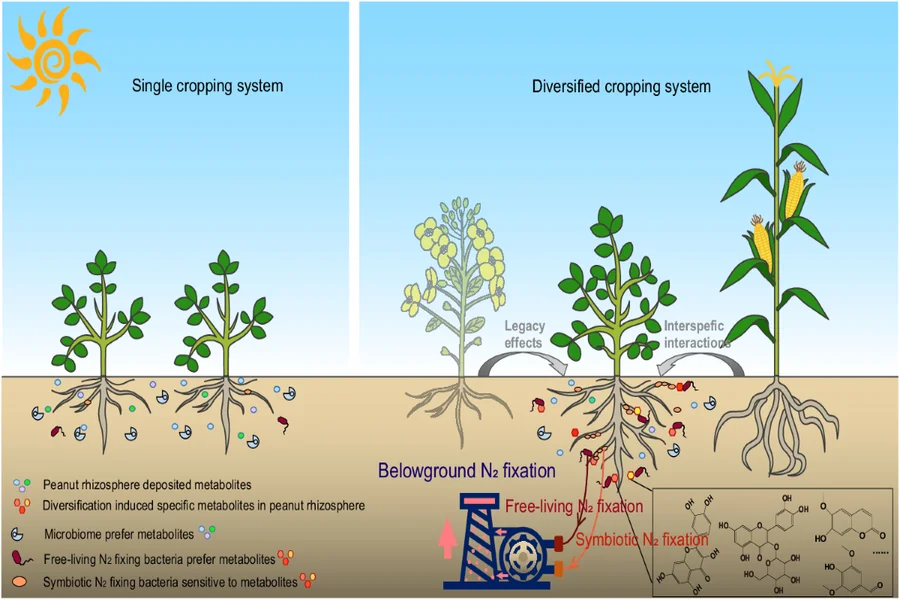

Nitrogen is essential to crop growth, but plants cannot use the abundant nitrogen gas in the atmosphere directly. Some microbes can convert it into forms that plants can use, making nitrogen fixation an important part of nutrient cycling in agricultural soils. Understanding where fixation occurs, what affects it, and how its benefits carry through a rotation helps put its contribution to crop yield in perspective.
What nitrogen fixation is and where it happens
Nitrogen fixation is the conversion of atmospheric nitrogen gas into compounds that can enter biological systems. In crop production, the process is most familiar in legumes, where certain bacteria live in close partnership with plant roots. Other microbes also fix nitrogen, though their contribution to a particular field can differ considerably.
How microbes convert atmospheric nitrogen into plant-usable forms
Atmospheric nitrogen gas is made of two nitrogen atoms joined by a strong bond, so plants cannot take it up as-is. Nitrogen-fixing microorganisms use an enzyme system called nitrogenase to convert this gas into ammonia, which can be incorporated into other nitrogen compounds. The process takes energy, and its rate depends on the organism and its surroundings.
The role of rhizobia in legume root nodules
In many legumes, rhizobia enter young roots and prompt the plant to form nodules, small structures where the bacteria live. The plant supplies energy to the bacteria, and the bacteria fix atmospheric nitrogen for use in the partnership. When nodules are active, their interior is often pink or reddish, though appearance alone is not a complete measurement of how much nitrogen a crop is fixing.
How free-living and associative microbes contribute nitrogen
Some nitrogen-fixing microbes live independently in soil or water; others associate more closely with plant roots without forming the same kind of nodule partnership found in legumes. These organisms can add fixed nitrogen to their surroundings, but their contribution is not automatically large enough to meet a crop’s nitrogen needs. The amount varies with microbial populations, soil conditions, and the crop environment.
How nitrogen fixation differs from nitrogen uptake
Fixation creates plant-usable nitrogen from atmospheric nitrogen, while uptake is a plant’s absorption of available nitrogen through its roots. A crop can take up nitrogen from soil organic matter, fertilizer, or nitrogen released by previous crops without fixing any itself. Keeping these processes distinct helps avoid assuming that vigorous growth or high plant nitrogen status proves fixation has occurred.
How fixed nitrogen supports crop growth
Once nitrogen becomes available to plants, it supports many processes that shape crop development. A crop’s ability to benefit depends on both the amount and timing of nitrogen supply, as well as water, light, and other nutrients. Fixation is one part of this larger picture rather than a substitute for all other crop needs.
Nitrogen’s role in chlorophyll, proteins, and plant development
Plants use nitrogen to build chlorophyll, the pigment involved in capturing light for photosynthesis, as well as amino acids, proteins, and other essential compounds. Adequate nitrogen helps support leaf area, stems, and the development of reproductive structures. When supply falls short, growth and leaf color may be affected, though similar symptoms can also arise from other stresses.
How fixed nitrogen moves from microbes to crops
In a legume partnership, fixed nitrogen is incorporated into compounds that support the host plant. Some nitrogen can later enter the soil as roots and nodules turn over, or as plant material decomposes. The amount and timing of that transfer depend on crop growth and residue breakdown, so not all nitrogen fixed by a crop is immediately available to another crop.
The likely route and timing of nitrogen return differ by source. This overview shows why nitrogen fixed within a living legume is not the same as nitrogen already released into the soil for any nearby plant to absorb.
| Nitrogen source or pathway | Where it is found | When it may become available |
| Active legume partnership | Plant and root nodules | During the legume’s growth, primarily supporting that plant |
| Root and nodule turnover | Soil around a crop’s roots | As biological material decomposes |
| Aboveground crop residue | Leaves and stems left after harvest or termination | As residue breaks down, at a rate shaped by its condition and the environment |
For rotation planning, the distinction matters: a following crop generally benefits from nitrogen released through decomposition, not simply from the fact that a predecessor fixed nitrogen. Residue quantity, composition, and weather influence how much is released and when.
When nitrogen demand is greatest during the growing season
Nitrogen demand changes as a crop develops. Rapid vegetative growth can require substantial nitrogen to build leaves and stems, while later demand supports reproductive growth and grain or seed formation. The pattern differs among crops, so matching nitrogen supply to crop stage is more useful than assuming fixation will meet demand uniformly through the season.
How crop residues can return nitrogen to the soil
After a legume crop is terminated or harvested, its roots, nodules, and aboveground residues become potential sources of nitrogen for the soil system. Microorganisms decompose this material, gradually moving some of its nitrogen into forms that plants can use. The release is neither immediate nor perfectly predictable, and it can be affected by residue quality, soil moisture, and temperature.
How nitrogen fixation can affect yield potential
Nitrogen fixation can improve the nitrogen supply available to a legume and may contribute to the nutrient pool for a subsequent crop. Its value depends on whether nitrogen is limiting and whether other conditions allow the crop to use that supply. For this reason, fixation can support yield potential, but it does not determine yield on its own.
Links between nitrogen supply and yield components
When nitrogen is limiting, improved supply can support canopy growth and the development of flowers, seeds, or grain. These effects may influence yield components such as the number of seeds or the size of harvested plant parts. The response depends on crop species and growing conditions; additional nitrogen does not necessarily increase yield if another factor is limiting.
Why benefits vary among legume crops and growing conditions
Legume species differ in their growth habits, nitrogen needs, and ability to form effective partnerships with compatible microbes. Even within a crop type, the amount fixed can change with soil conditions, season length, and plant health. A strong stand in favorable conditions may contribute differently from a stressed or poorly established stand.
What nitrogen-fixing crops can contribute to following crops
A legume can leave nitrogen in roots, nodules, and plant residues that may become available to later crops as those materials decompose. The following crop’s benefit depends on how much residue remains, how quickly it breaks down, and whether nitrogen is retained in the field. A crop rotation can therefore create a useful nitrogen opportunity, but the credit should be estimated with local conditions in mind.
Why fixation alone does not guarantee higher yields
Yield reflects more than nitrogen supply. Water availability, temperature, pests, disease, soil structure, planting conditions, and other nutrients can all constrain crop performance even when fixation is active. Strong nitrogen fixation cannot compensate for every limitation, so it should be considered alongside the full set of factors affecting crop growth.
Factors that influence the amount of nitrogen fixed
Biological fixation depends on the health of both the plant and the microorganisms involved. Soil conditions can favor or hinder their activity, while crop variety, growth stage, and nutrient availability shape the plant’s capacity to maintain the partnership. These influences often interact rather than acting one at a time.
Soil pH, moisture, temperature, and aeration
Soil pH outside a suitable range can interfere with rhizobia survival, nodulation, and nutrient availability. Drought can restrict plant growth and microbial activity, while waterlogged soil may limit oxygen around roots. Temperature also affects biological activity, and the balance of air and water in the soil helps determine whether roots and microbes can function well.
Nodulation success and compatibility between crops and microbes
A legume needs compatible rhizobia to form effective nodules. If the appropriate bacteria are absent or less suited to the crop, nodulation and fixation may be limited even when the crop is otherwise established. Seed history, field history, and inoculant use can all be relevant when assessing whether a crop is likely to form a productive partnership.
Crop variety, growth stage, and plant health
Varieties can differ in their growth patterns and in how they respond to environmental conditions. Fixation also changes over the growing season as roots develop, nodules become active, and the crop moves into later growth stages. Stress from pests, disease, or unfavorable weather can reduce plant growth and limit the energy available to support fixation.
Phosphorus, sulfur, and other nutrients needed for effective fixation
Nitrogen fixation requires a healthy, growing plant, so shortages of other nutrients can limit the process. Phosphorus supports energy-related processes, while sulfur is needed to build proteins; other nutrients also contribute to normal plant and microbial function. A soil test can help identify potential shortages rather than treating low nitrogen status as the only possible cause of weak growth.
A few field conditions are especially useful to keep in view when interpreting a crop’s fixation potential:
- Soil pH and drainage that support healthy roots and microbial activity.
- Moisture conditions that avoid prolonged drought or waterlogging.
- Adequate phosphorus, sulfur, and other nutrients for plant development.
- A compatible legume and microbial partnership with successful nodulation.
These checks do not measure nitrogen fixation directly, but together they can help explain why two fields—or two parts of one field—may differ. They also point toward practical steps to investigate before drawing conclusions from crop appearance alone.
Management practices that support nitrogen fixation
Management can help create conditions for effective nodulation and plant growth, though it cannot guarantee a particular fixation rate. Decisions about inoculation, rotation, fertilizer, and residues should reflect the crop, field history, and local recommendations. A coordinated approach can support both the current legume and the crops that follow it.
Choosing and applying the right microbial inoculant
Inoculants supply selected microorganisms intended to support a compatible crop. The choice should match the legume being planted and be guided by local agronomic recommendations and product directions. Proper handling and application matter because poor storage or application practices can reduce the number of viable microbes reaching the seed or soil.
Using crop rotations and cover crops to build nitrogen benefits
Including legumes in a rotation can create opportunities for biological nitrogen fixation and leave roots and residues that return nitrogen to the system. Cover crops can also contribute biomass and help keep soil covered between cash crops. Their nitrogen benefit depends on successful establishment, the amount and type of growth produced, and how the crop is managed before the next planting.
Managing fertilizer nitrogen without suppressing nodulation
High available nitrogen can reduce a legume’s incentive to invest in nodulation and fixation. At the same time, young plants may face establishment needs that vary by soil and field conditions. Fertilizer decisions should follow crop-specific, locally informed guidance rather than assuming that either no nitrogen or a large application is always appropriate.
Timing residue termination and accounting for nitrogen release
Termination timing affects the amount of residue left behind and the time available for it to decompose before a following crop needs nitrogen. Earlier termination may allow more time for breakdown but can change how much biomass is produced; later termination can leave more material while narrowing the release window. Consider both residue quantity and timing when estimating the nitrogen contribution to a subsequent crop.
How to evaluate fixation and its contribution to crops
No single observation tells the full story of how much nitrogen has been fixed or how much a following crop will receive. Root inspection, plant and soil tests, crop performance, and field history can provide complementary clues. Interpreting them together gives a more dependable picture than relying on one visual sign or a generalized nitrogen credit.
Checking roots and nodules for signs of active fixation
Dig up several representative plants rather than pulling them, which can leave roots and nodules behind. Look for nodules on the roots and, when appropriate, cut a few open: pink or reddish interiors are often associated with active nodules, while pale interiors may be less active. Nodules are useful evidence of the partnership, but their presence and color do not quantify total nitrogen fixed.
Using plant tissue and soil tests to assess nitrogen status
Plant tissue testing can show whether nitrogen levels in sampled plants are within an expected range for the crop and growth stage. Soil tests help assess soil nutrient conditions, though a routine soil test is not itself a direct measurement of biological fixation. Sampling at the recommended time and interpreting results with local guidance makes these tools more useful.
Tracking yield and crop performance across seasons
Keep records of crop establishment, nodulation observations, weather, management, and harvest results. Comparing fields or seasons can reveal patterns, especially when the comparison accounts for differences in soil and other inputs. Yield is an important outcome, but it cannot by itself show which share of a change came from fixation.
Accounting for variability when estimating nitrogen credits
Estimates of nitrogen available to a following crop should account for crop species, biomass, residue management, and conditions that affect decomposition. Local extension recommendations can provide a starting point, but field results may differ from a general estimate. The term Pharmgrade should not be treated as a measurement of fixation or a substitute for field-specific nutrient assessment; nitrogen status needs to be evaluated using relevant agronomic evidence.
Conclusion
Nitrogen fixation links certain microbes with the nitrogen needs of crops, most visibly through the partnership between rhizobia and legumes. Its contribution to crop growth and yield potential depends on soil conditions, plant health, management, and the timing of nitrogen release from residues. By combining sound field practices with careful observation and testing, growers can make more informed decisions about what fixation contributes to the current crop and the next one.
Frequently Asked Questions
What is nitrogen fixation?
Nitrogen fixation is the process by which certain microorganisms convert atmospheric nitrogen gas into nitrogen compounds that can enter biological systems and support plant growth.
Which crops can fix nitrogen?
Legumes such as beans, peas, and clovers can form partnerships with nitrogen-fixing rhizobia. The effectiveness of the partnership depends on the crop, compatible microbes, and growing conditions.
Do all legumes fix the same amount of nitrogen?
No. The amount varies with the crop and variety, microbial partnership, soil conditions, season, and plant health.
How can I tell if a legume has active nodules?
Carefully excavate roots and inspect the nodules. Pink or reddish interiors are often a sign of activity, but this observation does not measure the total amount of nitrogen fixed.
Does fixed nitrogen become available to the next crop immediately?
Usually not. Nitrogen in roots and crop residues becomes available as those materials decompose, and the timing depends on residue characteristics and environmental conditions.
Can fertilizer nitrogen affect nodulation?
High levels of available nitrogen can reduce a legume’s investment in nodulation and fixation. Appropriate fertilizer decisions depend on the crop and field conditions.
Does more nitrogen fixation always mean a higher yield?
No. Water, temperature, pests, disease, soil conditions, and other nutrients can limit yield even when fixation is occurring. Nitrogen supply is one influence among many.