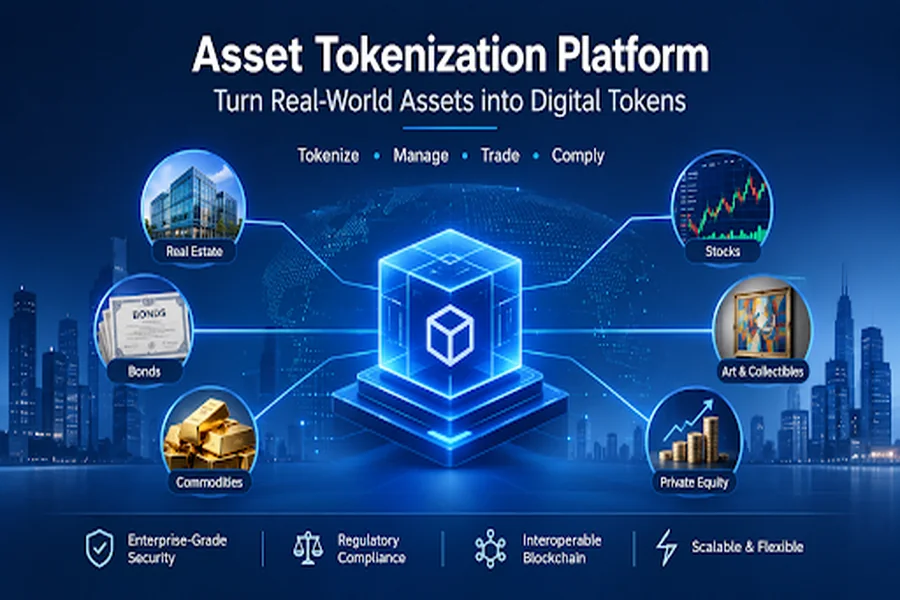

Asset tokenization has moved past the proof-of-concept stage. Financial institutions, asset managers, real estate companies and fintechs are now asking operational questions rather than conceptual ones: how do we onboard eligible investors, enforce transfer restrictions, distribute income and report to auditors, all on shared digital infrastructure?
That shift changes how an asset tokenization platform should be evaluated. Issuing a token on a blockchain is the easy part. The hard part is everything around it: identity, compliance rules, lifecycle events, integration with banks and custodians, and records that stand up to audit. A platform that can mint tokens but cannot manage these requirements is a demo tool, not enterprise infrastructure.
This guide sets out seven factors to evaluate, explains why blockchain architecture matters, shows where real estate tokenization fits, and provides a checklist you can use to compare vendors.
What Is an Enterprise Asset Tokenization Platform?
An enterprise asset tokenization platform is software infrastructure that lets an organization represent real-world assets, or rights linked to them, as digital tokens on a blockchain, and then manage those tokens through their full lifecycle under defined governance and compliance rules.
In practice, blockchain asset tokenization works like this: an asset or an investment structure holding it is defined legally, its eligible ownership interests or economic rights are mapped to tokens governed by smart contracts, and the blockchain records issuance, transfers and distributions in a shared, tamper-evident ledger. Digital ownership records replace or complement spreadsheets, registrars and manual reconciliation.
The important distinction is between basic token issuance and end-to-end asset tokenization infrastructure:
- Basic token issuance creates tokens and records balances. It typically leaves investor onboarding, compliance checks, income distributions and reporting to external processes.
- End-to-end infrastructure covers onboarding, eligibility verification, issuance, transfer controls, corporate actions, distributions, redemption, reporting and system integration within one governed environment.
Enterprises tokenize many categories of assets, including securities, bonds, commodities, private equity, private credit, infrastructure and real estate. Each carries different legal rights and workflows, which is why platform flexibility matters.
7 Key Factors to Evaluate in an Enterprise Asset Tokenization Platform
1. Enterprise-Grade Security and Access Control
Institutional asset tokenization raises the stakes on security. Tokens may represent regulated interests with significant value, and the platform must prevent unauthorized transfers, protect investor data and provide records that can be trusted.
Evaluate whether the platform offers:
- Permissioned blockchain infrastructure, where participants are identified and admitted rather than anonymous.
- Identity verification and role-based access, so issuers, administrators, auditors and investors see and do only what their roles permit.
- Multi-level transaction approvals for sensitive actions such as issuance, forced transfers or redemptions.
- Cryptographic security and key management, including how private keys are generated, stored, rotated and recovered.
- Tamper-evident transaction records, so any change to history is detectable.
- Controls against unauthorized transfers, enforced in smart contract logic rather than only in the user interface.
Security architecture is also a governance question. Ask who can change smart contract logic, how those changes are approved and how they are logged.
2. Regulatory Compliance and Governance Capabilities
Blockchain technology does not make an asset or an offering legally compliant. Compliance depends on the legal structure of the offering, the jurisdictions involved and the regulations that apply to issuers, intermediaries and investors. A platform’s job is to help you implement those requirements consistently, not to replace legal analysis.
Look for capabilities such as:
- KYC and AML integration, so only verified participants are onboarded.
- Investor eligibility and accreditation checks, aligned to the rules of the relevant jurisdiction.
- Jurisdiction-specific rule configuration, since offerings often span multiple regimes.
- Transfer restrictions, such as lock-up periods, investor caps or whitelisting.
- Audit trails and reporting that regulators, auditors and internal compliance teams can use.
- Compliance rules embedded in transaction workflows, so a non-compliant transfer is rejected at execution time rather than discovered afterward.
When assessing vendors, ask which requirements are configurable and which depend on your own legal and compliance teams.
3. Support for Multiple Asset Classes
An enterprise rarely tokenizes only one kind of asset. A platform restricted to a single asset type forces you to rebuild integrations, controls and processes each time you expand. A multi-asset platform allows shared infrastructure for identity, compliance, reporting and integrations, with asset-specific logic layered on top.
Categories to consider include:
- Securities and bonds, with coupon schedules, maturity and redemption.
- Private equity and private credit, with capital calls, distributions and investor-specific terms.
- Commodities and precious metals, where tokens may represent claims linked to stored physical assets and custody evidence matters.
- Infrastructure assets, with long-dated cash flows and multiple stakeholders.
- Real estate, with rental income, valuation and property-level documentation.
Example: real estate tokenization. A property-owning entity, such as a special purpose vehicle, holds a commercial building. Eligible ownership interests or investment rights in that entity can be represented as tokens. This can enable fractional participation, automated distribution of rental income through smart contracts and a more transparent record of who holds what. Tokenization does not automatically create legal ownership of the property, and it does not guarantee liquidity. The rights a token represents are determined by the legal structure and the regulations that apply.
4. Smart Contract Flexibility and Asset Lifecycle Management
Issuance is one event in a long lifecycle. Enterprises need a platform that manages what happens afterward, and that adapts as terms and regulations change.
Assess whether the platform supports:
- Configurable token standards and smart contracts, so asset-specific rules do not require starting from scratch.
- Issuance and investor onboarding in a single governed flow.
- Ownership transfers subject to configured restrictions.
- Corporate actions, such as voting events, splits or restructurings.
- Interest, dividend or rental income distributions, calculated and executed against current holder records.
- Redemption and retirement of tokens at maturity or exit.
- Lifecycle event tracking, giving a complete history of each asset.
The practical test: can your operations team run the full lifecycle of an asset, from onboarding to redemption, without custom engineering for each step?
5. Scalability and Performance
Pilots usually involve a handful of investors and a single asset. Production deployments involve growing investor populations, multiple issuances and sustained transaction volumes alongside other enterprise workloads.
Consider:
- Transaction throughput under realistic, sustained load rather than peak benchmark claims.
- Network performance as participants and nodes are added.
- Growth in investor and participant volumes across multiple asset issuances.
- Reliability and operational resilience, including node redundancy, backup, recovery and monitoring.
The underlying blockchain architecture has a direct effect on long-term scalability. Consensus design, network topology, data storage approach and the way transactions are validated all influence how a platform behaves as it grows. Ask vendors to explain these choices and to support their answers with testing you can verify, rather than relying on headline numbers.
6. Interoperability and Integration Capabilities
Tokenization platforms do not operate in isolation. They must fit into institutional workflows that already involve core systems, banking relationships and third-party providers.
Evaluate support for:
- Existing enterprise systems, including ERP and CRM connectivity for accounting, investor management and reporting.
- Banking and payment infrastructure, for funding, settlement and distributions.
- Custody solutions, where assets or tokens are held by regulated custodians.
- APIs and external data providers, for identity checks, pricing and valuation data.
- Oracle integration, to bring off-chain data such as valuations or events into smart contract logic in a controlled way.
- Cross-network interoperability, where assets or participants span more than one blockchain network.
Ask for specifics: which integration patterns are supported out of the box, which require custom work, and who is responsible for maintaining them.
7. Transparent Reporting, Auditability and Secondary Market Readiness
Institutions need to see what is happening on the platform at any time, and prove it afterward.
Look for:
- Real-time asset and transaction visibility for administrators and issuers.
- Investor dashboards showing holdings, distributions and activity.
- Reliable ownership records that reconcile with legal registers.
- Audit and compliance reporting that can be produced on demand.
- Distribution tracking, from calculation to payment.
- Secondary transfer workflows that enforce eligibility and transfer restrictions.
- Integration with regulated marketplaces and trading infrastructure, where applicable.
Secondary market readiness means the platform can support compliant transfers and connect to trading venues. It does not guarantee liquidity or an exchange listing. Liquidity depends on investor demand, market structure and regulation.
Why Blockchain Architecture Matters for Enterprise Asset Tokenization
The blockchain layer shapes what a tokenization platform can do for an enterprise. The main choice is between permissioned and public approaches, and the right answer depends on the use case.
| Consideration | Permissioned blockchain | Public blockchain |
|---|---|---|
| Participant identity | Known, admitted participants | Typically pseudonymous |
| Governance | Defined by the network’s members | Defined by the protocol and its community |
| Access permissions | Configurable by role and organization | Open by default, with controls added at the application layer |
| Privacy | Data can be restricted to relevant parties | Data is generally visible on-chain |
| Transaction visibility | Controlled | Broad |
| Compliance controls | Can be built into network and application layers | Must be implemented at the token or application level |
| Enterprise integration | Designed around enterprise IT environments | Varies; may require additional middleware |
Public networks can offer broad reach and established ecosystems, which some offerings value. Permissioned networks offer tighter control over identity, privacy and governance, which many regulated institutions require. Some organizations use both, keeping sensitive workflows on a private network while connecting to public ones where reach is needed. Not every enterprise needs the same architecture.
Hyperledger Fabric is a widely used example of permissioned blockchain infrastructure for enterprise use cases. Relevant capabilities include:
- Membership services, which identify and authorize participants through certificate-based identities.
- Channels, which create separate ledgers so only the organizations on a channel see its transactions.
- Private data collections, which let a subset of channel members share data while others see only a hash for verification.
- Chaincode, Fabric’s term for smart contracts, which encodes business logic and rules executed by the network.
Together, these features let organizations build networks with restricted visibility, defined governance and rule enforcement at transaction time.
How Real Estate Tokenization Fits into Enterprise Asset Tokenization
Real estate tokenization is one important use case within a multi-asset platform. Real estate is an attractive candidate because it combines high-value assets, income distributions and investor demand for smaller or more flexible participation. Those characteristics also bring documentation, valuation and regulatory complexity.
Key elements of asset tokenization real estate projects include:
- Property-backed investment structures, typically a legal entity that holds the property and issues the interests.
- Fractional investment opportunities, made possible by dividing eligible interests into smaller units.
- Tokenized ownership interests or economic rights, whose nature is defined by the legal documents rather than the token itself.
- Smart contract-based distribution workflows for rental income or sale proceeds.
- Investor eligibility and transfer restrictions, enforced at the platform level.
- Property valuation and supporting documentation, such as appraisals, title records and entity documents.
- Regulatory and jurisdictional considerations, which vary by location and investor type.
A practical example. Consider a real estate investment company that holds an office building through a dedicated entity and wants to offer eligible interests to a defined group of investors.
- The company’s legal team structures the offering and determines applicable requirements in the relevant jurisdictions.
- On the tokenization platform, the company configures the asset, token rules and transfer restrictions to reflect that structure.
- Investors complete KYC, AML and eligibility checks, and are admitted to the platform.
- The platform issues digital representations of the investment interests to approved investors.
- When an investor wishes to transfer an interest, the platform checks the transfer against configured rules before it executes, and records the result.
- When rental income is received, the platform calculates distributions against current holder records and tracks each payment.
- Administrators and auditors use reporting tools to view ownership records, transfers and distributions.
Throughout this process, the legal rights investors hold depend on the underlying structure and jurisdiction. The platform enforces and records the rules; it does not define the rights.
Enterprise Asset Tokenization Platform Evaluation Checklist
Use this table to compare vendors consistently.
| Evaluation Area | What to Check | Why It Matters |
|---|---|---|
| Security and access control | Permissioned network, role-based access, multi-level approvals, key management, tamper-evident records | Protects high-value assets and investor data, and supports institutional risk requirements |
| Compliance and governance | KYC/AML integration, eligibility checks, jurisdiction-specific rules, transfer restrictions, audit trails | Helps enforce regulatory requirements consistently; legal compliance still depends on structure and jurisdiction |
| Multi-asset support | Securities, bonds, private markets, commodities, infrastructure, real estate on shared infrastructure | Avoids rebuilding systems for each new asset class |
| Smart contract and lifecycle management | Configurable contracts, onboarding, transfers, corporate actions, distributions, redemption | Covers the full asset lifecycle, not just issuance |
| Scalability and performance | Throughput under sustained load, growth in participants and issuances, resilience, architecture | Ensures the platform can move from pilot to production |
| Interoperability and integration | APIs, ERP/CRM, banking, custody, oracles, cross-network options | Allows tokenization to fit existing institutional workflows |
| Reporting, auditability and secondary readiness | Real-time visibility, dashboards, audit reports, distribution tracking, compliant transfer workflows | Supports oversight and transparency; does not guarantee liquidity |
Build, Buy or Partner: Choosing an Implementation Approach
There are three common routes to an enterprise tokenization capability. Each involves trade-offs.
| Factor | Build custom | Buy existing platform | Partner with enterprise blockchain provider |
|---|---|---|---|
| Time to deployment | Longest, as everything is developed from scratch | Typically shorter, depending on configuration needs | Typically shorter than building, with provider support |
| Customization | Highest control over design | Limited to what the product supports | Often a balance of configurable components and tailored work |
| Maintenance | Entirely your responsibility | Vendor maintains the core; you manage configuration | Shared between you and the provider |
| Security expertise | Requires in-house blockchain and security specialists | Relies on vendor practices, which you should verify | Draws on provider expertise, which you should verify |
| Long-term scalability | Depends on your architecture and team capacity | Depends on the vendor’s roadmap and architecture | Depends on provider architecture and the working relationship |
Building suits organizations with specialized requirements and the capacity to sustain a blockchain engineering team. Buying suits those who want a defined product with predictable scope. Partnering suits enterprises that want configurable infrastructure and expert support without owning every layer. Whichever route you choose, evaluate vendors against the seven factors above, and ask for evidence rather than assurances.
How Spydra Supports Enterprise Asset Tokenization
Spydra is an enterprise-grade blockchain platform for real-world asset tokenization. It is designed for organizations that need to develop and manage tokenization solutions without building blockchain infrastructure from scratch.
Relevant characteristics include:
- Low-code asset tokenization platform, which helps teams configure solutions faster than custom development typically allows.
- Built on Hyperledger Fabric, bringing permissioned network capabilities such as controlled membership and data privacy to enterprise deployments.
- Support for private and public blockchain environments, so organizations can choose the architecture that fits each use case.
- Enterprise-focused infrastructure, aimed at institutional requirements for governance, access control and operations.
- Configurable asset tokenization workflows, covering stages such as onboarding, issuance, transfers and distributions.
- Compliance-ready architecture, designed to help organizations implement the rules their legal and compliance teams define.
- ISO 27001 certification, reflecting an established information security management framework.
These capabilities can support tokenization across asset categories, including real estate, within a single platform. Spydra supports the technical implementation; the legal structure, regulatory obligations and compliance decisions for any offering remain with the issuer and its advisors.
Ready to assess how this fits your use case? Explore Spydra’s asset tokenization capabilities or book a product demo to walk through your requirements.
Conclusion
Choosing an asset tokenization platform is an infrastructure decision, not a token-minting decision. The platforms that serve enterprises well manage the whole lifecycle: secure access, embedded compliance controls, flexible smart contracts, scalable architecture, integration with existing systems and transparent reporting.
Evaluating on those criteria, rather than on issuance alone, reduces the risk of rebuilding later. It also positions your organization to extend tokenization from a first use case, such as real estate tokenization, to a wider range of assets on the same foundation.
Use the checklist above, test each vendor against the seven factors, and involve legal and compliance teams early. Technology can enforce and record the rules, but the rules themselves come from the legal structure and the jurisdiction.
Frequently Asked Questions
1. What is an enterprise asset tokenization platform?
It is infrastructure that lets organizations represent real-world assets or related rights as blockchain tokens and manage them through onboarding, issuance, transfers, distributions and redemption under defined security and compliance controls.
2. What features should an asset tokenization platform have?
Key features include permissioned access and strong key management, KYC/AML and eligibility controls, support for multiple asset classes, configurable smart contracts, lifecycle management, scalability, integration with enterprise systems and custodians, and audit-ready reporting.
3. How does real estate tokenization work?
A property-owning legal structure issues eligible interests, which are represented as tokens governed by smart contracts. Investors are onboarded and verified, transfers are checked against rules, and distributions are tracked. The investor’s legal rights depend on the structure and jurisdiction, not on the token alone.
4. Can one platform tokenize multiple asset classes?
Yes, if it is designed for it. A multi-asset platform shares identity, compliance, reporting and integration layers while allowing asset-specific rules for securities, bonds, private markets, commodities, infrastructure and real estate.
5. Why is permissioned blockchain important for enterprise tokenization?
Permissioned networks provide known participants, defined governance, restricted data visibility and easier enforcement of compliance controls. These properties align with the requirements of many regulated institutions, though the right choice depends on the use case.
6. How does Hyperledger Fabric support asset tokenization?
Fabric provides membership services for participant identity, channels for separating ledgers, private data collections for restricting sensitive data, and chaincode for encoding business rules. These features help build governed, privacy-aware tokenization networks.
7. Does asset tokenization guarantee liquidity?
No. Tokenization can make transfers more efficient and records more transparent, but liquidity depends on investor demand, market access, regulation and the legal structure of the asset.
8. How should businesses choose an asset tokenization platform?
Evaluate security, compliance, multi-asset support, lifecycle management, scalability, integration and reporting. Compare vendors using a consistent checklist, request evidence for claims, and involve legal and compliance teams before committing.