
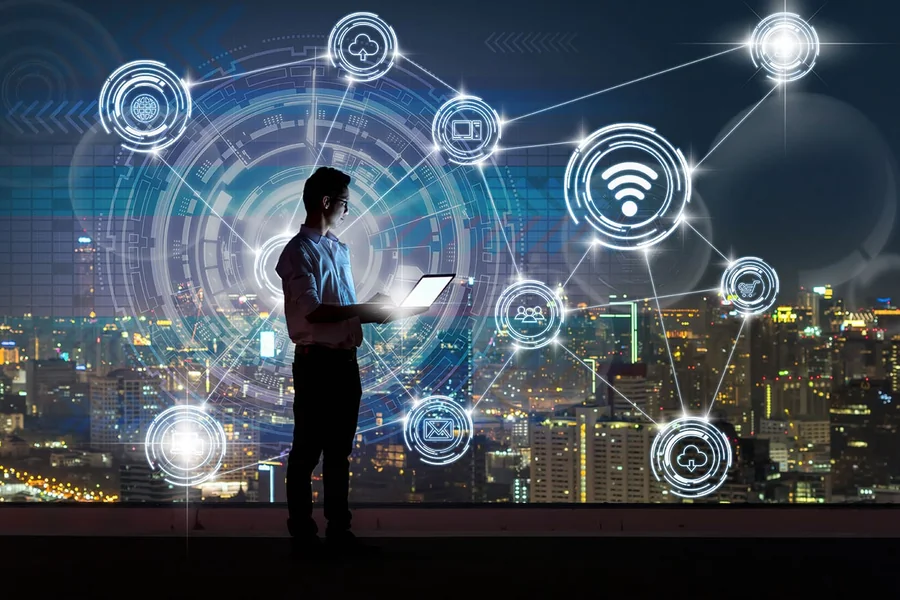

The future of Internet of Things (IoT) technology refers to the continued growth of connected devices, sensors, software, and networks that collect and exchange data with little or no human intervention. IoT is expected to become more intelligent, secure, and integrated into everyday life as artificial intelligence, edge computing, 5G, automation, and cloud technologies develop. From smart homes and connected vehicles to healthcare, manufacturing, agriculture, and cities, IoT will help organizations make faster decisions, automate routine tasks, reduce costs, and create more responsive services.
The Internet of Things has moved from a technology concept to a part of everyday life. Smart watches track activity, connected appliances can be controlled remotely, and factories use sensors to monitor equipment. Businesses also rely on connected devices to collect data and improve operations.
But the next phase of IoT is about more than connecting more devices. The technology is becoming more intelligent and capable of responding to data in real time. Artificial intelligence, edge computing, faster networks, and improved security are changing what connected devices can do.
As these technologies mature, IoT could have an even greater impact on homes, businesses, healthcare, transportation, agriculture, and public services.
How the Internet Of Things Is Evolving
It is hard not to get the basic concept of IoT confused. Things become physically attached to the internet and are able to gather, send, receive or process data. They can be sensors, machines, vehicles, medical devices, home appliances, and industrial equipment.
Most of the old IoT systems were based on simple monitoring. A temperature sensor could be used to measure the temperature and report the data to the cloud platform. The data would then be evaluated by a human or computer system and a course of action would be determined.
Today, IoT systems are getting smarter. Devices can process information, detect patterns and activate processes automatically. This change is significant because it means that individuals have to spend less time than usual keeping connected systems under watch.
There are several developments that are helping push this transformation.There are some developments that are contributing to this transformation.
- Artificial intelligence: AI can process vast amounts of IoT data and uncover valuable patterns.
- Edge computing: Data can be processed nearer to where it is collected, which helps minimize latency.
- Advanced networks and 5G: More reliable and faster connections that will enable massive numbers of connected devices.
- Cloud computing: Cloud platforms provide high levels of ease in storing and managing IoT data and its analysis.
- Smaller and more capable sensors: Smaller and more capable sensors enable organizations to track more conditions.
- Increased automation: IoT devices can increasingly respond to data without human intervention.
As these technologies combine, they are ushering in the era of intelligent automation in IoT.
The Role Of AI and Edge Computing In Future IoT
AI is expected to be one of the most significant technologies of the future for IoT. A lot of data can be produced by connected devices, and the raw data is useless if it can’t be understood.
AI can be used to identify patterns and make predictions in IoT systems. For instance, vibration, temperature and performance can be monitored from sensors installed on industrial machinery. With the help of an AI system, these signals can be analyzed and signs of potential equipment failure will be detected.
The method is referred to as predictive maintenance. By avoiding a breakdown, a business can have an early warning, allowing them to plan for maintenance at the right time. This can increase uptime and save on maintenance expenses.
Edge computing provides another valuable functionality. Typical IoT applications have data moving to a remote cloud server for processing. This can be fine, but can be problematic if a quick response is required.
IoT Applications Across Major Industries
Smart home technology is not the only domain of the future of IoT. Its potential most likely lies in sectors where the integrated data can enhance safety, efficiency, and decision-making processes.
Healthcare:
Healthcare providers can use connected medical devices to remotely monitor patients and gather health-related data. Wearable devices can track measurements such as heart rate and activity. IoT could help to monitor and detect potential issues earlier in the future, and more personally.
Manufacturing:
The connected machines and sensors are already used in smart factories. Future systems will be able to link equipment in the production process, supply chains, quality control processes and maintenance activities. This can aid in discovering issues at an earlier stage and resource utilization.
Agriculture:
Through the use of the IoT sensors, farmers can monitor soil moisture, soil temperature, weather conditions, and even crop health. This information can be used with automated irrigation systems to help them decide when to water. This can help to improve resource use and farm productivity.
Transportation:
To exchange information with digital systems about traffic, vehicle condition, routes and road conditions. IoT can also be used in the fleet management industry to track vehicles and optimize delivery routes.
Smart cities:
The cities can track and control traffic, energy consumption, garbage collection, lighting, and public facilities, just to name a few, via connected sensors. The systems can provide local authorities with information on the use of public resources and on what needs to be improved.
Retail:
With the IoT technology, retailers can track their stock, gain insights into store conditions, and optimize their supply chains. The interconnected systems can also help companies cut down on waste and ensure products are accessible to customers when they’re needed.
Security, Privacy, And Other IoT Challenges
As with all technologies, IoT promises a lot but faces significant challenges. The more devices that are connected, the more potential points of attack. However, if a smart device isn’t properly secured it can be a vulnerability in the bigger network.
Security must be taken into account from the start of the development of IoT. Future strong authentication, frequent software updates, encryption, network monitoring, and access control will be even more critical.
Privacy is also a top priority. IoT devices can gather data on the home, workplace, health, movements, and daily habits. There must be clear policies for organisations around the way that they collect, store and use this information.
Other challenges include:
- Compatibility of devices: Products from different manufacturers may have different standards and systems.
- Data management: IoT networks can produce a lot of data.
- Maintenance: Software requalification, monitoring and technical support are required for connected devices.
- Connectivity: There are some areas that still don’t receive a good internet connection.
- Energy consumption: Efficient hardware and communication techniques are needed with battery powered devices.
- Large-scale deployments of IoT networks can be costly.
Solving these problems will be crucial for the continued growth and adoption of IoT. Greater innovation and reliability, security, privacy and cost will be a challenge for businesses and technology providers.
What Businesses Should Expect From The Future Of IoT
In enterprises IoT will come to be an integral part of the overall technology and not just a project. Businesses will integrate devices with their cloud platforms, analytics, artificial intelligence solutions and business applications.
The shift from reactive operations to predictive operations will be one of the major changes. Rather than react to failure, businesses are able to see the risks and opportunities earlier with the help of IoT data.
For instance, a logistics firm can keep track of vehicle performance and fuel use. A manufacturer knows abnormal machine characteristics. A retailer can monitor the movement of inventory. Every use case makes physical activity data, helping to make business decisions.
But the idea of connecting devices shouldn’t be based on their popularity. The first step to a successful IoT strategy is a clear business problem.
One way to do this is to use a practical approach such as:
- Outline a particular operational problem.
- Identify data required to address it.
- Choose appropriate sensors and devices to connect.
- Create trusted data and network structures.
- Leverage data to find insights with analytics or artificial intelligence.
- Take measurements and increase the system if it is useful.
This will decrease the amount of unnecessary investment and ease the management of IoT projects.
The Future Of IoT: Smarter, More Connected Systems
Looking forward, IoT will not be as public, but more pervasive in daily systems. Sometimes people don’t consider the individual devices. Rather, connected technology will be a force in the background.
Energy consumption patterns can be automatically adjusted depending on the occupancy and demand for electricity. Information can be shared between vehicles and transportation systems. Healthcare devices may be able to send data continuously to authorized healthcare providers. The factories might be able to tweak production according to the real-time demand and equipment condition.
A second development that will be significant is more technology collaboration. Increasedly, there will be the convergence of IoT, AI, cloud, edge, digital twins, robotics and advanced networks.
One of these examples is the use of digital twins. A digital twin is a virtual copy of a physical object, machine or system. IoT sensors can provide real-world data to keep the digital model updated. The model can then be used by businesses to experiment with different scenarios, track performance and forecast issues.
This kind of integration might enable IoT to be more functional in complex environments.
The industry in the same period will require higher standards. If the connected devices can be reliably communicated across platforms, then the organisations can construct larger and more flexible systems.
Final Thoughts
The IoT technology of the future will be more intelligent, more fast and more connected. The real power of IoT devices will be in what happens after they have collected the data.
Systems will be able to interpret information with the help of artificial intelligence. Responses will be quicker with edge computing. Advanced networks will be able to join up more devices and Cloud platforms will facilitate large data management. These technologies can all contribute to making IoT more useful in industries and in our everyday lives.
But growth in IoT is to be sensible and responsible. Data management, compatibility, privacy, security, and cost must not be secondary considerations.
The biggest question isn’t just how many devices can connect, for businesses and consumers. It is about the ways that technology can have a real impact and provide some measurable value.


