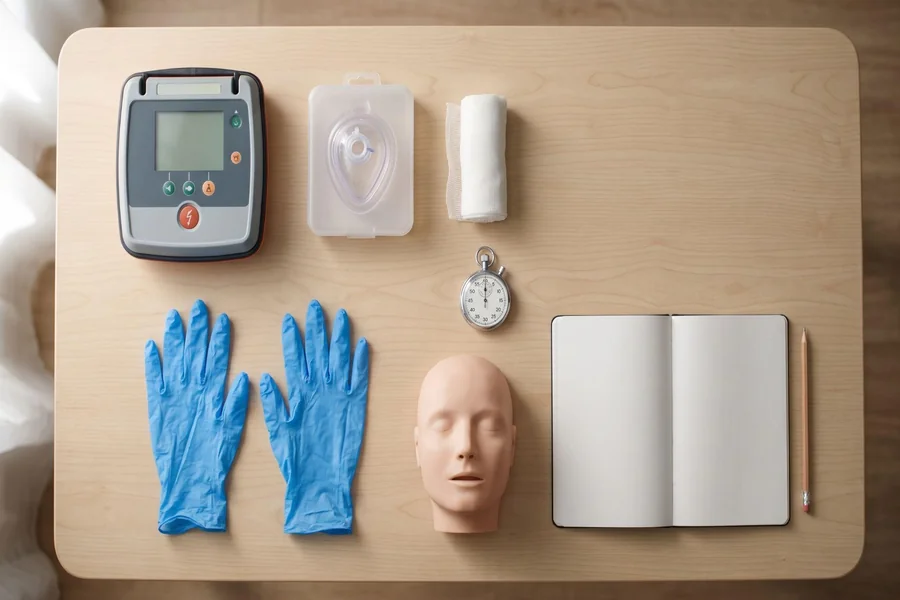

First aid has its own vocabulary, and the terms are easy to mix up. CPR, AED, BLS, Part 11, requalification: it can read like alphabet soup. Here’s a plain-language glossary written for Alberta readers. If you’re comparing Coast2Coast First Aid Courses Edmonton with other options, knowing what these words mean helps you pick the right course and avoid paying for the wrong one.
Rules in other provinces and countries differ, so check your own if you’re outside Alberta.
What Do the Basic First Aid Terms Mean?
First aid is the immediate care given to someone who is injured or suddenly ill, until professional help arrives or the person recovers.
CPR stands for cardiopulmonary resuscitation. It’s a set of actions, mainly chest compressions, that keep blood moving to the brain and other vital organs when someone’s heart has stopped. According to Heart & Stroke, immediate CPR keeps the blood pumping to keep the brain and other vital organs alive.
AED stands for automated external defibrillator. It’s a portable device that can deliver a shock to help restart the heart. Heart & Stroke describes it as a device that shocks the heart to help it restart.
Cardiac arrest is when the heart suddenly and unexpectedly stops beating. The person collapses, doesn’t respond, and isn’t breathing or isn’t breathing normally. It’s caused by an abnormal heart rhythm, according to Heart & Stroke.
Heart attack is when the heart isn’t getting enough blood because blood flow to it is blocked. The heart keeps pumping, and the person is generally conscious. Heart & Stroke notes that a heart attack can lead to a cardiac arrest if it is severe enough.
What Do the Course Terms Mean?
CPR/AED Level C is a course covering CPR for adults, children and infants, plus choking response and AED use. It suits workplaces and the public. Providers describe it as the standard CPR course for non-clinical roles.
BLS stands for Basic Life Support. It’s resuscitation training for healthcare professionals, such as nurses, paramedics and clinical staff. It covers high-performance CPR, airway management and team-based skills. It replaced an older course called CPR-HCP in April 2019, and providers typically list a one-year validity. Confirm the validity for the course you choose.
Blended learning means you do the theory online at your own pace, then attend a shorter in-person session for hands-on skills. It’s popular with people who have busy schedules.
Certificate validity is how long a certificate stays current. Check the figure for each course, because it differs between CPR, workplace first aid and BLS.
Requalification is Alberta’s word for renewing a workplace first aid certificate. Alberta requires requalification every three years. According to the Government of Alberta, workers can recertify before their certification expires. After it expires, a full course is required instead.
What Do the Alberta Workplace Terms Mean?
These terms come from Alberta’s workplace safety system. They matter if you’re an employer, a supervisor or a worker.
OHS Code is the Occupational Health and Safety Code, a set of rules made under Alberta’s workplace safety law. It sets out detailed requirements for employers and workers.
Part 11 is the section of the OHS Code about first aid. Under Part 11, employers (or the prime contractor, where there is one) must provide first aid services, supplies and equipment at the work site.
Hazard level describes how risky the work is. It’s one of three factors that determine how much first aid coverage a work site needs. The other two are the number of workers on shift and the distance to a health care facility.
WCB Alberta is the Workers’ Compensation Board, which handles workers’ compensation. It’s separate from the OHS Code. WCB Alberta deals with injury claims and insurance, while the OHS Code sets the first aid rules.
Director of Medical Services is a Government of Alberta role. Workplace first aid training has to come from a course approved by the Director of Medical Services.
Prime contractor is the party responsible for overall health and safety on a work site with several employers. Under Part 11, the prime contractor is responsible for first aid on a shared site. If there’s no prime contractor, the employer is.
Working alone is covered by Part 28 of the OHS Code. It applies when a worker is alone at a work site and help isn’t readily available if there’s an emergency or the worker is injured or ill. The employer must provide an effective communication system, such as radio, a landline or cellular telephone, along with regular contact with the worker. It doesn’t replace first aid.
Which Terms Get Mixed Up the Most?
A few pairs cause real confusion.
Cardiac arrest versus heart attack. One is a heart that has stopped. The other is a heart that isn’t getting enough blood. The first steps are different. For cardiac arrest, call 9-1-1 and shout for an AED, start CPR, and use an AED. For a heart attack, call 9-1-1 and have the person stop and rest.
BLS versus CPR/AED Level C. BLS is the healthcare-provider standard. CPR/AED Level C is for workplaces and the public. If an employer asks for one, don’t assume the other will do. Ask first.
Requalify versus start over. Renewing before expiry is a shorter path. After expiry, a full course is required.
WCB versus OHS. WCB Alberta handles compensation. The OHS Code sets safety rules. They’re two different things.
How Do You Use These Terms to Pick a Course?
Once you know the words, choosing gets easier. Use this checklist:
- Start with your purpose. Is it for work, school, a clinical role or personal confidence?
- Ask which course your employer needs. The level and the name matter.
- Check that it’s approved. For workplace first aid in Alberta, the course must meet the Director of Medical Services’ requirements.
- Look for hands-on practice. You want time with mannequins and an AED trainer, plus feedback from an instructor.
- Choose a format. Blended or fully in person, depending on your schedule.
- Confirm certificate details. Ask about validity and how renewal works.
To see what formats and levels are available, compare Coast2Coast First Aid course types and check the details with any provider you consider.
What Should You Ask Before You Book?
A short list of questions saves time and money:
- Which course level does my workplace need?
- Is the course approved for workplace first aid in Alberta?
- Is it blended or fully in person?
- How long is the certificate valid?
- How does renewal work, and when should I book it?
- Do you offer private group sessions, and is there a minimum group size?
If a provider can’t answer these clearly, that tells you something.
Why Does It Matter?
Because the right words lead to the right training. According to Heart & Stroke, about 60,000 cardiac arrests happen outside hospitals in Canada every year, and only one in 10 people survives. Nearly half happen to people under 65.
Heart & Stroke also says that doing CPR and using an AED can double a person’s chance of survival. Every minute without CPR or defibrillation lowers the odds by about 10%. Knowing the terms helps you choose the training that prepares you for those minutes.
If you are looking for first aid training near Jasper Avenue and 100th Street, Rogers Place, or surrounding areas in downtown Edmonton, you may reach out to Coast2Coast First Aid Inc. in that area.
FAQs
Q: What is the difference between a heart attack and cardiac arrest?
A: In a heart attack, blood flow to the heart is blocked, but the heart keeps pumping and the person is generally conscious. In cardiac arrest, the heart suddenly stops beating because of an abnormal rhythm, and the person collapses and isn’t breathing normally.
Q: What does “Part 11” mean in Alberta first aid?
A: Part 11 is the first aid section of Alberta’s OHS Code. It requires employers, or the prime contractor, to provide first aid services, supplies and equipment, based on hazard level, number of workers on shift and distance to a health care facility.
Q: How long is an Alberta workplace first aid certificate valid?
A: Three years. According to the Government of Alberta, workers can recertify before expiry. After the expiry date, a full course is required.
Q: Is BLS the same as CPR/AED Level C?
A: No. BLS is for healthcare professionals and goes further. CPR/AED Level C is for workplaces and the public. Ask your employer which one they require.
Q: Who approves workplace first aid training in Alberta?
A: Courses must be approved by the Director of Medical Services, Government of Alberta. Ask any provider for proof before you book.